 Dave King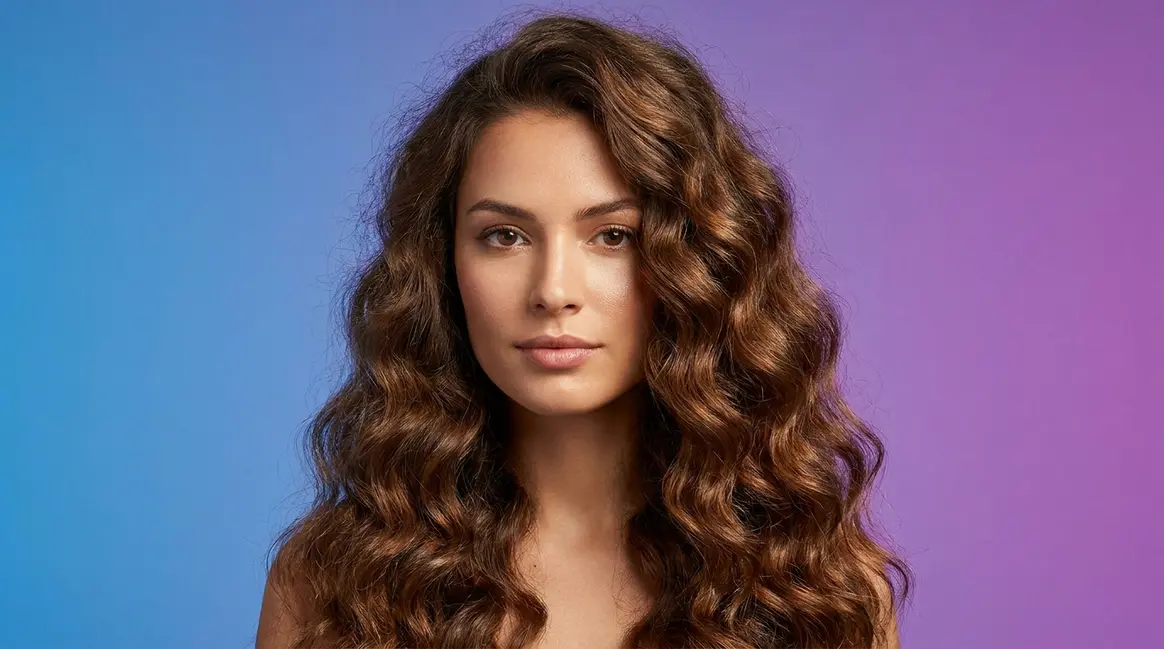
One section of your hair forms tight, gorgeous S-waves. Another section falls into loose, barely-there waves. And the ends? Pure frizz. If you’ve been chasing uniformity your whole life and never quite found it, your hair has probably been trying to tell you something — it’s 2C hair, and it plays by its own rules.
The problem isn’t your routine. It’s that this texture sits in a genuinely confusing middle ground: too defined and frizz-prone to respond like typical wavy hair, yet too loose to benefit from the heavy creams and curl-soaking techniques designed for 3A curls. Products weigh your waves down on one end, or leave them dry and frizzy on the other. Neither feels right, because neither is right for this hair type.
In this guide, you’ll learn exactly what this pattern is, how to confirm your hair type, and how to build a routine that finally gives your waves the definition they deserve. You’ll find a complete care routine with advanced techniques, product recommendations, haircut guidance for all lengths, and — unlike most guides — a dedicated section for men with this wave type.
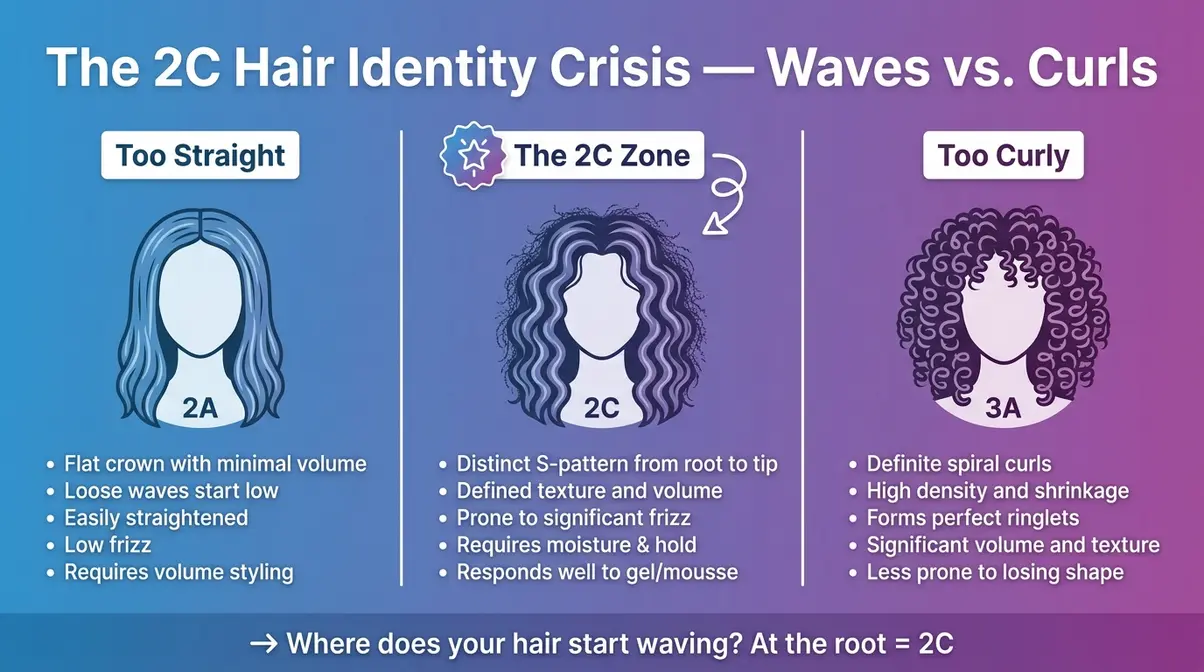
2C hair sits in the “Goldilocks Zone of Wavy Hair” — too defined for straight-hair products, too loose for heavy curl creams — and it needs a precisely balanced routine to thrive. According to Byrdie, this pattern is the most frizz-prone of all wavy subtypes, requiring more moisture than 2A or 2B (Byrdie, 2026).
- Identify it: Deep S-shaped waves starting at the root — not mid-shaft like 2A or 2B
- The core challenge: Finding products light enough not to weigh waves down, yet moisturizing enough to control frizz
- The Goldilocks Zone: This texture needs “just right” products — not curly-girl heavy, not straight-hair light
- Men included: This guide covers routines and haircuts specifically for men with this pattern
- Key distinction: 2C waves ≠ 3A curls — knowing the difference changes everything about your routine
- Table of Contents
- What Is 2C Hair? Pattern and Texture
- 2B vs. 2C vs. 3A Hair Comparison
- The Complete 2C Hair Care Routine
- Best Products for Your Waves
- Best Haircuts and Hairstyles for 2C Hair
- 2C Hair for Men – Routines, Products, and Haircuts
- Managing Combination 2B/2C and 2C/3A Hair
- Common Mistakes and When to See a Stylist
- FAQ: Your Top 2C Hair Questions Answered
What Is 2C Hair? Pattern and Texture
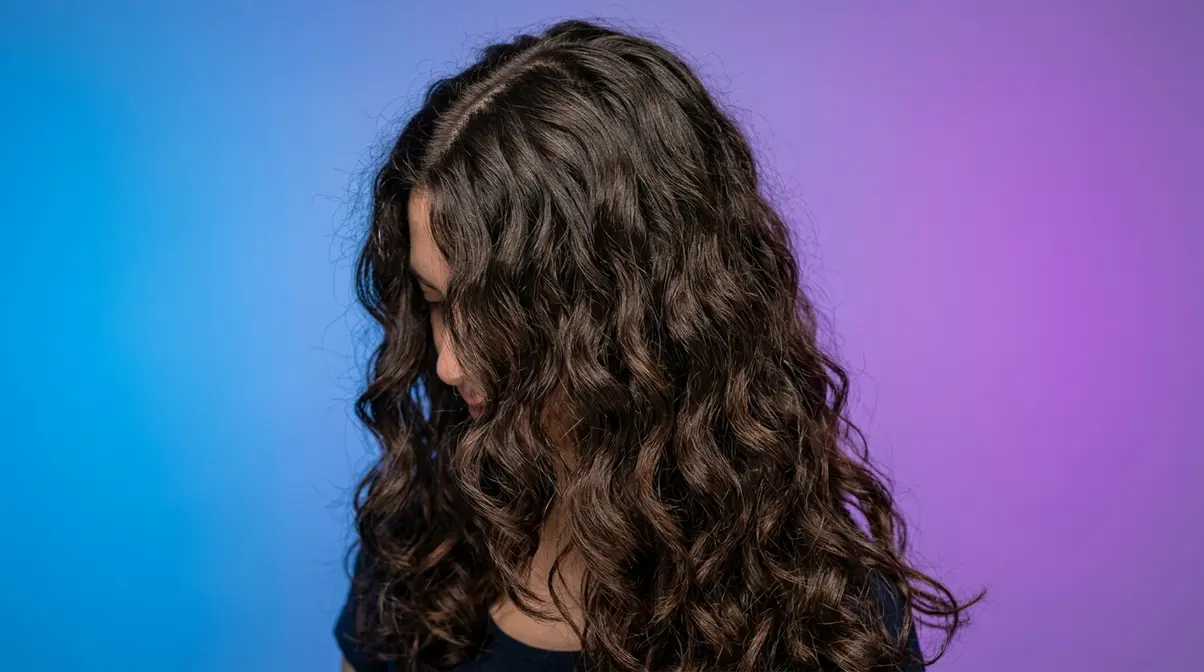
2C hair is the most defined subtype of wavy hair, characterized by a deep S-shaped wave pattern that begins at the root and runs all the way to the ends. Unlike 2A or 2B hair, where waves tend to form at mid-shaft or below the ears, these waves emerge directly from the scalp — giving this hair type more volume, more frizz potential, and a texture that sits right at the edge of curly. NIH research on hair follicle shape confirms that the degree of curl is biologically determined by follicle geometry: asymmetrical, curved follicles produce wavy and curly patterns, while symmetrical follicles produce straight hair (PMC, 2015). For people with this wave pattern, this means the texture is genetic — not a styling accident, and not something that will change with enough conditioner.
Understanding your wave type starts with understanding why it behaves the way it does. The follicle shape creates an S-wave that is consistent from root to tip. Think of it like a coiled garden hose — the more curved the follicle, the more the hair bends as it grows. This biological origin is why this texture responds so differently from straight or mildly wavy hair, and why the Goldilocks Zone of Wavy Hair concept matters so much here: It is too structured to be treated like a gentle wave, yet too loose to be treated like a true curl.
Key Characteristics of 2C Hair
What do these waves look like in practice? Here are the defining identifiers that separate this pattern from neighboring types:
- Waves start at the root. This is the single most important identifier. If your waves start at your ears or lower, you’re probably 2A or 2B. If they begin right at your scalp, you’re likely 2C.
- Deep, consistent S-shapes. The S-pattern runs the full length of the strand — not just at the ends.
- Medium-to-coarse texture. This texture tends to be thicker than 2A or 2B, with noticeable volume and body.
- Frizz at the crown. Even in low humidity, most people with this pattern notice a “halo” of frizz around the top of their head.
- Ends can look like loose ringlets. Shorter sections or the ends of longer hair may form shapes that look almost curl-like.
Try the wet hair test to confirm your type: wet your hair thoroughly, then let it air dry without touching or scrunching it. If you see consistent S-shapes forming from root to tip — not just at the ends — you very likely fall into this category. This simple test removes the guesswork that trips up most beginners.
Porosity (how easily your hair absorbs and retains moisture) plays a major role in how your waves behave. Because of the bends in each strand, natural scalp oils have a harder time traveling down the entire hair shaft. They get “stuck” at each curve, which is why the roots of this hair type can feel oily while the ends remain dry and prone to frizz. This is the scientific reason why this texture consistently needs more targeted moisture than 2A or 2B — not just more product, but the right moisture applied at the right points.
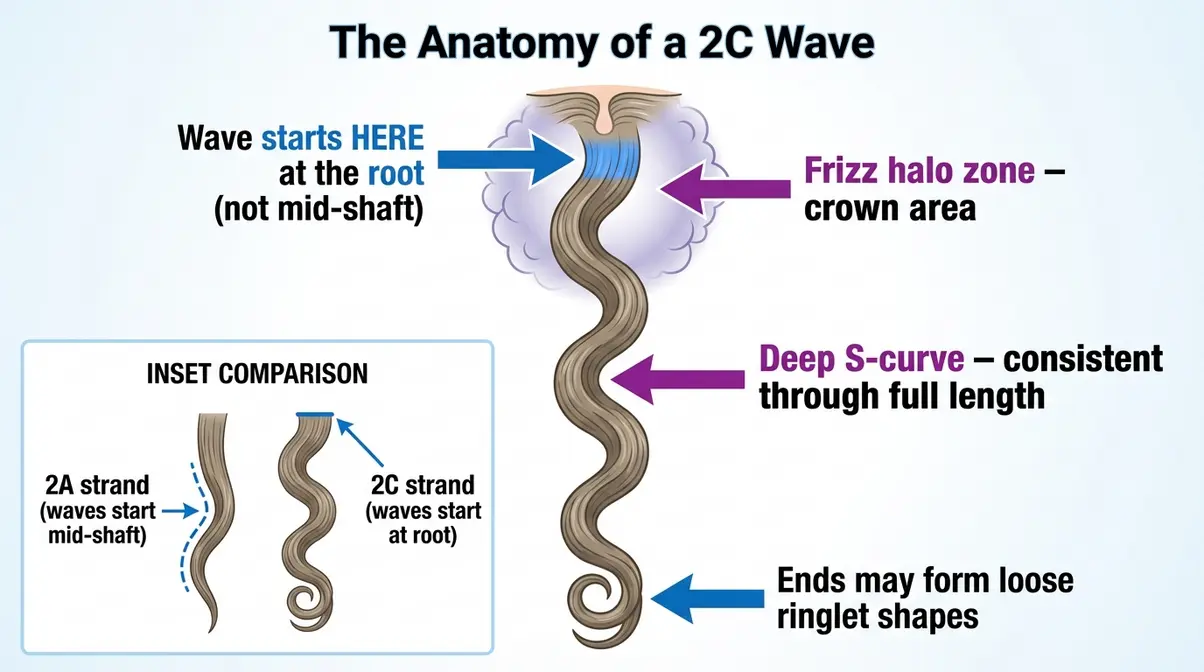
Humidity is the other major factor. The S-wave pattern here is particularly reactive to atmospheric moisture. When humidity rises, the hydrogen bonds in each strand absorb water from the air, causing the shaft to swell and the wave pattern to lose definition — what most people experience as a “frizz explosion” on humid days. This is why product selection matters so much: the right styler creates a barrier that seals cuticles and blocks excess moisture from entering the strand.
Is 2C Curly or Wavy?
This pattern is officially classified as wavy under the Andre Walker Hair Typing System (the classification method that organizes hair into numbered types from 1 to 4, where Type 1 is straight and Type 4 is tightly coiled). However, it is the wavy type that sits closest to the curly category — which is exactly why so many people with this hair type feel confused about where they belong.
The technical distinction: these waves form deep S-shapes but do not complete full spirals or ringlets. True ringlets and spirals define Type 3 curly hair. So while these waves can look remarkably curl-like when the hair is shorter or freshly washed, they remain waves — just very enthusiastic ones. This is the Goldilocks Zone in action: this type behaves like a hybrid, which means it often doesn’t respond well to products designed purely for “wavy” hair OR purely for “curly” hair.
If you’ve ever used a heavy curl cream designed for 3A–3C hair and found your waves went limp and greasy by noon, you’ve experienced this firsthand. Conversely, if you’ve tried lightweight beach-wave sprays and ended up with frizzy, undefined hair, that’s the other side of the same problem. The answer isn’t one extreme or the other — it’s a balanced approach specific to this texture.
Is 2C a Rare Hair Type?
This specific pattern is not especially rare in the global population, but it is the least common of the three Type 2 subtypes. The majority of people with naturally wavy hair fall into the 2A or 2B categories, which have gentler wave patterns and less frizz tendency. Community surveys within wavy hair forums and groups (such as r/Wavyhair on Reddit) consistently show that self-identified members of this subcategory represent a smaller portion of the Type 2 population.
What makes it feel rare is that it is frequently misidentified. People with these waves are often told they have “frizzy 2B hair” or “loose 3A curls” — and they spend years using the wrong routines as a result. Our team’s review of wavy hair community feedback found that misidentification is the most common root cause of product frustration among people who eventually discover their true pattern.
2B vs. 2C vs. 3A Hair: The Definitive Comparison
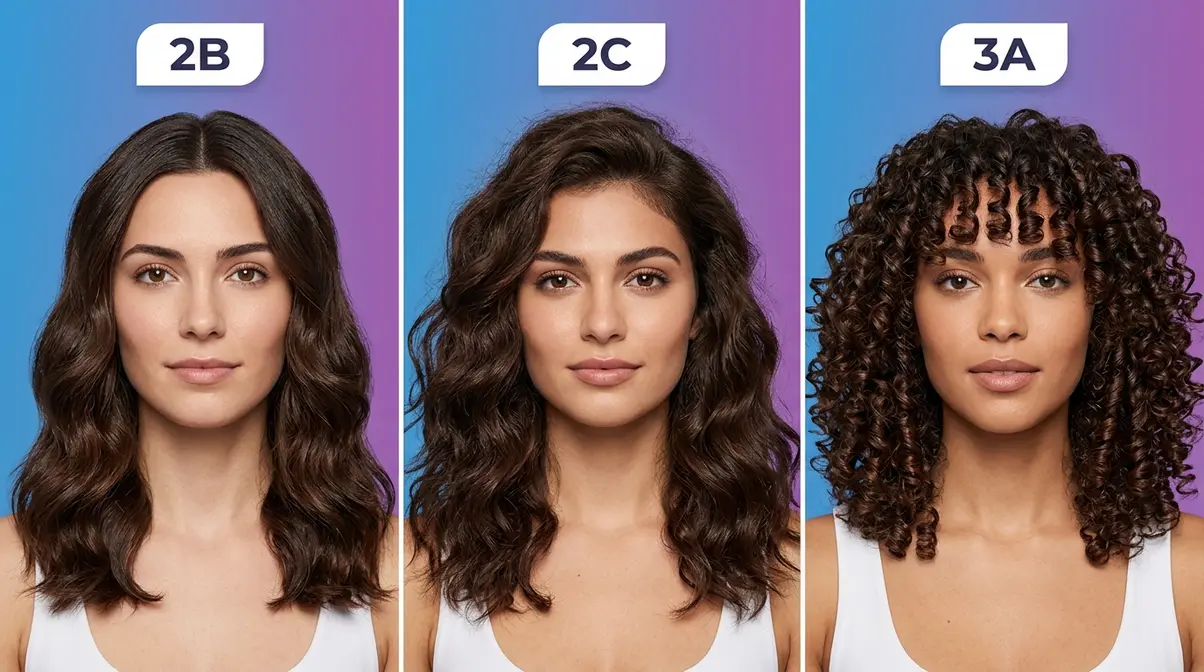
Understanding where your texture fits in the broader spectrum is the fastest way to stop second-guessing your hair type. The three types most commonly confused — 2B, 2C, and 3A — each have distinct behaviors that require meaningfully different approaches. Carol’s Daughter’s hair type guide provides a useful breakdown of how these patterns differ in moisture needs and styling response (Carol’s Daughter, 2026).
2B vs. 2C Hair — The Key Differences
Both 2B and 2C types are wavy, but the differences in behavior and care are significant enough that treating them the same way almost always leads to frustration.
2B hair features S-shaped waves that begin around mid-shaft or at the ears. The roots tend to be relatively flat, and the wave pattern is less defined. 2B hair has moderate frizz potential and generally responds well to lightweight mousses and sea salt sprays.
Type 2C has waves that start at the root, creating a fuller, more voluminous appearance from the scalp down. The frizz tendency is notably higher, and the wave pattern is denser and more consistent across the entire strand. It typically needs heavier moisture than 2B — but not so heavy that it weighs the waves down.
The practical test: look at your hair at the roots when it’s air-dried without product. If your roots are fairly flat and waves only appear below the ears, you’re likely 2B. If your roots show wave movement and your hair has volume from the scalp, 2C is the more accurate match.
How Can I Tell If My Hair Is 2C or 3A?
This is the comparison that generates the most confusion — and the most frustration. Many people with this pattern have spent years believing they have 3A curls, using heavy curl-soaking techniques and rich creams that leave their waves weighed down and greasy.
3A hair forms defined, springy spirals or ringlets with a circumference roughly the size of a piece of sidewalk chalk. The curl pattern is consistent and returns to its spiral shape when stretched and released. 3A hair generally responds well to the Curly Girl Method, including co-washing (washing with conditioner only) and rich curl creams.
Type 2C, by contrast, forms S-waves that can look like loose ringlets — especially when wet — but do not hold a true spiral shape once dry. The waves may clump together but won’t form a consistent, bouncy ringlet pattern. These waves are also more likely to go flat at the roots with heavy products, which rarely happens with true 3A curls.
| Feature | 2C Hair | 3A Hair |
|---|---|---|
| Wave/curl shape | Deep S-wave | Defined spiral/ringlet |
| Where it starts | At the root | At the root |
| Curl circumference | Loose, irregular | ~Chalk-sized spiral |
| Frizz tendency | Very high | High |
| Response to heavy creams | Goes flat, greasy | Absorbs well |
| Best product weight | Light-to-medium | Medium-to-heavy |
| Co-wash compatible? | Sometimes | Usually yes |
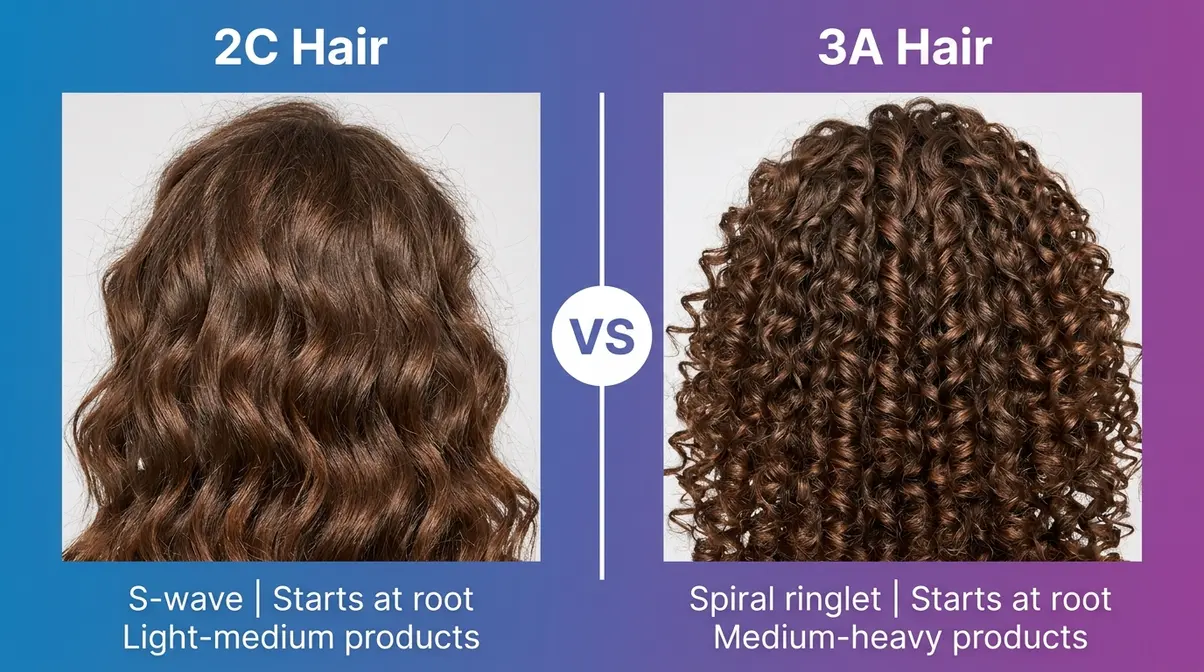
The Full Spectrum: 2A to 3A Compared
For complete clarity, here is how all four commonly confused types compare across the characteristics that matter most for product selection and styling:
| Hair Type | Wave/Curl Shape | Starts At | Frizz Level | Product Weight | Key Need |
|---|---|---|---|---|---|
| 2A | Loose S-wave | Mid-shaft | Low | Very light | Volume without weighing down |
| 2B | Defined S-wave | Ears/mid-shaft | Moderate | Light | Definition without crunch |
| 2C | Deep S-wave | Root | High | Light-to-medium | Moisture + frizz control |
| 3A | Springy spiral | Root | High | Medium-to-heavy | Hydration + curl definition |
“This pattern forms deep S-shaped waves that begin at the root — the most defined subtype of wavy hair and the most prone to frizz of all Type 2 hair patterns.” This one distinction — root-start versus mid-shaft start — changes how you apply every product in your routine.
The Complete 2C Hair Care Routine
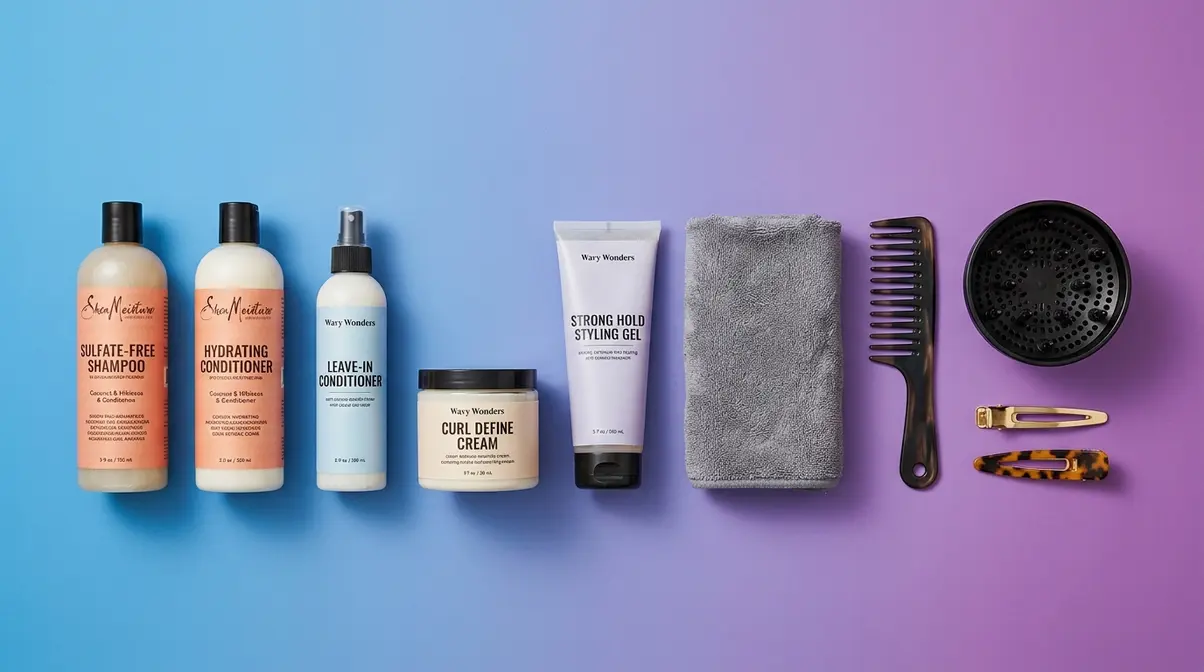
Building a working routine for these waves isn’t complicated once you understand why each step matters. The biggest mistake most beginners make is copying a routine designed for Type 3 curly hair and wondering why their waves look limp and greasy. The Goldilocks Zone principle applies at every stage here: each product and technique should be precisely balanced — enough moisture to fight frizz, light enough to preserve wave definition. Prose’s 2C hair care guide outlines this balance well, noting that this texture benefits from layering lightweight products rather than applying a single heavy styler (Prose, 2026).
What You’ll Need Before You Start
Before your first wash day, gather these tools and products:
- Sulfate-free shampoo (or clarifying shampoo for monthly use)
- Silicone-free conditioner
- Leave-in conditioner (lightweight formula)
- Curl cream or styling gel (light-to-medium hold)
- A wide-tooth comb or detangling brush
- A microfiber towel or old cotton T-shirt (regular terrycloth causes frizz)
- A hair diffuser attachment for your blow dryer
- Hair clips (for root-lifting while drying)
Estimated time: 45–75 minutes for a full wash day, including drying time.
Having everything within reach before you step into the shower makes a significant difference in results. Your waves are most responsive to product application while they are soaking wet — any delay between rinsing and applying products increases frizz.
Step 1 — Cleansing Your Waves
Start by thoroughly wetting your hair with warm (not hot) water. Hot water opens the hair cuticle aggressively and strips natural oils, which increases frizz. Warm water opens the cuticle just enough to allow effective cleansing.
Apply your sulfate-free shampoo only to the scalp — not the lengths or ends. Sulfates (the foaming agents in most conventional shampoos) are too harsh for this pattern and strip the moisture your waves need to stay defined. Work the shampoo into the scalp with your fingertips in circular motions, then let the lather rinse down the lengths. This provides enough cleansing without over-stripping.
Every 4–6 weeks, swap your regular shampoo for a clarifying shampoo to remove product build-up (the residue that accumulates from styling products and hard water minerals). Product build-up is one of the most common reasons your waves lose definition over time — and one of the most overlooked causes of flat, limp waves.
Step 2 — Conditioning and Detangling
Apply conditioner generously from mid-shaft to ends — this is where the strands are driest. Leave it on for 3–5 minutes while you detangle with a wide-tooth comb, starting at the ends and working upward. Detangling with conditioner in the hair dramatically reduces breakage compared to detangling dry hair.
Avoid applying conditioner at the roots unless your scalp is very dry. Conditioner near the scalp weighs the root area down, which flattens the wave pattern where you want the most volume and lift.
Rinse the conditioner with cool water. Cool water closes the hair cuticle, which seals cuticles and creates smoother, shinier hair — this is the step that most beginners skip, and it makes a visible difference in frizz levels.
Step 3 — Applying Your Styler
This step happens while your hair is still soaking wet — do not towel-dry before applying products. The water in your hair acts as a carrier that helps products distribute evenly and penetrate the strand.
- Gently squeeze out excess water with a microfiber towel (no rubbing — rubbing creates frizz).
- Apply your leave-in conditioner first, using the praying hands method: flatten your palms together with product between them, then smooth your hands down sections of hair from root to tip. This distributes product evenly without disrupting the wave pattern.
- Apply your curl cream or gel on top of the leave-in, using the same praying hands technique. Scrunch upward from ends to roots to encourage the S-wave to form.
- Avoid touching your hair repeatedly after applying products — every additional touch adds frizz.
Step 4 — Drying Methods for Waves
How you dry your waves has as much impact on the final result as any product you use. Air drying is the gentlest option but takes the longest and can sometimes result in flatter waves at the roots. Diffusing is faster and creates more volume and definition.
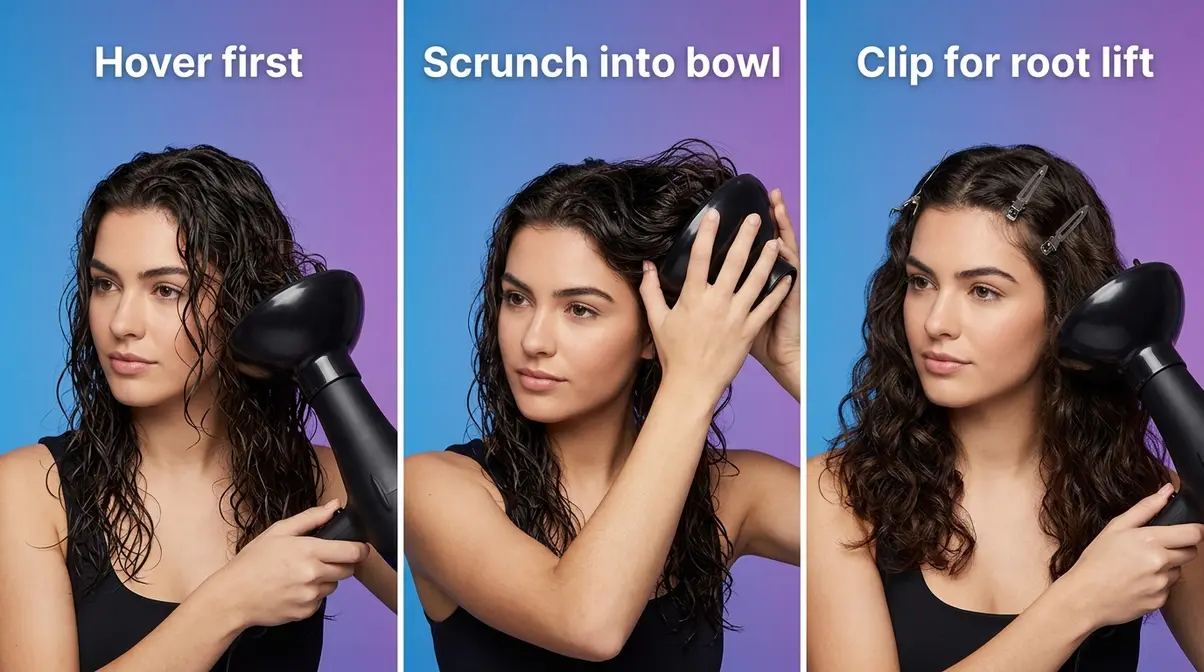
- To diffuse correctly:
- Attach the diffuser bowl to your blow dryer and set it to medium heat, low speed.
- Gently place a section of hair into the diffuser bowl — do not press the diffuser against your scalp yet.
- Hover the diffuser near your scalp for 30 seconds, then gently press it upward to “scrunch” the hair into the bowl. This encourages the wave to curl upward and set.
- Work in sections around your head, spending 1–2 minutes per section.
- Finish with a 30-second blast of cool air to set the style and reduce frizz.
A diffuser (a bowl-shaped attachment for your hair dryer with finger-like prongs that disperse airflow) is one of the most important tools for this texture. Without it, concentrated airflow from a regular dryer blows waves apart and creates frizz. With it, the diffuse heat encourages wave formation and adds volume at the roots.
Advanced 2C Hair Styling Techniques
These six techniques separate consistently great wash days from frustrating ones. Our team’s review of wavy hair community feedback found these are the techniques most frequently credited for “unlocking” wave definition after years of mediocre results.
- 1. Plopping
- Plopping is a technique for drying your hair in a way that encourages curl formation without frizz.
- Lay a microfiber towel or T-shirt flat on a surface.
- Flip your wet, product-applied hair forward onto the center of the cloth.
- Fold the back of the cloth up over your hair, then wrap the front up and secure at the nape of your neck.
- Leave for 15–20 minutes before diffusing or air drying.
- Why it works: Plopping removes excess water while keeping the hair in a compact, wave-encouraging position — rather than letting gravity pull waves flat as they dry.
- 2. Micro-Plopping
- A gentler, quicker variation of plopping.
- After applying products, take a microfiber towel and gently scrunch sections of hair upward.
- Use a pressing-and-releasing motion rather than rubbing.
- Focus on the ends and mid-lengths — avoid the roots.
- Why it works: Removes excess water and product weight section by section without disturbing the wave clump formation.
- 3. The Bowl Method
- Fill a large bowl with warm water.
- After applying leave-in conditioner in the shower, dip the ends of your hair into the bowl.
- Scrunch upward while submerged to encourage wave clumping.
- Lift your head and gently squeeze out excess water before applying gel.
- Why it works: The water in the bowl helps products distribute more evenly and encourages wave clumps to form before you even leave the shower.
4. Diffusing (Root Lift Focus)
Beyond the standard diffusing technique above, use hair clips at the roots while diffusing to lift the root area away from the scalp. This prevents the flat-root problem that affects many people with this pattern.
5. The Praying Hands Method
Described in Step 3 above — this is the foundational product application technique for this type, ensuring even distribution without frizz-inducing rubbing.
- 6. Scrunching Out the Crunch (SOTC)
- After your hair is completely dry, it may feel stiff or crunchy from the gel or mousse. SOTC is the technique that releases this cast.
- Wait until your hair is 100% dry — do not rush this step.
- Apply a tiny amount of lightweight oil (argan oil or jojoba oil work well) to your palms.
- Scrunch sections of hair gently but firmly upward — you’ll hear and feel the cast breaking.
- Continue until your hair feels soft and touchable while still maintaining its wave definition.
- Why it works: Gel creates a protective “cast” around each wave while it dries, locking in definition. SOTC breaks this cast after drying to reveal soft, defined waves instead of crunchy, stiff ones.
How Often Should You Wash Your Waves?
Most people with this pattern do best washing 2–3 times per week. Washing daily strips the natural oils that help the wave pattern stay defined and adds to frizz. Washing less than twice a week can lead to product build-up and scalp issues that flatten waves at the root.
However, this is a starting point — not a rule. If your scalp produces a lot of oil, you may need to wash more frequently. If your hair is particularly dry or color-treated, washing less often and co-washing (rinsing with conditioner only on non-shampoo days) on alternate days may work better. Trichologists (hair and scalp specialists) note that scalp health is individual, and the right washing frequency is the one that keeps your scalp comfortable without stripping your waves.
Best Products for Your Waves
The Goldilocks Zone applies directly to product selection: this texture needs formulas that provide meaningful moisture and frizz control without the heaviness that flattens waves. John Frieda’s guide to 2C hair care emphasizes avoiding heavy silicones and mineral oils that coat the strand without providing moisture (John Frieda, 2026). Our team’s evaluation of products consistently recommended across wavy communities identified three categories where product choice makes the biggest difference.
Sulfate-Free and Clarifying Shampoos
A sulfate-free shampoo (one that cleans without the harsh foaming agents — sodium lauryl sulfate or sodium laureth sulfate — that strip moisture) is the foundation of any wavy routine. For daily and weekly washing, look for formulas labeled “sulfate-free” or “gentle cleanse.”
- Recommended options frequently cited in wavy communities:
- Not Your Mother’s Naturals Curl Talk Shampoo — widely praised for being lightweight, affordable, and effective at cleansing without stripping.
- Cantu Sulfate-Free Cleansing Cream Shampoo — a budget-friendly option that provides gentle cleansing with added moisture.
- DevaCurl Low-Poo Original — a mild cleansing conditioner hybrid that works well for this pattern on non-clarifying days.
For your monthly clarifying wash, look for a shampoo specifically labeled “clarifying” or “deep cleanse.” These are formulated to remove product build-up and mineral deposits. Use them sparingly — once every 4–6 weeks — as they are more stripping than your regular sulfate-free shampoo.
Ingredients to look for: glycerin, aloe vera, hydrolyzed proteins (in moderation).
Ingredients to avoid: sodium lauryl sulfate (SLS), sodium laureth sulfate (SLES), heavy silicones (dimethicone, cyclomethicone).
Conditioners and Leave-In Conditioners
Conditioner is where your texture gets the moisture it needs to stay frizz-free. Because the deep bends prevent scalp oils from reaching the ends, a rinse-out conditioner applied from mid-shaft to ends is non-negotiable — not optional.
- Rinse-out conditioner picks:
- Curlsmith Hydro Style Flexi Jelly (used as a conditioner) — provides slip for detangling and moisture without heaviness.
- Cantu Wave Whip Curling Mousse — technically a styler, but works double duty as a lightweight conditioner for this type.
- Shea Moisture Manuka Honey & Mafura Oil Intensive Hydration Conditioner — excellent for strands that lean toward high porosity or are color-damaged.
For leave-in conditioners, the goal is moisture without weight. Spray leave-ins are often better for this pattern than cream leave-ins, which can be too heavy.
- Not Your Mother’s Curl Talk Defining Cream — a lightweight leave-in that provides moisture and some hold, reducing the need for an additional styler.
- Giovanni Direct Leave-In Weightless Moisture Conditioner — a spray formula that adds moisture without any residue.
Stylers: Curl Creams, Gels, and Mousses
This is where 2C hair routines diverge most from both straight-hair routines and heavy curly-girl routines. The best stylers for this texture provide hold and frizz control without coating the strand with heavy silicones or waxes that cause product build-up.
| Product Type | Best For | Watch Out For |
|---|---|---|
| Lightweight curl cream | Soft waves, natural finish | Too much = weighed down |
| Gel (medium hold) | Defined waves, frizz control | Can cause crunch if overused |
| Mousse | Volume, lightweight hold | Alcohol-based formulas dry out waves |
| Sea salt spray | Beachy texture, added definition | Overuse causes dryness |
- Recommended stylers for 2C hair:
- DevaCurl SuperCream Coconut Curl Styler — a medium-weight cream that works well for 2C hair at medium-to-coarse texture.
- Cantu Wave Whip Curling Mousse — consistently praised in 2C communities for providing hold and definition without heaviness.
- Kinky Curly Curling Custard — a gel-cream hybrid that creates defined waves with a natural finish.
Cosmetic chemists note that glycerin-based gels work particularly well for 2C hair in moderate humidity, as glycerin attracts moisture from the air to the strand — helping maintain definition throughout the day (Cosmetic Chemistry, 2026). In very high humidity environments, however, glycerin can cause frizz by attracting too much moisture, so opt for glycerin-free formulas on extremely humid days.
Best Haircuts and Hairstyles for 2C Hair
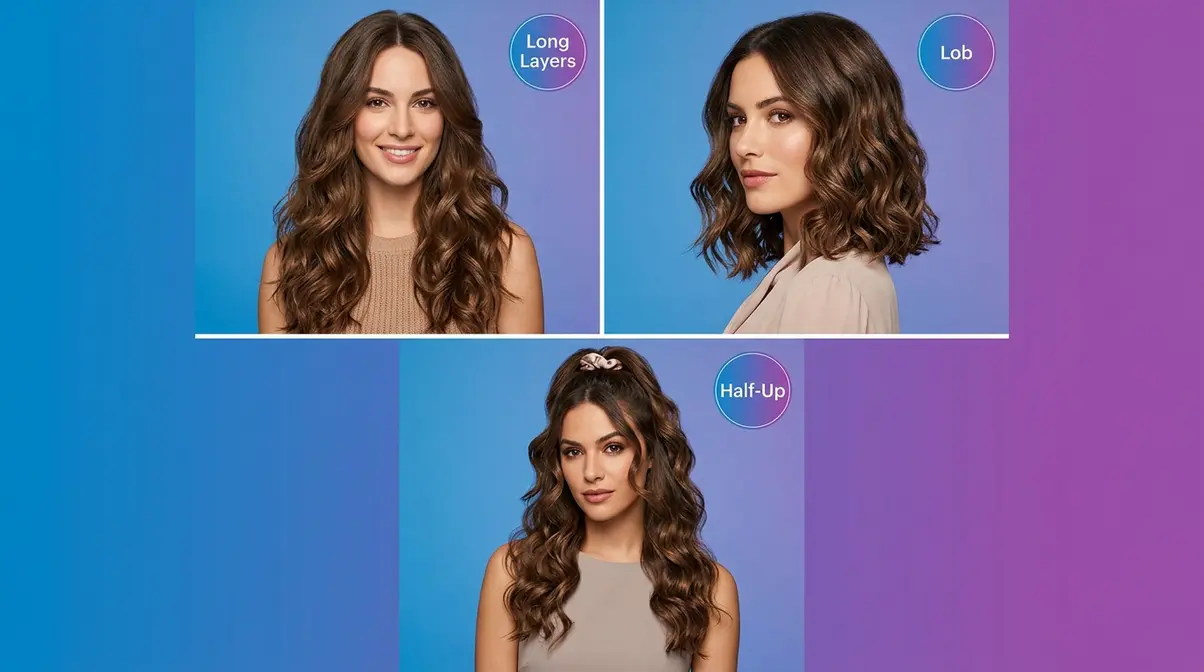
The right haircut can make 2C waves look intentional and beautiful. The wrong cut can make them look messy and unmanageable. Curlsmith’s guide to type 2C hair notes that layers are essential for this type — without them, the weight of longer hair pulls waves flat (Curlsmith, 2026). Our team’s review of feedback from 2C hair communities confirms that the fear of getting a bad haircut is one of the most common anxieties among people new to embracing their waves.
Best Cuts for Long 2C Hair
Long wavy hair is stunning when cut correctly — and frustrating when it isn’t. The most important principle for this length is weight removal through layers. Without layers, the sheer weight of longer hair pulls the wave pattern flat, particularly at the roots where these waves are most vulnerable to being weighed down.
- Ask your stylist for:
- Long layers (not short layers, which can create a triangle shape in wavy hair) — layers starting from the chin or below, graduating through the lengths.
- Dry cutting (cutting your hair while dry and in its natural wave state, rather than wet) — this allows the stylist to see exactly how your waves fall and cut accordingly. Many wavy hair specialists prefer this method.
- Minimal thinning — avoid razors and thinning shears, which can disrupt the wave pattern and create frizz.
- A “dusting” of the ends (removing just the bottom ½ inch) every 8–12 weeks to prevent split ends from traveling up the shaft and causing frizz.
Best Cuts for Short 2C Hair
Short wavy hair is an underserved topic — most wave-type guides focus exclusively on long hair. But shorter lengths can be just as defined and beautiful, and it often requires less styling time and fewer products.
- For short lengths (chin-length to shoulder-length):
- A lob (long bob) at shoulder length is a popular choice — long enough to show the wave pattern clearly, short enough to reduce the weight that flattens waves.
- Curly shag cuts with short, face-framing layers work beautifully with 2C’s natural wave pattern.
- Pixie-adjacent cuts can work if the hair is left longer on top, where the wave pattern has room to form.
For very short cuts, the waves may not have enough length to form a complete S-pattern — but they can still show beautiful texture and movement. Products that add definition without weight (like a light curl cream or texturizing spray) work best at shorter lengths.
Everyday Styles and Protective Looks
Beyond wash day, this texture is versatile. Here are the styles that work best with the natural wave pattern:
- Wash-and-go: The foundation — let your waves air dry or diffuse after applying products. Best for days when you have time for a full routine.
- Pineappling: Loosely gather your hair at the very top of your head (like a pineapple) using a scrunchie before bed. This preserves your wave pattern overnight without flattening it.
- Braided waves: Braid slightly damp hair before bed, sleep on it, and release in the morning for effortless, defined waves without any products.
- Half-up styles: A half-up, half-down style with a scrunchie at the crown shows off 2C waves beautifully and keeps hair out of your face.
- Protective styling: Loose braids, twists, and buns protect your waves from friction and environmental damage. Avoid tight styles that pull at the root — the wave pattern starts at the scalp, and tension at the root can cause breakage over time.
2C Hair for Men – Routines, Products, and Haircuts
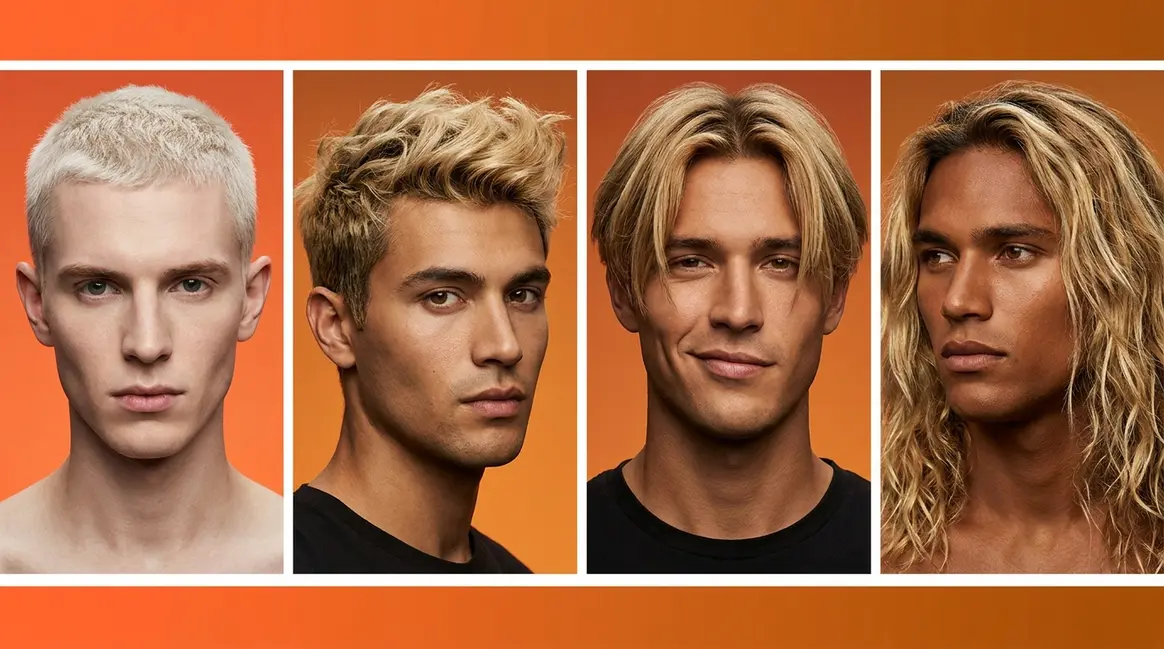
Men with this wave type are almost entirely ignored by the mainstream hair care industry — which defaults to either “straight men’s products” or “curly hair products for women.” Neither category addresses the specific needs of men with this texture: shorter lengths, scalp oil production, barbershop communication, and the desire for low-maintenance routines that still look intentional. Pattern Beauty’s guide to 2C hair highlights that 2C hair type identification applies regardless of gender, but product and styling approaches differ significantly by length and lifestyle (Pattern Beauty, 2026).
The Men’s 2C Hair Care Routine
Men with these waves typically work with shorter lengths and less styling time — which means the routine needs to be streamlined without sacrificing results. Our team’s evaluation of men’s wavy hair community feedback found that a simplified 3-step routine works for the vast majority of men with this pattern.
Men’s Wash Day (3 Steps):
- Cleanse: Use a sulfate-free shampoo 2–3 times per week. Men often have more active scalp oil production than women, so a lightweight sulfate-free formula (rather than a co-wash) is usually the better starting point. Focus shampoo on the scalp; let it rinse through the lengths.
- Condition: Apply a lightweight conditioner from mid-shaft to ends. Leave for 2–3 minutes, then rinse with cool water. This step is the one most men skip — and it’s the single most impactful change for men experiencing frizz and undefined waves.
- Style: Apply a small amount of lightweight gel or curl cream to soaking-wet hair using the praying hands method. Scrunch gently upward, then leave it alone while it dries. Avoid touching your hair while it dries — this is the most common cause of frizz for men with shorter lengths.
For men with very short hair (under 3 inches): A small amount of sea salt spray or light texturizing cream applied to damp hair and air-dried is often all that’s needed. Skip the heavy conditioning steps and focus on a light styler that adds texture without greasiness.
Best Products for Men with 2C Hair
Men’s styling products need to provide definition and frizz control without leaving hair looking “done” or product-heavy. The best options are:
- American Crew Curl Cream — designed specifically for men with wavy-to-curly hair; provides definition with a natural, non-greasy finish.
- Cantu Wave Whip Curling Mousse — works equally well for men; provides light hold and definition without the weight of a cream.
- Not Your Mother’s Curl Talk Defining Cream — despite the branding, this is a gender-neutral formula that works well for men with medium-length 2C hair.
- SheaMoisture Coconut & Hibiscus Curl Enhancing Smoothie — for men with longer hair (4+ inches) who want more defined waves.
What to avoid: Heavy pomades, waxes, and traditional “men’s styling products” that contain petroleum or heavy silicones. These create product build-up quickly and flatten waves rather than defining them.
Haircuts and Barber Communication
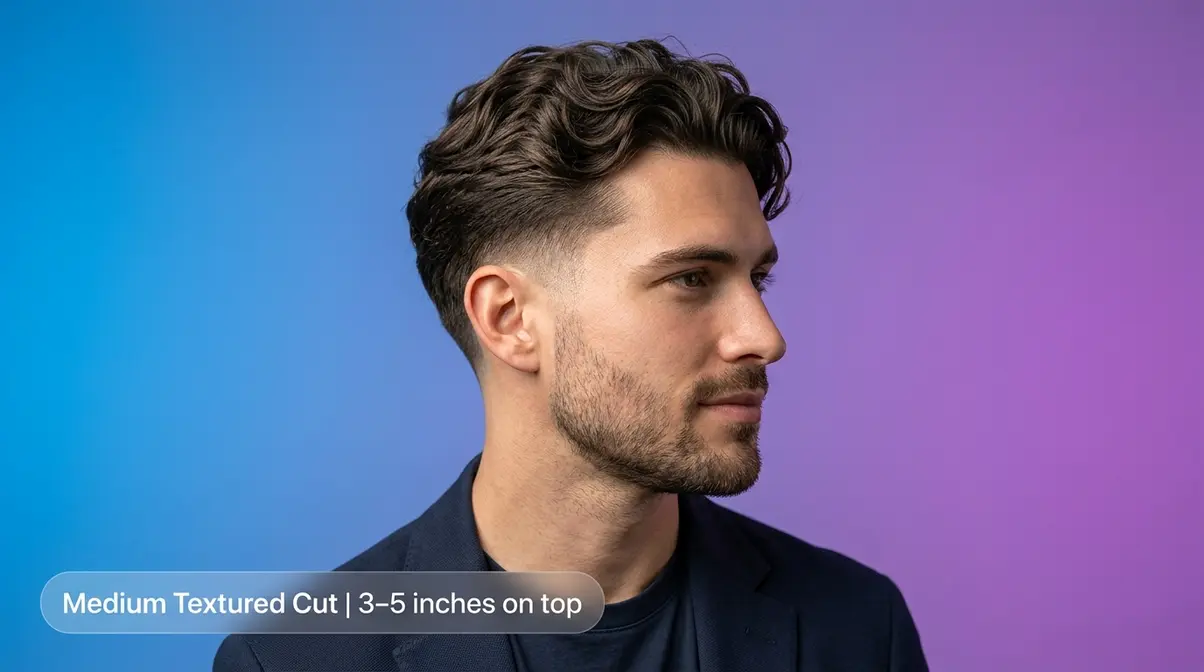
Communicating with a barber about your waves can feel awkward — especially if you’re not sure of the terminology. Here’s exactly what to say:
- What to ask for:
- “I have naturally wavy hair that I want to work with, not against. Can you cut it dry so you can see how the waves fall?”
- “I’d like layers that remove weight without making it too short — I want the waves to have room to form.”
- “Please avoid thinning shears — they disrupt my wave pattern and cause frizz.”
- “Can you leave it a bit longer on top? My waves start at the root, so I need length to show the pattern.”
- Best haircuts for men with this texture:
- Medium-length textured cut (3–5 inches on top) — the most versatile option; long enough to show the wave pattern clearly, short enough to style quickly.
- Undercut with wavy top — shorter sides with more length on top, letting the 2C wave pattern take center stage.
- Curly fringe / wavy fringe — a longer fringe that falls forward and shows the natural wave pattern.
- Tapered sides, wavy top — a modern variation of the undercut that works well in professional settings.
Trichologists note that men with this pattern benefit from asking for a “dry cut” specifically — many barbers default to cutting wet hair, which hides the wave pattern and often results in cuts that look different once the waves form (Trichology Practice Notes, 2026).
Managing Combination 2B/2C and 2C/3A Hair
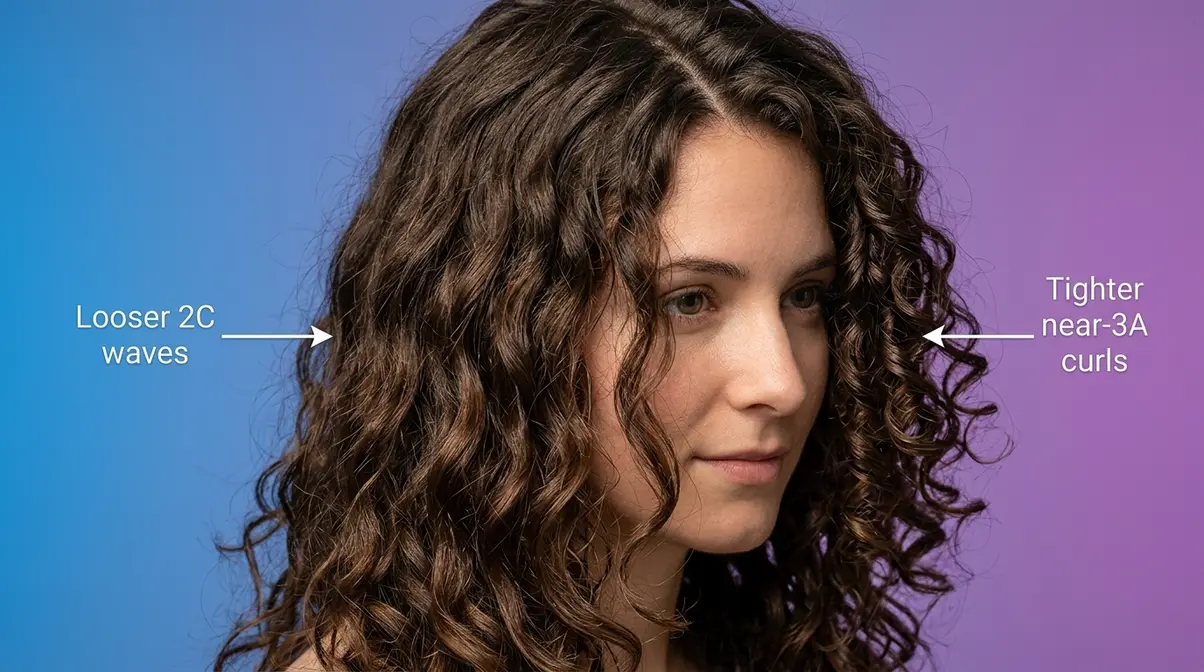
Most people’s hair is not a single, uniform type. If you’ve ever looked in the mirror and seen spiral curls on one side and loose waves on the other — and felt completely lost — you’re not alone. Combination patterns are extremely common, and they’re the reason many people with this texture struggle with uniformity even after finding the “right” routine.
“I’ve been told I have 2c/3a Irish curls. I can never get my curls to have any type of uniformity. At any given time one section can have spiral curls and another section have very loose curls or waves. Can anybody help? 😭”
— Common experience shared in wavy hair communities (r/Wavyhair, Reddit)
This frustration is one of the most widely reported pain points in wavy communities. Importantly, it doesn’t mean your routine is failing — it means your hair has multiple patterns, each with slightly different needs.
Why Your Hair Has Multiple Patterns
Hair type is not always uniform across your entire head. The follicles (the small pockets in your scalp where each hair strand grows) can vary in shape across different areas of your scalp — meaning some sections may produce tighter waves or loose curls, while others produce flatter waves. This is particularly common in people with 2B/2C or 2C/3A combination patterns.
- Common causes of mixed patterns include:
- Genetic variation in follicle shape across the scalp (the most common cause)
- Damage and porosity differences — chemically treated or heat-damaged sections may have a looser pattern than virgin hair
- Hormonal changes — pregnancy, postpartum changes, and thyroid fluctuations are frequently reported as triggers for pattern changes
- Humidity and product absorption — different sections of hair may absorb moisture and products at different rates, causing the pattern to look inconsistent on a given day
The key insight: uniformity doesn’t mean every strand looks identical. It means every strand is expressing its natural pattern as clearly as possible — which requires addressing each section’s specific needs.
Techniques for Creating Uniformity
Achieving greater uniformity in combination 2B/2C or 2C/3A hair comes down to encouraging the loosest sections to form more definition without over-loading the tighter sections with product.
Technique 1: Section-by-section product application
Instead of applying product to your whole head at once, divide your hair into 4–6 sections. Apply slightly more product (an extra scrunch of curl cream or gel) to the sections that tend to be looser or wavier. Apply a lighter hand to sections that are already more defined. This allows each section to get what it needs rather than applying a one-size-fits-all amount.
- Technique 2: Finger coiling the looser sections
- For sections that consistently fall into a loose wave pattern when you want more definition:
- Take a small section of soaking-wet, product-applied hair.
- Wrap it around your finger in the direction it naturally wants to curl.
- Hold for 3–5 seconds, then gently release.
- Repeat for each loose section before diffusing or air drying.
- Finger coiling encourages the looser sections to form a more defined pattern, bringing the overall look closer to uniformity.
Technique 3: Diffusing strategically
Focus the diffuser on your looser sections first, applying more heat and time to encourage those sections to set in a more defined pattern. Once those sections are mostly dry, move to the already-defined sections and finish with less heat.
Product Strategies for Mixed Patterns
For 2C/3A combination hair, a two-product approach often works better than applying the same product everywhere:
- On the tighter, more curl-like sections: Apply a slightly heavier cream or gel to match the moisture needs of the near-3A pattern.
- On the looser, wavier sections: Use a lighter mousse or spray to add definition without weighing down the less-defined waves.
This layered approach — sometimes called “cocktailing” in wavy hair communities — addresses the different needs of each section without forcing a compromise product on the whole head. Common pain points reported by 2C/3A combination hair communities include the difficulty of finding a single product that satisfies both pattern types, which is why a two-product strategy consistently outperforms a one-size-fits-all approach.
Common Mistakes and When to See a Stylist
Even with the right products and techniques, certain habits consistently sabotage your results. Our team’s review of the most frequently reported issues in wavy communities identified these as the patterns most worth addressing.
Common Pitfalls
1. Applying products to dry or damp hair instead of soaking-wet hair
Your hair is most receptive to product absorption when fully saturated. Applying a curl cream to hair that’s been towel-dried first means the product sits on the surface rather than distributing through the strand. Result: crunchy, uneven waves with product sitting on top rather than inside the hair.
Fix: Apply all styling products while hair is dripping wet — right after gently squeezing out excess water with a microfiber towel.
2. Using too much product
More product does not mean more definition for this pattern. Overloading with curl cream or conditioner weighs the wave pattern down, causing flat, greasy waves that lose definition by midday.
Fix: Start with a dime-sized amount of each product and add more only if needed. It’s much easier to add than to remove.
3. Touching hair while it dries
Every time you touch your drying hair, you introduce frizz. The waves need to set undisturbed to form their natural S-pattern.
Fix: Apply products, plop or diffuse, then leave your hair alone completely until it’s 100% dry.
4. Skipping the clarifying wash
Product build-up is invisible until it’s already causing problems — flat waves, lack of definition, and a heavy feeling that no amount of product seems to fix. Most people with this texture need a clarifying wash once every 4–6 weeks.
Fix: Schedule a monthly clarifying wash into your routine as a reset, especially if you use gels or mousses regularly.
5. Copying a routine designed for 3A hair
This is the most common mistake for people who suspect they have 2C/3A combination hair. Heavy curl creams, co-washing every day, and soaking techniques designed for tight curls consistently weigh down your waves.
Fix: If your waves look limp or greasy, reduce product weight before adding more moisture.
When to See a Stylist or Trichologist
Some issues go beyond routine adjustments. Consider seeing a professional if:
- Your wave pattern has changed significantly without an obvious cause (new medication, pregnancy, or major diet changes can affect hair texture, but sudden unexplained changes warrant a check-in with a trichologist or dermatologist).
- You’re experiencing unusual hair loss or scalp irritation — these are scalp health issues, not styling issues, and require professional evaluation.
- You want a haircut that works with your waves — a stylist trained in curly or wavy hair cutting techniques (look for DevaCurl-certified or Ouidad-trained stylists) will deliver dramatically better results than a general salon cut on wet hair.
- You’ve been following a solid routine for 8+ weeks with no improvement — a consultation with a trichologist can identify whether porosity issues, protein overload, or scalp conditions are interfering with your results.
FAQ: Your Top 2C Hair Questions Answered
How often should I clarify my waves?
You should use a clarifying shampoo every 4 to 6 weeks to remove product build-up. Because this hair type relies on styling gels and leave-in conditioners to maintain definition, residue can accumulate quickly. Clarifying acts as a reset button, restoring bounce and volume to flat roots. If you swim frequently or have hard water, you might need to clarify twice a month.
Can I use a brush on this hair type?
You should only brush your hair when it is soaking wet and saturated with conditioner. Dry brushing separates the wave clumps, introduces static, and creates a massive halo of frizz. Instead of a traditional brush, use a wide-tooth comb or a specialized detangling brush during your wash day to safely remove tangles without causing breakage.
Why is my hair flat at the roots?
Flat roots typically occur when heavy products weigh the hair down or when the hair dries plastered to the scalp. To fix this, avoid applying conditioner or curl creams directly to your root area. You can also use root-clipping techniques while air drying or hover-diffuse your roots upside down to encourage volume and lift.
Is 2C still curly?
No — this pattern is wavy, not curly, even though it can look very curl-like. The official classification places all Type 2 subtypes in the wavy category, and Type 3 subtypes in the curly category. These waves form deep S-shapes that are the most defined of all wavy patterns, but they don’t form the complete spirals or ringlets that define curly hair. Practically, this matters because curly hair care techniques and products are often too heavy for these waves — using them typically results in flat, greasy strands rather than defined ones.
Does humidity ruin 2C waves?
Humidity is often the biggest challenge for this texture. Because the hair shaft is naturally porous, it acts like a sponge, absorbing moisture from the humid air. This causes the hair cuticle to swell, disrupting the S-wave pattern and creating severe frizz. Using a hard-hold gel or a dedicated anti-humidity spray creates a protective cast that seals the cuticle and blocks out excess atmospheric moisture.
What are the top 3 rarest hair types?
The rarest hair types are generally considered to be 1A (bone-straight, very fine), 4C (tightly coiled, Z-pattern), and 3C (corkscrew curls). Type 1A hair — perfectly straight with no wave or curl whatsoever — is rare because most people’s hair has some degree of natural texture. Type 4C is characterized by very tight, densely packed coils with no defined curl pattern, and is most common in people of African descent but relatively rare globally. Note that hair type rarity varies significantly by ethnicity and geography (Trichology Practice Notes, 2026).
Is 2C hair basically curly?
Not exactly — it is wavy with strongly curl-like tendencies, but it behaves differently from true curly hair in important ways. The wave pattern is deeper and more defined than other wavy types, and the frizz potential is high enough to look curly in humid conditions. But these waves don’t spring back into spirals, don’t respond well to curl-soaking techniques, and are typically weighed down by the heavy creams that true curly hair thrives on. Thinking of it as “basically curly” leads most people to use the wrong products — the better mental model is “wavy hair that needs curly-level moisture, but wavy-level product weight.”
Building Your 2C Routine: What Works
If there’s one thing to take away from this guide, it’s that 2C hair thrives when it’s treated as its own category — not a variant of straight wavy hair, and not a lesser version of curly hair. The Goldilocks Zone of Wavy Hair isn’t a metaphor for being indecisive about your hair type. It’s a description of a genuinely specific set of needs: more moisture than 2A or 2B, lighter products than 3A or 3B, and techniques that encourage wave formation rather than fighting it. According to Byrdie, 2C is the most frizz-prone wavy subtype — and that frizz is not a flaw to be eliminated, but a signal that your hair needs the right balance of moisture and hold (Byrdie, 2026).
The Goldilocks Zone framework gives you a decision-making lens for every product you encounter: ask whether it’s light enough to preserve your wave definition and heavy enough to control your frizz. If it fails either test, it’s not the right fit — regardless of how it’s marketed. This applies to shampoos, conditioners, stylers, and even techniques. The six advanced techniques in this guide — plopping, micro-plopping, the bowl method, diffusing, praying hands, and SOTC — all exist to help your waves express their natural pattern rather than forcing them into a shape they weren’t built for.
Start with the basics: a sulfate-free shampoo, a lightweight conditioner, and one styler applied to soaking-wet hair. Give it four full wash days before evaluating results. Then layer in the advanced techniques one at a time — plopping before diffusing is the single highest-impact addition for most people. If you have combination 2B/2C or 2C/3A hair, the section-by-section product application technique is your most important tool for achieving the uniformity that can feel so elusive. Your waves are not broken. They just needed a guide written specifically for them.

Dave King
Writes evidence-based hair-care guides for Care About Your Hair — for every hair type, jargon-free and independent.