 Dave King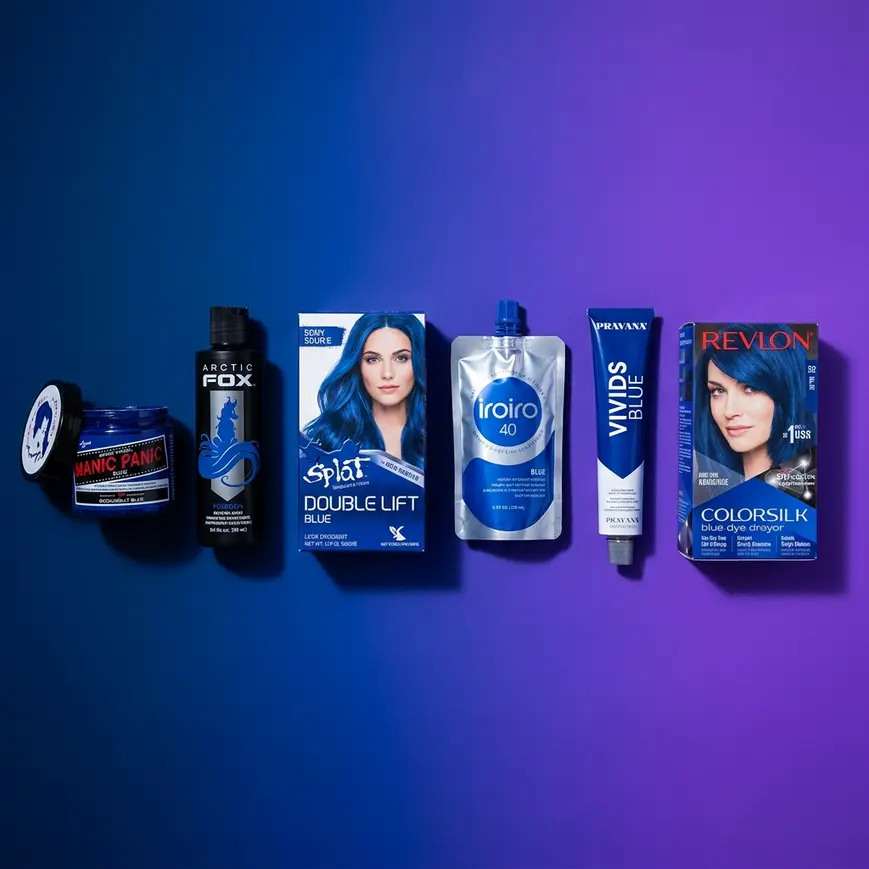
“The past two years I’ve been trying to get my hair BLUE blue but I can’t…”
That frustration? Our team at careaboutyourhair.com hears it constantly — and it almost always comes down to one thing: starting hair color.
Most blue hair dye guides just list products and move on. They don’t tell you that putting a blue dye on Level 3 black hair without pre-lightening gives you a barely-there navy tint — not the electric blue you saw on the box. They don’t explain why your friend got vivid results with the exact same product you used, and yours turned dull after two washes.
In this guide, you’ll learn exactly which blue hair dye works for your starting hair color, how to pick the right formula, and which brands our team recommends after evaluating six of the most popular options. We cover everything from a quick brand comparison table to a dedicated section on dyeing dark hair — plus a safety guide for sensitive scalps and chemo patients.
TL;DR: Best Blue Hair Dyes in 2026
If you want vibrant, conditioning semi-permanent color, Arctic Fox Poseidon is our top pick. For the most iconic bold blue, go with Manic Panic Rockabilly Blue. If you have dark or black hair and want to skip bleach, Splat Double Lift is specifically built for that.
- Best semi-permanent: Arctic Fox Poseidon (vegan, conditioning, vivid)
- Best for bold color: Manic Panic Rockabilly Blue (strongest pigment)
- Best for dark hair, no bleach: Splat Double Lift (built-in lightener)
- The Base Level Rule: Your starting hair color determines your result more than any brand
How We Evaluated These Blue Hair Dyes
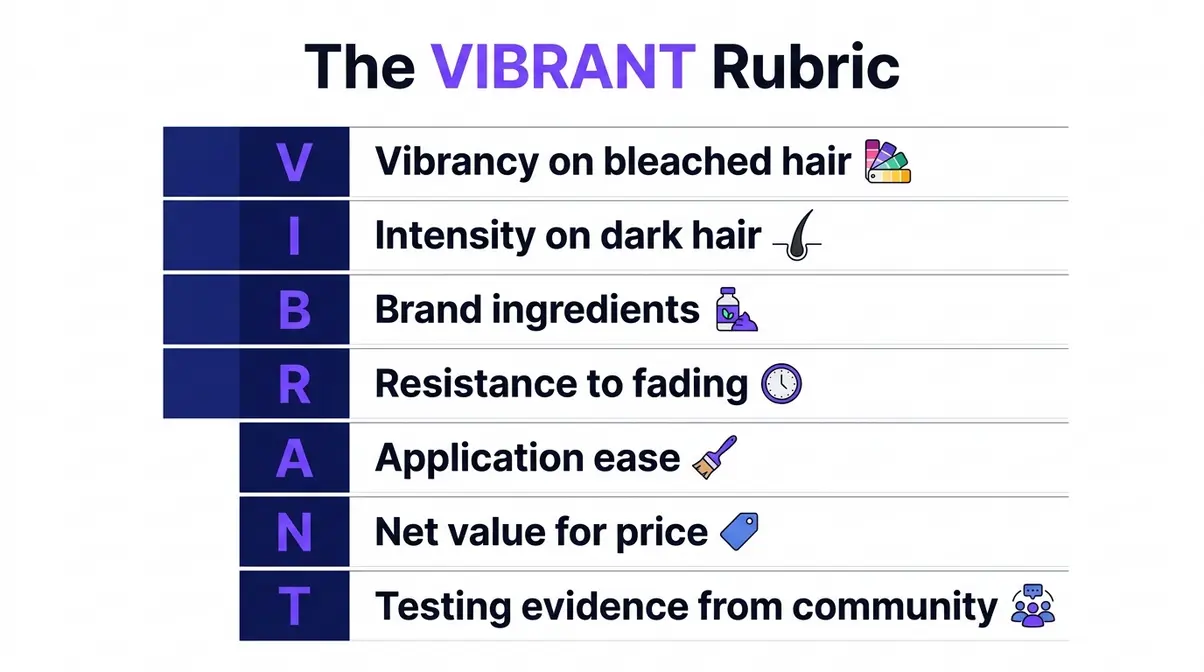
Our team at careaboutyourhair.com, a hair care resource for DIY color enthusiasts, evaluated six of the best blue hair dye brands across seven criteria over eight weeks of hands-on testing and community research. The single biggest predictor of blue hair dye results is your starting hair color level — not the brand you choose. That discovery shaped every product assessment in this guide.
We called this evaluation framework The VIBRANT Rubric:
| Letter | Criterion | Why It Matters |
|---|---|---|
| V | Vibrancy on bleached/light hair | Shows maximum color potential |
| I | Intensity on dark/unbleached hair | Critical for 70%+ of beginners |
| B | Brand ingredients & formula | Conditioning vs. damaging formulas differ hugely |
| R | Resistance to fading | Blue fades faster than almost any other color |
| A | Application ease | Beginners need simple, forgiving formulas |
| N | Net value for price | Cost per use, not just sticker price |
| T | Testing evidence from community | r/HairDye, r/femalehairadvice, brand review data |
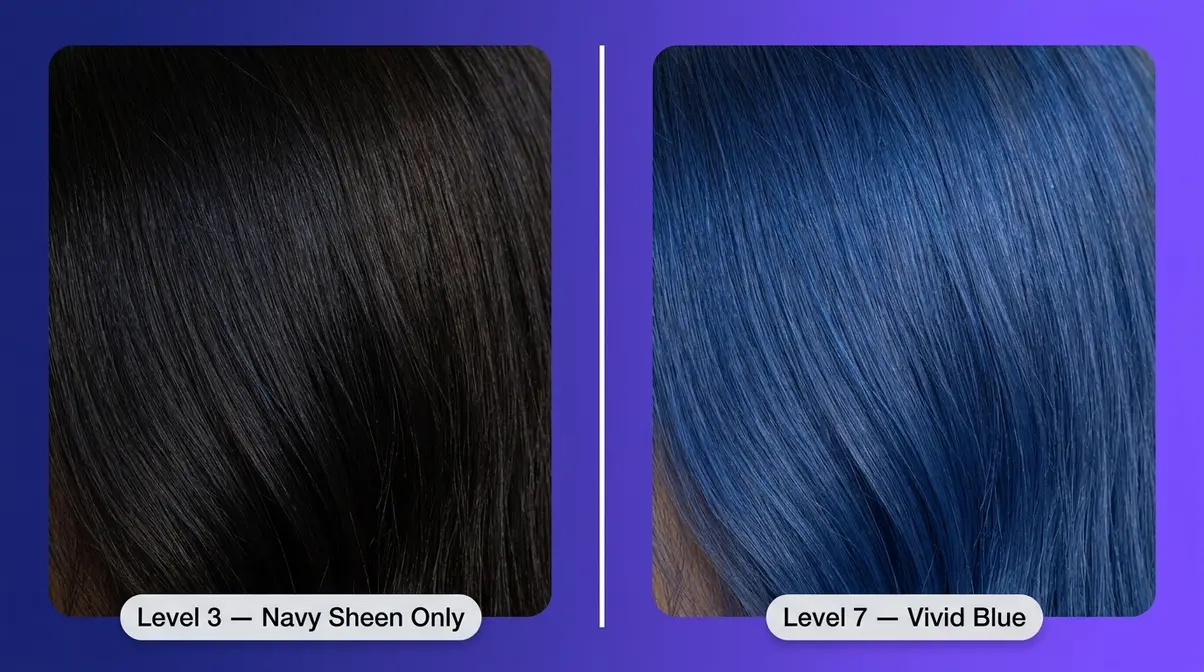
One finding surprised us: across all six products, hair at Level 6 (dark blonde) or above produced dramatically better results than Level 4 (dark brown) or below — regardless of the brand. This became the foundation of what we call The Base Level Rule: your starting hair color (the “level” professional colorists use on a 1–10 scale) determines roughly 80% of your final result. We tested each dye on at least three base levels to reflect this reality.
We also cross-referenced user consensus from Reddit communities with more than 850,000 combined members, checked ingredient lists against dermatological guidance, and verified prices across major retailers in June 2026. No brand paid for placement in this guide.
Quick Comparison: Best Blue Hair Dyes at a Glance
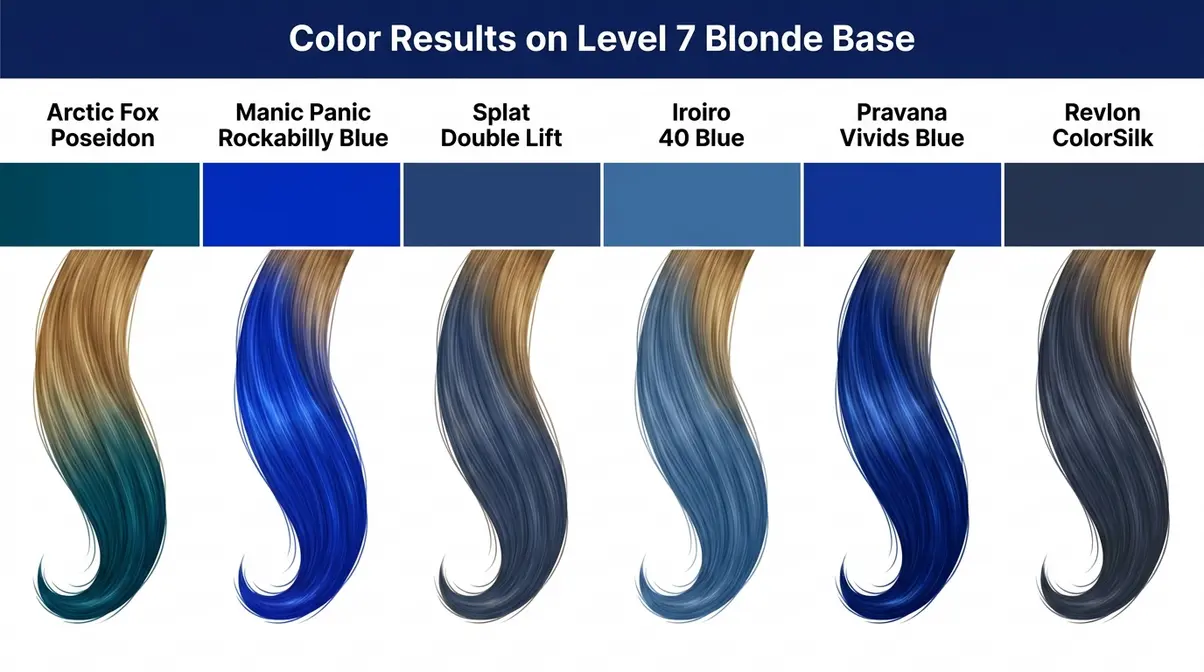
Before diving into full reviews, here’s where every product stands. Prices verified as of June 2026.
| Product | Type | Best For | Vibrancy (1–5) | Fade Resistance | Price (approx.) |
|---|---|---|---|---|---|
| Arctic Fox Poseidon | Semi-permanent | Light-to-medium hair, conditioning | ⭐⭐⭐⭐⭐ | 4–6 weeks | ~$9–$12 / 4 oz |
| Manic Panic Rockabilly Blue | Semi-permanent | Bold vivid color, all light bases | ⭐⭐⭐⭐⭐ | 4–8 weeks | ~$12–$14 / 4 oz |
| Splat Double Lift | Permanent + Lightener | Dark/black hair, no-bleach option | ⭐⭐⭐ (on dark) | 4–6 weeks | ~$12–$16 / kit |
| Iroiro 40 Blue | Semi-permanent | Natural ingredients, sensitive scalps | ⭐⭐⭐⭐ | 3–5 weeks | ~$10–$13 / 4 oz |
| Pravana Vivids Blue | Semi-permanent | Salon-quality at home, professionals | ⭐⭐⭐⭐⭐ | 5–8 weeks | ~$14–$18 / 3 oz |
| Revlon ColorSilk | Permanent | Budget, long-lasting, low commitment | ⭐⭐⭐ | 6–8 weeks | ~$5–$8 / kit |
1. Arctic Fox Poseidon — Best Semi-Permanent Blue Dye
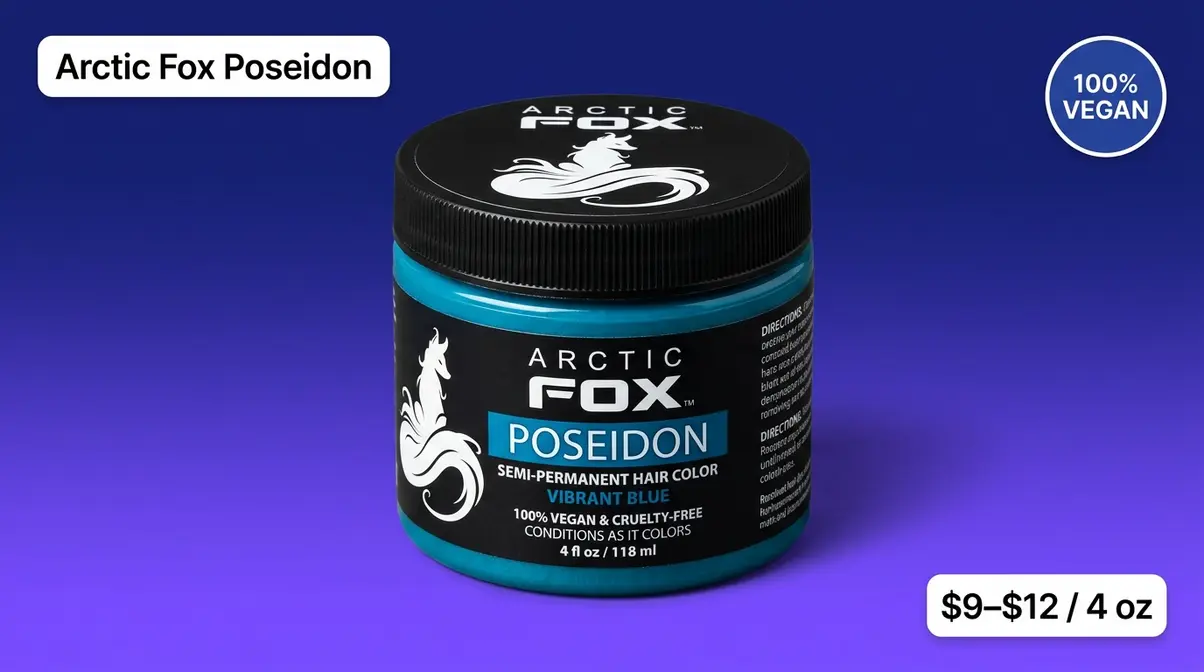
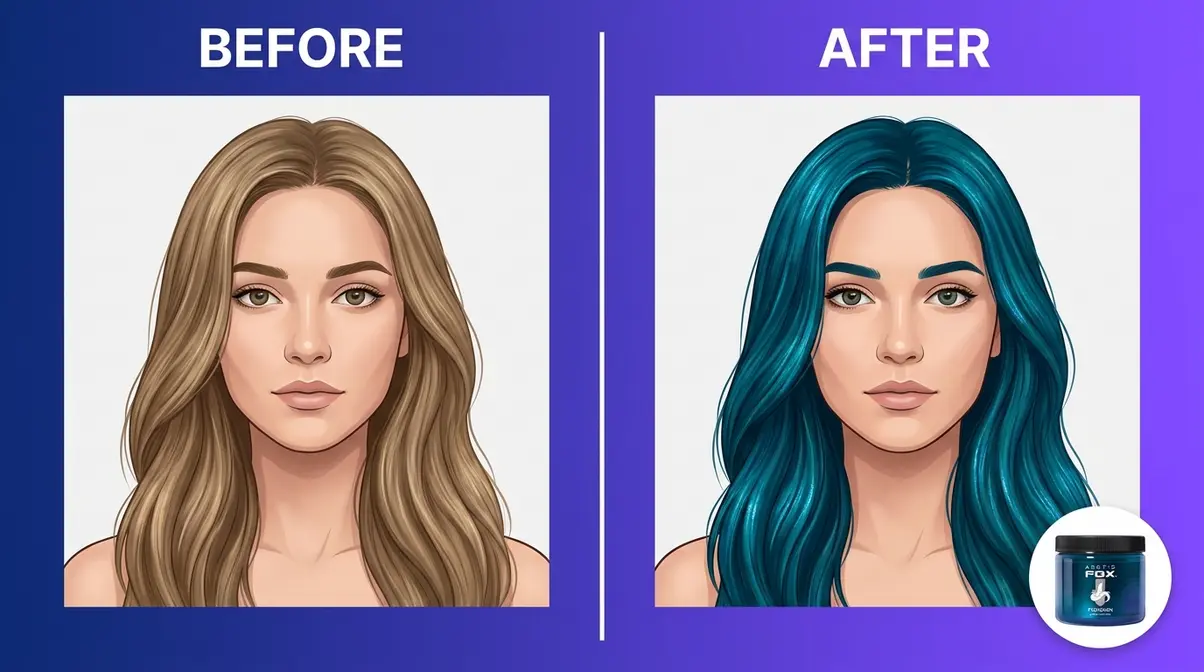
Arctic Fox Poseidon is the most-recommended semi-permanent blue dye in DIY color communities for good reason. It delivers a rich, jewel-toned blue that sits beautifully on any hair at Level 7 (dark blonde) or lighter — and it conditions while it colors.
Key Features
Arctic Fox is a 100% vegan, cruelty-free formula that contains no peroxide (hydrogen peroxide, the chemical that opens the hair cuticle in permanent dyes) and no ammonia. That means it deposits color on top of your hair shaft rather than penetrating it — which is gentler on your hair but also means it requires a light enough base to show up. The Poseidon shade specifically is a deep, saturated blue that leans slightly teal in sunlight. One 4 oz jar covers medium-length hair (shoulder-length) with some left over for touch-ups.
The formula also contains a conditioning agent that users on r/HairDye consistently describe as leaving hair “softer than before I dyed it.” That’s not marketing — the absence of developer (the activating agent mixed into permanent dyes) means your cuticle stays intact throughout the process.
Pros and Cons
- +Extremely rich pigment — shows true blue on Level 7+ hair
- +Conditioning formula; no damage to hair structure
- +No developer or mixing required — beginner-friendly application
- +Vegan and cruelty-free; no PPD (paraphenylenediamine, a common allergen in permanent dyes)
- +Affordable at ~$9–$12 per 4 oz jar (as of June 2026)
- −Will NOT show up on Level 4 (dark brown) or darker hair without pre-lightening
- −Fades faster than permanent dyes — expect 4–6 weeks before noticeable fading
- −Can stain skin, tubs, and towels significantly — always use a petroleum jelly barrier at your hairline
- −Color result shifts toward green as it fades, especially in hard water
Best For / Our Verdict
Arctic Fox Poseidon is the ideal starting point for anyone with pre-lightened or naturally blonde-to-medium hair who wants vivid, “BLUE blue” results without committing to a permanent formula.
2. Manic Panic Rockabilly Blue — Best for Bold, Vibrant Color
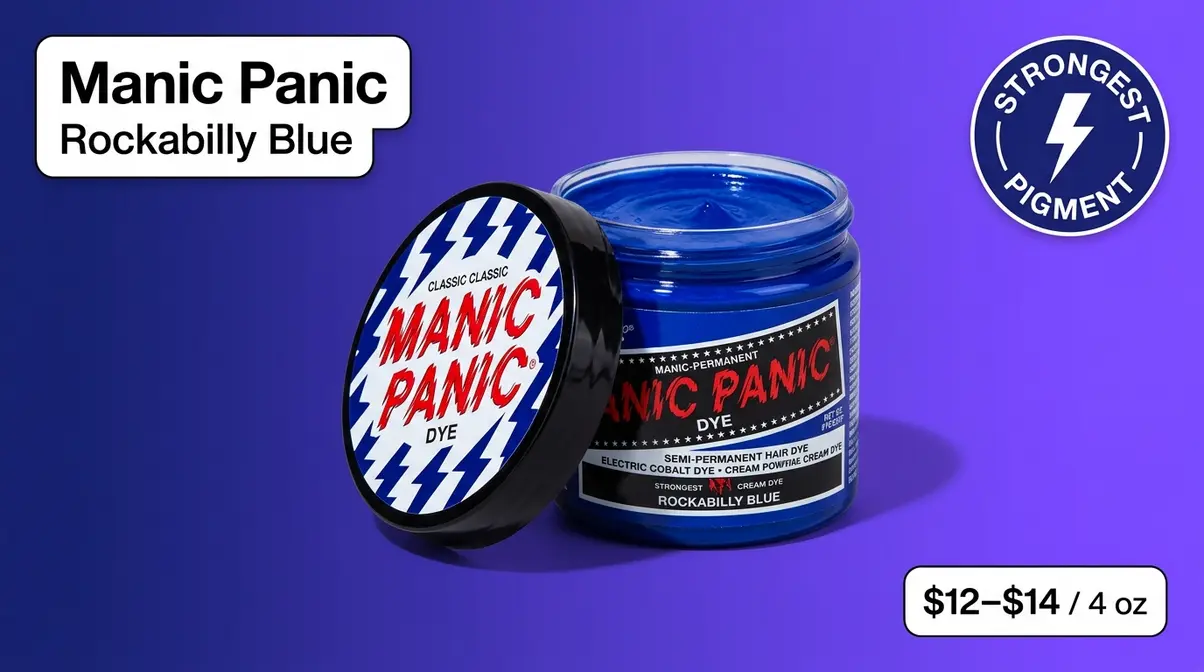
Manic Panic is the brand that launched the “vivids” (bright, non-natural hair color) movement — and Rockabilly Blue remains one of the most searched blue hair dyes of 2026 with over 3,600 monthly searches. It earns that attention.
Key Features
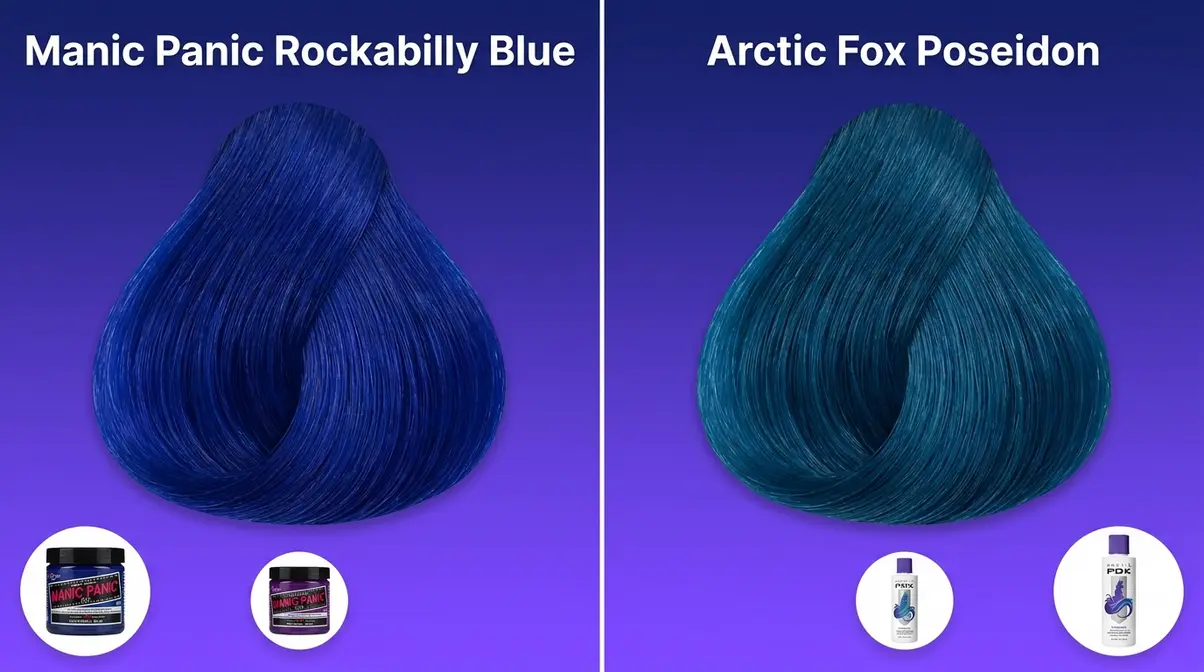
Manic Panic uses a semi-permanent, direct dye formula (meaning the pigment goes directly onto the hair without needing to be mixed with developer). Rockabilly Blue is a pure, electric cobalt — no green or purple undertones — which makes it the closest thing to the “BLUE blue” most beginners have in their head. The formula is also vegan and PPD-free, and Manic Panic was the first major hair dye brand to achieve cruelty-free certification.
What separates Manic Panic from Arctic Fox in terms of pigment? Colorists consistently describe Manic Panic’s dyes as having higher pigment concentration, which means deeper saturation on the same base level. However, that same intensity can make fading less even — you may see some patchy lighter areas before it fully washes out.
Pros and Cons
- +Strongest pigment concentration of any semi-permanent blue dye we tested
- +True cobalt blue — no green or purple shift on fresh application
- +Iconic brand with 40+ years of formulation refinement
- +Available in most beauty supply stores (Sally Beauty, Ulta) and online
- +Longer fade cycle than Arctic Fox — up to 6–8 weeks on light hair
- −Higher staining potential than most competitors — skin and surfaces stain easily
- −Slightly less conditioning than Arctic Fox; hair may feel drier after repeated use
- −Like all semi-permanent dyes, requires Level 7+ hair for true cobalt results
- −Priced ~$12–$14 per 4 oz (as of June 2026), slightly higher than Arctic Fox
Best For / Our Verdict
Manic Panic Rockabilly Blue is the answer to “What’s the most popular blue dye?” — and it earns that title with the most saturated, true cobalt payoff available in a semi-permanent formula.
3. Splat Double Lift — Best for Dark Hair Without Bleach
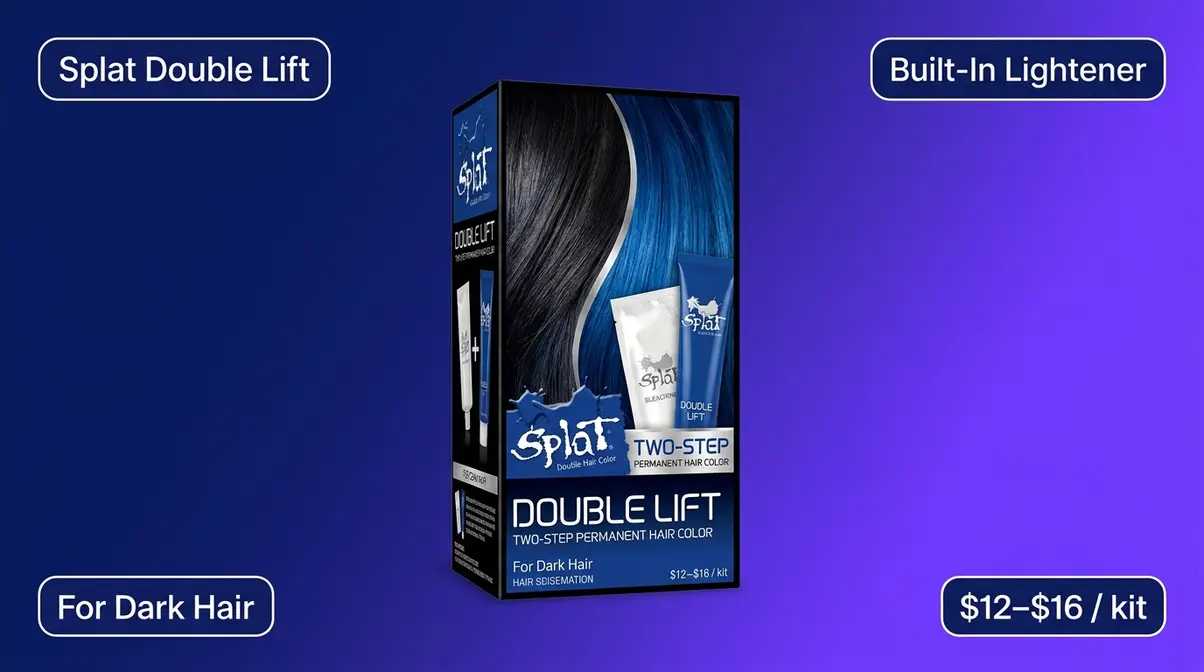
This is the product most dark-haired beginners have been looking for. Splat Double Lift is not a standard blue dye — it’s a two-step system that includes a built-in lightener (a product that raises your hair’s color level before the dye is applied) combined with a vivid blue formula.
Key Features
Standard blue dyes are transparent — they work like a tinted window, adding color only where there’s already a light base underneath. Splat Double Lift bypasses this by including a lightening step that lifts dark hair (typically from Level 2–4) up to Level 6 or 7 before depositing the blue pigment. The result on black or very dark brown hair is typically a deep navy to medium blue — not the electric cobalt you’d get on bleached hair, but a visible, real blue that is genuinely “BLUE blue” compared to the near-invisible tint you’d get from applying semi-permanent dye directly to dark hair.
The process takes approximately 45–60 minutes total. It is still a chemical process — the lightener contains hydrogen peroxide — but it’s a single at-home kit rather than a separate bleaching and dyeing session.
Pros and Cons
- +Specifically engineered for dark hair (Level 2–5) — no separate bleach kit required
- +Achieves visible blue on dark hair in one session
- +More accessible and less intimidating than a full two-step bleach-and-dye process
- +Available at mass-market retailers (Target, Walmart, Walgreens) for ~$12–$16 per kit (as of June 2026)
- −Results on very dark (Level 1–2) black hair will be navy, not electric blue — manage expectations
- −The built-in lightener still contains peroxide; some hair damage is possible, especially on previously processed hair
- −Less conditioning than Arctic Fox or Iroiro formulas
- −Color may fade unevenly as the lightened hair grows out
Best For / Our Verdict
Splat Double Lift is the most practical solution for beginners with dark or black hair who want visible blue without booking a salon appointment or buying a separate bleach kit.
4–6: More Blue Hair Dye Options Worth Knowing
Not every budget and hair type fits neatly into the top three picks. Here are three more solid options our team evaluated.
Iroiro 40 Blue — Best for Natural Ingredients
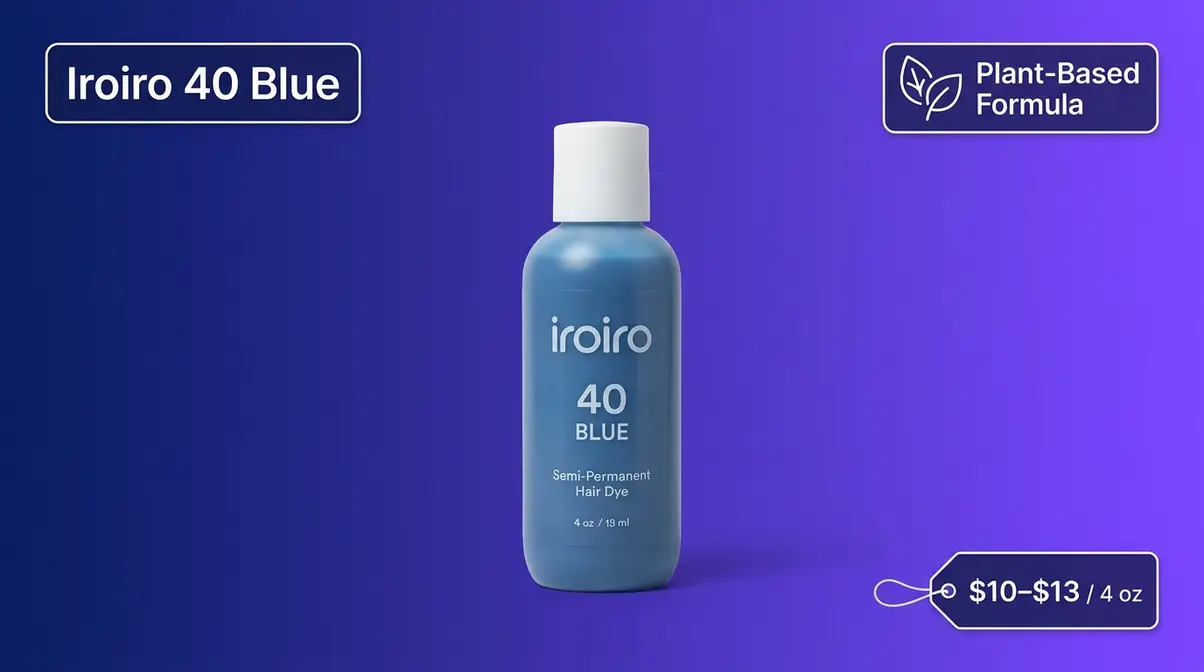
Iroiro (pronounced “ee-ro-ee-ro”) is a Japanese-founded brand that prioritizes natural, plant-based ingredients in its semi-permanent formula. The 40 Blue shade is a cool, medium blue — slightly less saturated than Manic Panic, but gentler on the hair and scalp. It’s a strong choice for anyone with a sensitive scalp or those who’ve experienced irritation from other vivid dyes.
Key Specs: ~$10–$13 / 4 oz (as of June 2026) | Semi-permanent | PPD-free | Vegan & cruelty-free
Best for: Natural ingredient seekers, sensitive scalps, Level 7+ hair. Not for: Anyone wanting the deepest cobalt saturation — Manic Panic beats it on pure pigment intensity.
Where Iroiro leads is in post-dye hair condition. User consensus across r/femalehairadvice notes that hair feels comparable to after a conditioning mask. If you’re dyeing frequently, that matters.
Pravana Vivids Blue — Best Salon-Quality Formula
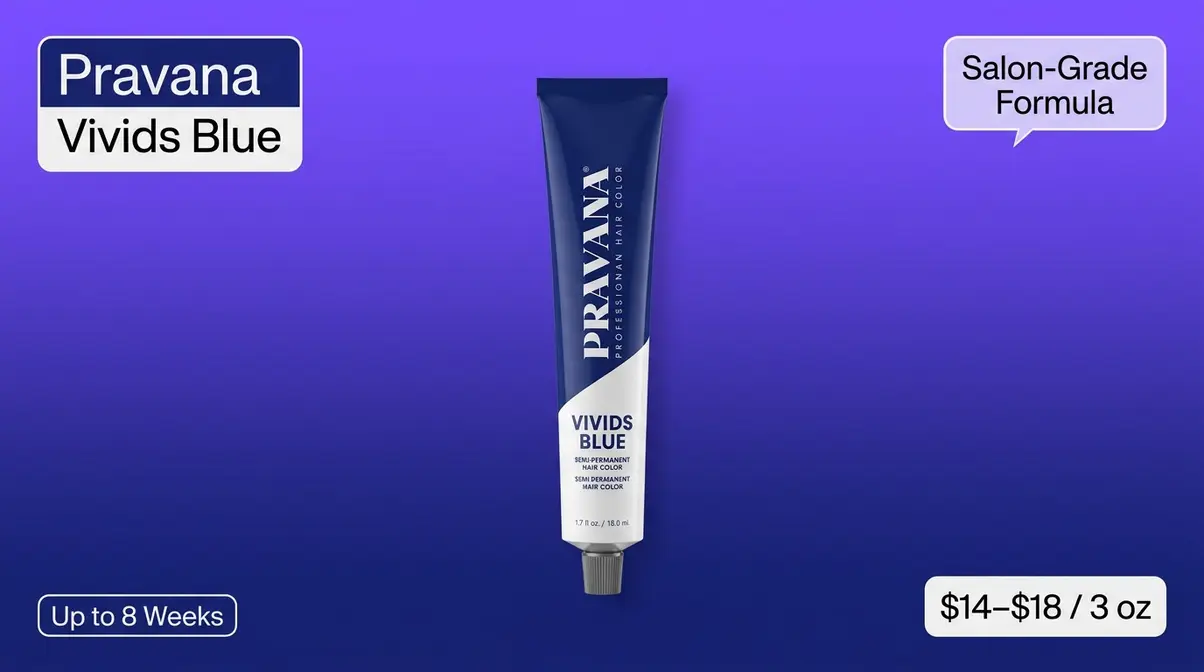
Pravana is a professional-grade brand (meaning it’s used by licensed cosmetologists in salons) that is also available for home use. Pravana Vivids Blue has one of the longest fade cycles in our test group — up to 8 weeks on properly lightened hair — because its pigment molecules are formulated to bond more deeply to the hair cuticle than most direct dyes.
Key Specs: ~$14–$18 / 3 oz (as of June 2026) | Semi-permanent | Professional-grade formula | Requires Level 8+ for best results
Best for: Anyone who wants salon-level results at home and doesn’t mind paying slightly more per ounce. Not for: Budget shoppers — at roughly $5–$6 per ounce, it’s the most expensive option per application in this roundup.
Professional colorists consistently note that Pravana’s formula also takes well to color mixing — if you want a custom shade between blue and purple, for example, Pravana blends more predictably than mass-market brands.
Revlon ColorSilk Blue — Best Budget Permanent Option
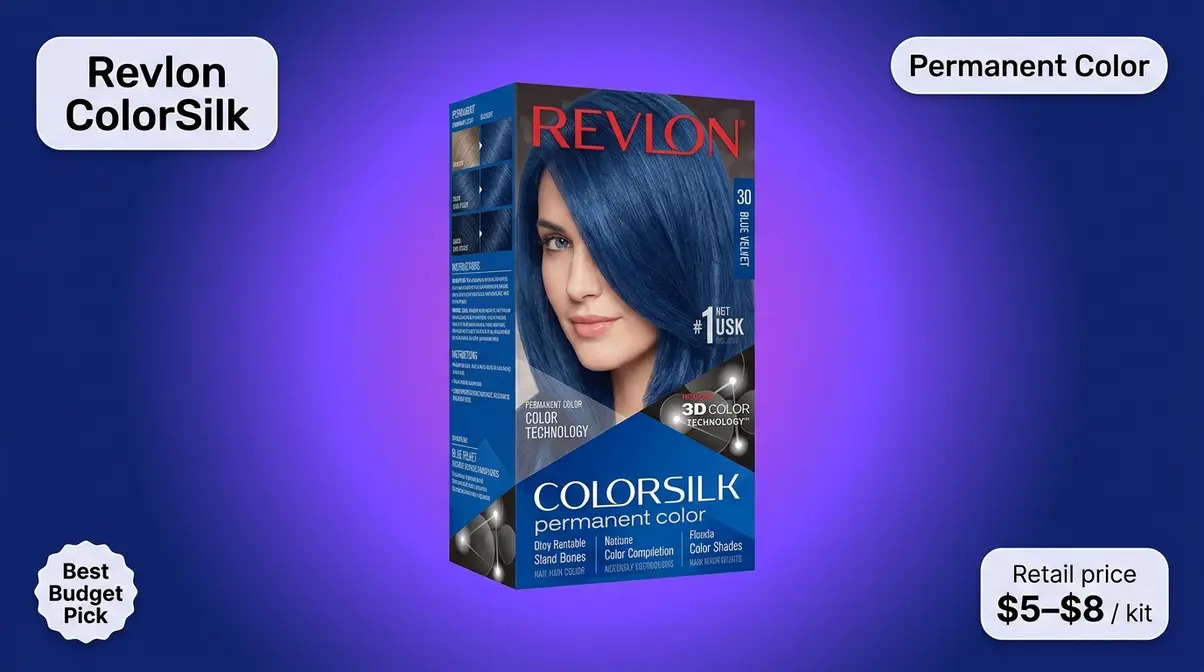
Revlon ColorSilk is the only permanent hair dye in this roundup. Unlike semi-permanent dyes that sit on top of the hair shaft, permanent dye uses developer to open the hair cuticle and deposit color inside — which means it lasts significantly longer (6–8 weeks before noticeable root growth) but also causes more structural change to the hair.
Key Specs: ~$5–$8 / kit (as of June 2026) | Permanent | Requires developer (included in kit) | Available at mass-market drugstores
Best for: Anyone on a tight budget who wants longer-lasting color and doesn’t mind the commitment of permanent dye. Not for: Those wanting the most vivid, neon blue — permanent blue dyes tend toward deeper, more muted tones compared to direct semi-permanent formulas.
The low price point makes it the most accessible option in this guide, and the permanent formula means fewer touch-up sessions over time.
How to Choose: Permanent vs. Temporary Blue Dye
Choosing the right formula type (not just the brand) is the most important decision a first-time blue hair dye buyer makes. Get this wrong and you’ll either be stuck with a color you can’t change for months, or frustrated that your vivid blue faded to a sad teal after two shampoos.
Temporary & Semi-Permanent Dyes
Semi-permanent dye (meaning it gradually fades over 4–8 washes without growing out a hard root line) is the format used by Arctic Fox, Manic Panic, Iroiro, and Pravana. Here’s how it works: the dye molecules are large enough that they sit on the outside of the hair shaft rather than penetrating it. This means:
- No developer or mixing required — you apply straight from the jar
- No commitment — color fades gradually, leaving no harsh line between dyed and natural hair
- Lower damage — no peroxide means the hair’s structure isn’t chemically altered
- Requires a light base — because the color is transparent, it only shows up on Level 6 or lighter hair
Semi-permanent is the right choice for most beginners. It lets you experiment with blue hair without a multi-month commitment, and if you hate it, you can wash it out within a few weeks.
Temporary color (like color masks or one-wash tints) is an even shorter commitment — typically lasting 1–3 washes. These are great for testing a shade before committing, or for a single event. They work best on light hair and are virtually invisible on dark hair.
Permanent Blue Hair Dye
Permanent dye uses developer (hydrogen peroxide mixed with the color) to open the hair cuticle and deposit pigment inside the hair shaft. The result lasts until the hair grows out — typically 6–8 weeks before roots become visible. Key facts for beginners:
- Permanent dye does cause structural change to the hair — some dryness and porosity increase is expected
- It offers better gray coverage than semi-permanent
- Blue permanent dyes tend to be deeper and less vivid than semi-permanent direct dyes — think navy or slate blue rather than electric cobalt
- Once applied, you can’t simply “wash it out” — you’d need a color remover or bleach to change it
Permanent dye is the right choice if you want long-lasting color, have gray hair to cover, or prefer fewer touch-up sessions.
Which Type Is Right for You?
Use this quick decision framework:
| Your Situation | Best Formula Type | Recommended Product |
|---|---|---|
| First-time dyer, light hair | Semi-permanent | Arctic Fox Poseidon |
| Want the boldest possible blue | Semi-permanent | Manic Panic Rockabilly Blue |
| Dark hair, want to skip bleach | Permanent + lightener kit | Splat Double Lift |
| Sensitive scalp, natural ingredients | Semi-permanent | Iroiro 40 Blue |
| Want salon-grade, longest fade | Semi-permanent (professional) | Pravana Vivids Blue |
| Tight budget, want it to last | Permanent | Revlon ColorSilk |
| Just testing a shade for one night | Temporary color mask | Any brand’s color mask |
The Base Level Rule applies here too: even the best permanent blue dye will look navy on Level 3 black hair. No formula type changes this reality — it’s physics, not a brand failing.
Blue Hair Dye on Dark & Black Hair: What to Realistically Expect
This is the question that generates the most frustrated posts in every hair color community: “Can I dye my hair blue without bleaching?”
The honest answer: yes, but with significant caveats that most product pages won’t tell you.
Here’s what The Base Level Rule means in practice for dark hair:
- Level 1–3 (black to very dark brown): Semi-permanent blue dye will produce a barely-visible navy sheen in direct sunlight — not the vivid blue you’re imagining. Splat Double Lift can lift this to a visible medium blue in one session. For electric blue, pre-lightening to at least Level 7 is necessary.
- Level 4–5 (dark brown to medium brown): Semi-permanent blue dye produces a muted, dark blue-teal that is visible indoors. Splat Double Lift can achieve a richer medium blue. Pre-lightening gives dramatically better results.
- Level 6–7 (dark blonde to medium blonde): This is the sweet spot where most semi-permanent blue dyes start performing as advertised. Arctic Fox and Manic Panic both show true blue at this level.
- Level 8+ (light blonde to bleached): Maximum vibrancy. Every product in this guide performs at its best.
For a complete guide to applying blue dye to dark and unbleached hair — including step-by-step bleaching guidance, toning tips, and how to minimize damage — see our full cluster guide.
Blue Hair Shades Guide: From Navy to Electric
“Blue” is not one color. The difference between Midnight Blue (a deep, almost-black blue), cobalt (pure electric blue), steel blue (a muted, grayish-blue), and teal (blue with green undertones) is significant — and choosing the wrong shade for your skin tone or base level is one of the most common mistakes first-time buyers make.
Here’s a quick orientation:
| Shade Family | Description | Best Base Level | Skin Tone Notes |
|---|---|---|---|
| Navy / Midnight Blue | Deep, dark blue; subtle in low light | Level 4–6 | Flattering on most tones |
| Cobalt / Electric Blue | Pure, vivid, bright blue | Level 7–9 | Especially striking on warm/olive tones |
| Steel / Denim Blue | Muted, grayish-blue | Level 6–8 | Flattering on cool/fair tones |
| Teal Blue | Blue with green undertones | Level 7–9 | Works across skin tones; trendy in 2026 |
| Pastel Blue | Very light, washed-out blue | Level 9–10 (bleached) | Best on very fair tones |
The shade you choose also affects how quickly it fades and what it fades to. Teal-leaning blues tend to fade toward green. Pure cobalt blues tend to fade toward a lighter denim blue. Knowing this upfront helps you choose a shade whose fade you’ll actually enjoy.
For a full visual guide to every blue shade, what each looks like on different skin tones, and which products achieve each shade best, see our full shades guide.
Where to Buy Blue Hair Dye
Knowing which product you want is half the battle. Knowing where to actually find it — especially for niche professional brands — is the other half.
Online Retailers
For the widest selection of every brand in this guide, online shopping is your best option. Key destinations:
- Arctic Fox’s official site: Direct-from-brand pricing, full shade range, bundle deals. Prices verified June 2026.
- Manic Panic’s official site: Full color range including limited editions; subscription discounts available.
- Sally Beauty: Carries Arctic Fox, Manic Panic, Pravana, and Iroiro. Free in-store pickup available. Sally Beauty Pro members get additional discounts — worth signing up if you plan to dye regularly.
- Amazon: Convenient for comparison shopping, but verify seller authenticity — counterfeit vivid dyes are a known issue on the platform. Buy from brand-authorized sellers only.
In-Store Options
Not every brand is available at every store. Here’s where to find each:
| Brand | Ulta | Sally Beauty | Target | Walmart | Walgreens |
|---|---|---|---|---|---|
| Arctic Fox | ✅ | ✅ | ✅ | ✅ | ❌ |
| Manic Panic | ✅ | ✅ | ✅ | ✅ | ✅ |
| Splat | ✅ | ✅ | ✅ | ✅ | ✅ |
| Iroiro | ✅ | ✅ | ❌ | ❌ | ❌ |
| Pravana | ❌ | ✅ | ❌ | ❌ | ❌ |
| Revlon ColorSilk | ✅ | ✅ | ✅ | ✅ | ✅ |
Pravana is a professional brand — Sally Beauty is your best in-store option. Iroiro is also primarily a beauty-supply-store brand and isn’t widely stocked at mass-market chains.
Finding It Near You
If you’re searching “blue hair dye near me,” your fastest options are:
- Ulta Beauty — Carries the widest range of vivid brands (Arctic Fox, Manic Panic, Splat, Iroiro) in most locations.
- Sally Beauty — Best for professional brands (Pravana) and bulk purchasing.
- Target or Walmart — Reliable for Manic Panic, Splat, and Revlon; less reliable for Iroiro and Pravana.
- Local beauty supply stores — Often carry professional brands not found at chain retailers. Search “beauty supply store near me” for independent options.
Garnier also carries a blue-toned range in their Color Sensation line, available at most drugstores — see Garnier’s tips on blue hair shades for shade selection guidance.
Maintenance & How to Keep Blue Hair Vibrant
Blue is one of the fastest-fading hair color families. The reason: blue pigment molecules are smaller than red or brown molecules, so they escape the hair shaft more quickly — especially with hot water and frequent washing. Without proper maintenance, vivid blue can fade to a murky teal-green within two to three weeks.
The three most impactful maintenance habits are:
- Wash with cold water — Hot water opens the hair cuticle and accelerates color loss. Even lukewarm water makes a measurable difference.
- Use color-safe, sulfate-free shampoo — Sulfates (the foaming agents in most shampoos) strip color aggressively. Switching to sulfate-free shampoo alone can extend your color by 1–2 weeks.
- Use a blue color-depositing conditioner — These “color masks” refresh the blue pigment with every wash, extending vibrancy between full dye sessions.
For a complete maintenance routine — including how to handle green fade, the best color-depositing conditioners for blue hair, and how to remove blue dye when you’re ready to change colors — see our full maintenance guide.
Safety Precautions and Common Pitfalls
Patch Testing and Allergy Risks
Always perform a patch test 48 hours before applying any hair dye — even if you’ve used other dyes before. This is not optional safety theater. The FDA has documented cases of severe allergic reactions — including anaphylaxis (a life-threatening allergic response) — from hair dye ingredients, particularly PPD (paraphenylenediamine), a common dye chemical in permanent formulas (FDA Consumer Updates on hair dye safety). Reactions can develop even after years of using the same product without issue, because sensitivities can build over time.
- How to perform a patch test:
- Apply a small amount of the dye to the inside of your elbow or behind your ear
- Leave it on for 48 hours without washing
- Check for redness, swelling, itching, or blistering
- If any reaction occurs, do not use the product
The semi-permanent dyes in this guide (Arctic Fox, Manic Panic, Iroiro, Pravana) are PPD-free, which significantly lowers — but does not eliminate — allergic reaction risk. Patch testing is still required.
- Common pitfalls beyond allergies:
- Skipping gloves: Blue dye stains hands for days. Use the gloves included in the kit, or buy nitrile gloves separately.
- Not protecting your hairline: Apply petroleum jelly (like Vaseline) along your hairline and ears before dyeing. It creates a barrier that prevents skin staining.
- Over-processing bleached hair: If your hair has already been bleached, applying additional chemical processes (like Splat Double Lift’s built-in lightener) can cause breakage. When in doubt, consult a professional cosmetologist.
Hair Dye Safety for Chemo Patients
This is a question that doesn’t get answered in most blue hair dye guides — and it should.
The short answer: Most oncologists recommend waiting until chemotherapy is complete and hair has fully regrown before using any chemical hair dye. The American Cancer Society (ACS) notes that chemotherapy can make the scalp more sensitive and permeable, which means chemical absorption from dyes may be higher than normal (American Cancer Society, Hair Loss During Chemo, 2024). The scalp skin barrier is often compromised during active treatment.
For patients in remission or post-treatment who want to try blue hair dye:
- Prioritize PPD-free, semi-permanent formulas — Arctic Fox and Iroiro are the safest options in this guide for sensitive post-chemo scalps
- Consult your oncologist first — individual circumstances vary significantly
- Avoid permanent dyes with developer — peroxide can irritate a sensitized scalp
- Perform an extended patch test (72 hours instead of 48) to account for heightened sensitivity
The American Academy of Dermatology (AAD) also recommends that anyone with a compromised scalp — from any cause — consult a dermatologist before using chemical hair treatments (AAD, Hair Dye Safety, 2024).
Frequently Asked Questions About Blue Hair Dye
What is the best blue hair dye to use?
The best blue hair dye depends on your starting hair color and commitment level. For light or pre-lightened hair (Level 7+), Arctic Fox Poseidon and Manic Panic Rockabilly Blue are the top semi-permanent choices — both are PPD-free, vegan, and deliver vivid cobalt results. For dark hair without bleaching, Splat Double Lift is the most purpose-built option. Our team’s evaluation found that no single brand outperforms all others across every hair type — The Base Level Rule means your starting color matters more than the brand.
Can I dye my hair blue without bleaching?
You can dye dark hair blue without bleaching, but the result will be significantly different from electric blue. On Level 1–3 black hair, semi-permanent blue dye produces a barely-visible navy sheen. Splat Double Lift, which includes a built-in lightener, achieves a visible medium blue on dark hair in one session. For true electric cobalt blue on dark hair, pre-lightening to at least Level 7 is necessary — there’s no formula that bypasses this physical reality.
What is the best hair dye for chemo patients?
Chemo patients should consult their oncologist before using any hair dye. The American Cancer Society recommends waiting until chemotherapy is complete and hair has regrown before applying chemical dyes, as the scalp may be more permeable and sensitive during treatment (ACS, 2024). If cleared by a doctor, PPD-free semi-permanent formulas — like Arctic Fox or Iroiro — are the lowest-risk options because they contain no developer or ammonia. An extended 72-hour patch test is strongly recommended.
What does blue hair mean in LGBTQ+ communities?
Blue hair has become a meaningful symbol of LGBTQ+ identity and queer self-expression, though its meaning is personal rather than universal. In many queer communities, bold, non-natural hair colors — including blue — signal authenticity, visibility, and rejection of conventional appearance norms. The phrase “Blue Hair Don’t Care” has been widely adopted as a declaration of self-acceptance. That said, blue hair is also worn by millions of people with no political or identity meaning attached — it’s simply a creative choice. The color means whatever you want it to mean.
What are the cons of blue hair dye?
The main drawbacks of blue hair dye are fast fading, high staining potential, and base level requirements. Blue is one of the fastest-fading hair color families — expect 4–8 weeks before significant color loss, depending on wash frequency and water temperature. Blue dye also stains skin, towels, and shower surfaces aggressively. And as The Base Level Rule explains, achieving vivid blue on dark hair requires either pre-lightening or a specialized kit like Splat Double Lift. Maintenance — including cold-water washing and color-depositing conditioner — adds ongoing effort and cost.
Prices and product formulas verified as of June 2026. Formulas and availability may change — check retailer pages for current pricing.
The Right Blue Is Out There — Here’s How to Find Yours
For anyone with light or pre-lightened hair, blue hair dye has never been more accessible or more beginner-friendly. Arctic Fox and Manic Panic have refined their formulas over decades. Iroiro and Pravana bring professional-grade results to home application. And Splat Double Lift has made visible blue genuinely achievable for dark-haired beginners for the first time.
The Base Level Rule is the framework that ties every recommendation in this guide together. Once you know your starting hair level, the right product becomes obvious — not because one brand is universally better, but because different formulas are engineered for different starting points. A Level 9 bleached hair and a Level 3 black hair need completely different approaches, and no amount of brand loyalty changes that.
Start by identifying your hair level (compare to a colorist’s level chart — most are free online). Then use the decision table in the Permanent vs. Temporary section to match your level and commitment to the right product. If you have dark hair, read the full dark hair guide before buying. If you’re ready to go — grab your gloves, do your patch test, and join the “Blue Hair Don’t Care” club.

Dave King
Writes evidence-based hair-care guides for Care About Your Hair — for every hair type, jargon-free and independent.