 Dave King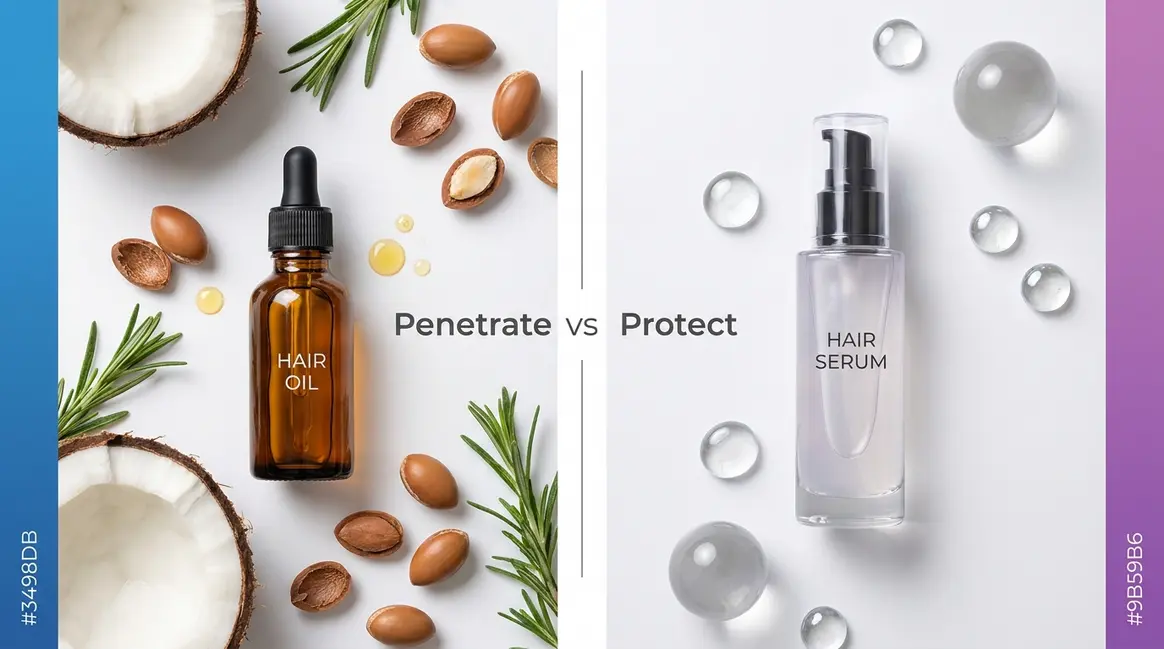
“I ended up buying both the Hair Serum and Hair Oil but not sure which one to try first. Reading their descriptions, they both seem to do the same thing…”
Sound familiar? You’re not alone — and you’re definitely not using them wrong on purpose. The problem is that most product labels are written for people who already know the difference. When navigating the hair oil vs hair serum debate, many people feel overwhelmed. If you’re starting from scratch with hair oil vs. hair serum, the descriptions genuinely do sound identical.
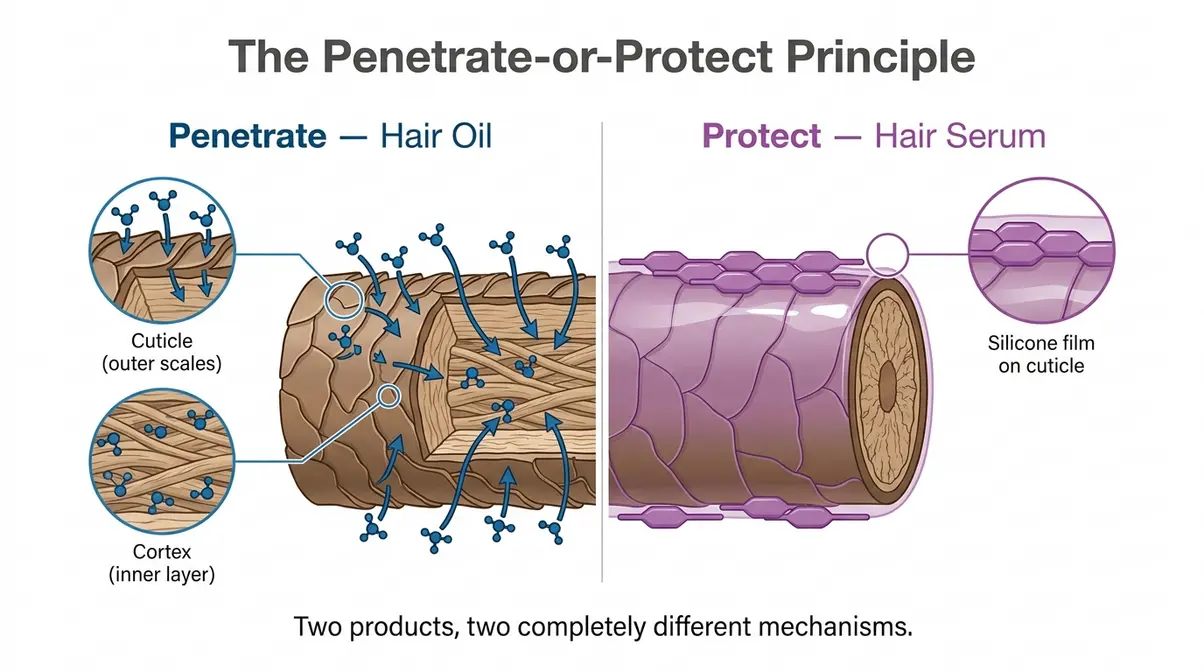
Here’s the truth: these two products work in completely opposite ways. One goes inside your hair strand to nourish it. The other stays on the outside to shield it. Once you understand that single distinction — what we call the Penetrate-or-Protect Principle — the right choice becomes obvious. This guide walks you through exactly what each product does, which one your specific hair needs, and how to layer them together for the best possible results.
Quick Verdict
Hair oil wins for: Deep nourishment, scalp health, damage repair, and hair growth.
Hair serum wins for: Frizz control, heat protection, instant shine, and styling hold.
Key difference: Oil penetrates the hair shaft to nourish from within; serum coats the surface to protect from outside damage.
Can you use both? Yes — and you should. Full layering guide below.
Recommended Products
| # | Image | Product | Best For |
|---|---|---|---|
| 1 |  |
Olaplex No.7 Bonding Oil | Heat-damaged hair repair |
| 2 | No products found. | Moroccanoil Treatment Original | Dry, frizzy, thick hair |
| 3 | No products found. | Mielle Organics Rosemary Mint Oil | Scalp health, hair growth |
| 4 | No products found. | OGX Argan Oil of Morocco | Everyday shine, fine hair |
| 5 | No products found. | L’Oréal Paris Elvive Serum | Frizz control, color-treated |
| 6 | No products found. | TRESemmé Keratin Smooth Serum | Heat styling protection |
| 7 | No products found. | CHI Silk Infusion Serum | Fine hair, lightweight shine |
| 8 |  |
Kenra Platinum Silkening Mist | Detangling, daily smoothing |
Understanding hair oil vs. hair serum comes down to one principle: does your hair need nourishment from the inside, or protection on the outside?
- The Penetrate-or-Protect Principle: Oils absorb into the hair shaft for deep conditioning; serums coat the cuticle for surface protection and shine.
- Use both together: Apply oil first on damp hair, then serum on top as a finishing product — this sequence maximizes both benefits.
- Hair porosity matters: Low-porosity hair benefits more from lightweight serums; high-porosity hair craves rich, penetrating oils.
What Is Hair Oil?
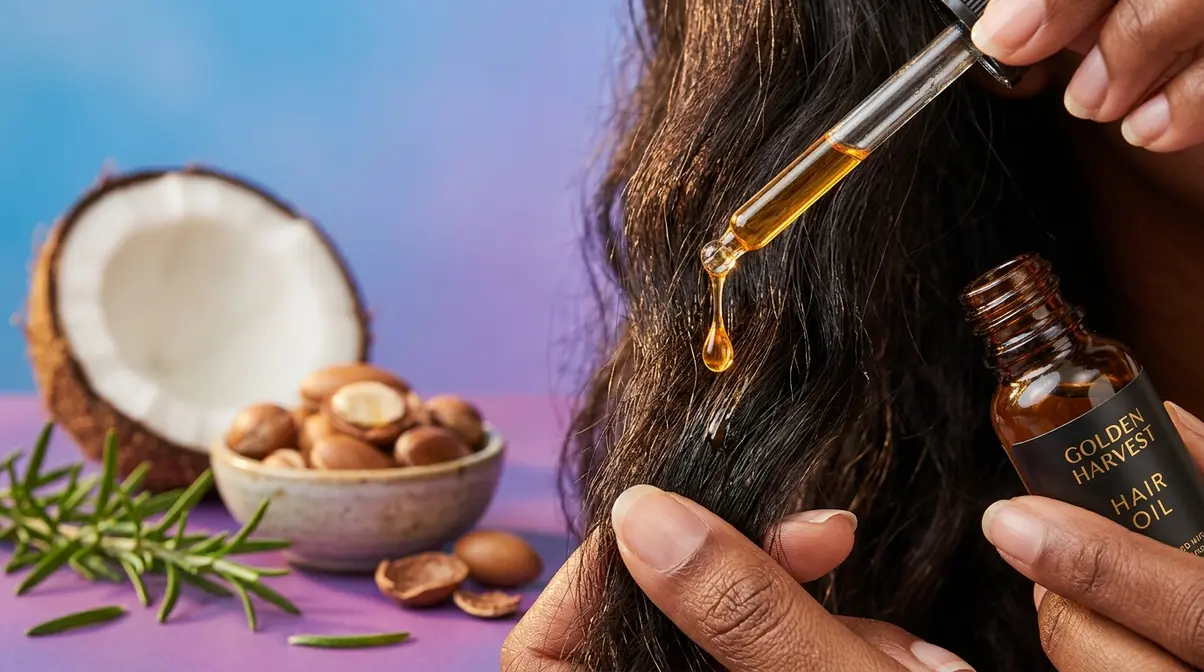
Hair oil is a restorative and nourishing treatment — its primary job is to feed your hair from the inside out. Unlike a styling product you apply and forget, a good hair oil actually travels into the hair strand itself and works at a structural level. Research published in the Journal of Cosmetic Science confirms that certain oils — particularly coconut oil — have a molecular structure small enough to penetrate the cortex (the inner layer of the hair shaft), reducing protein loss during washing (Rele & Mohile, Journal of Cosmetic Science, 2003).
Think of hair oil like a vitamin pill for your hair: it doesn’t just sit on top — it actually gets absorbed and does repair work from within.
How Hair Oil Works: The Science of Penetration
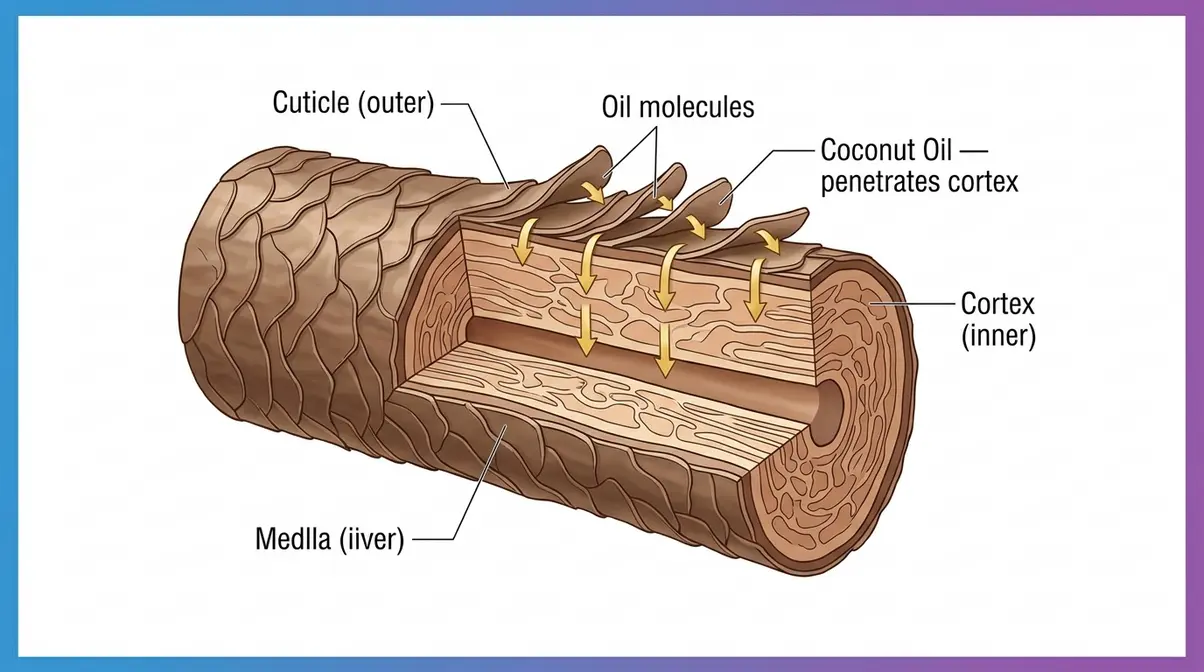
Every hair strand has three layers. The outermost is the cuticle (picture fish scales or roof tiles overlapping each other — that’s exactly what it looks like). Beneath that is the cortex, which gives hair its strength and elasticity. Some oils are small enough at a molecular level to slip between those cuticle scales and reach the cortex.
Coconut oil is the most studied example. Because of its low molecular weight and straight carbon chain structure, it penetrates deep into the hair shaft rather than just coating it. Research from the Journal of Cosmetic Science found coconut oil reduced protein loss in both damaged and undamaged hair by up to 39% compared to mineral oil and sunflower oil, which primarily stay on the surface (Rele & Mohile, 2003). Argan oil, while heavier, also penetrates to a meaningful degree and adds elasticity.
This is why hair oil is considered a treatment rather than a styling product. If you’re wondering about hair oil vs serum and which is the best for your hair, understanding this penetration mechanism is the first step. It works best applied before washing (a “pre-poo” treatment), overnight as a deep conditioning mask, or on damp hair as a leave-in nourisher.
Key Ingredients Found in Hair Oils
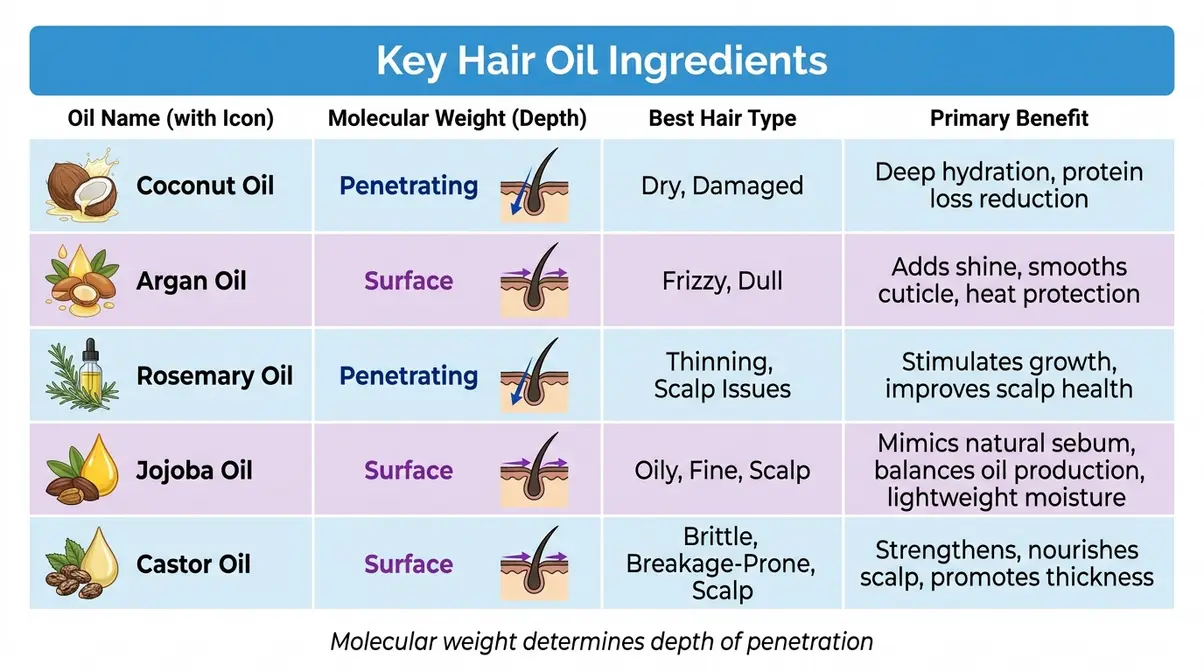
Not all hair oils are created equal. Some are pure, single-ingredient oils; others are blended formulas. Here’s what to look for:
- Coconut oil — Penetrates the hair shaft, reduces protein loss, strengthens from within. Best for dry, damaged, or normal hair.
- Argan oil — Rich in fatty acids and vitamin E; adds elasticity and shine while partially penetrating the cuticle. Works for most hair types.
- Rosemary oil — A scalp-stimulating oil with emerging research supporting hair growth (more in the Growth section below).
- Jojoba oil — Technically a liquid wax that closely mimics the scalp’s natural sebum (oil). Lightweight and non-greasy; excellent for fine hair.
- Castor oil — Thick and deeply moisturizing; best for high-porosity or very dry hair. Can feel heavy on fine hair.
Which Hair Types Benefit Most from Oil
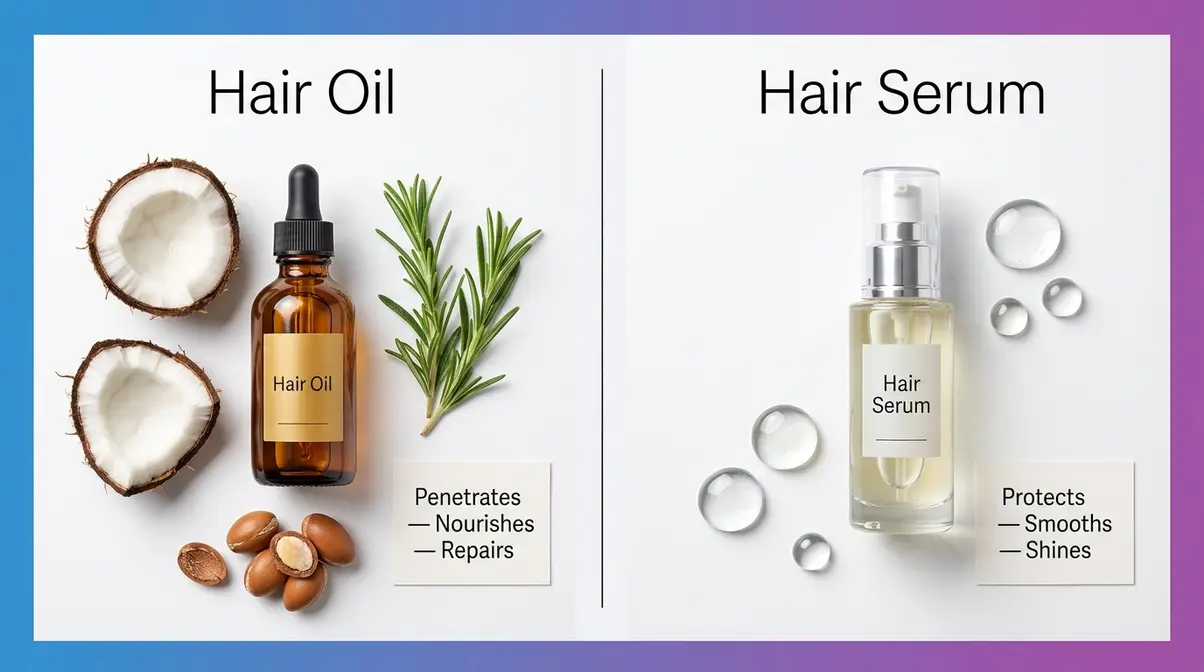
Hair oil delivers the most noticeable results for:
- Dry or dehydrated hair — Oil replenishes lipids (natural fats) that daily washing and heat styling strip away.
- Damaged or chemically treated hair — Bleached, permed, or relaxed hair has a compromised cuticle layer; oil helps seal gaps and reduce breakage.
- Coarse or thick hair — Heavier oils like castor or coconut absorb well into dense strands without making them feel weighed down.
- High-porosity hair — Hair that absorbs moisture quickly but loses it just as fast benefits from oil’s ability to fill in gaps in the cuticle and lock moisture in.
Fine or low-porosity hair can also use oil — but lighter options (jojoba, a few drops of argan) work better than heavier formulas.
What Is Hair Serum?
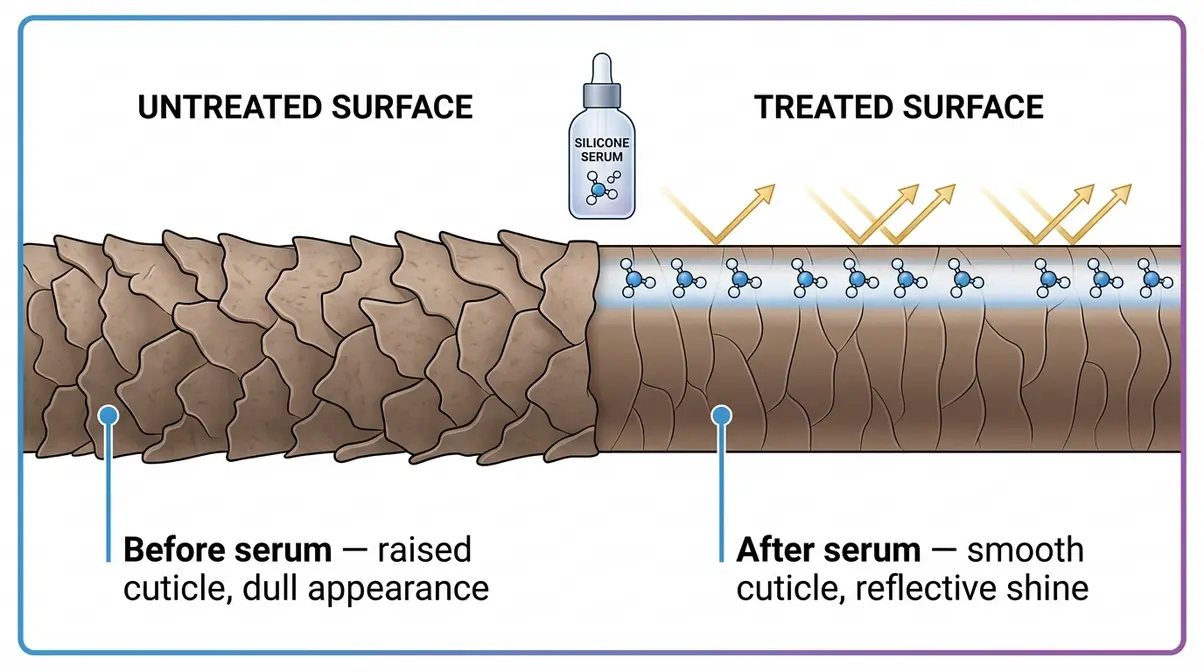
Hair serum is a finishing product for styling — its job is to create a smooth, protective barrier on the outside of your hair strand. Where oil goes in, serum stays out. Most serums are silicone-based, which means they contain ingredients like dimethicone (a smooth, slippery silicone polymer) or cyclomethicone (a lighter, fast-evaporating silicone). These form a thin film over the cuticle that reflects light (hello, shine), repels humidity (bye, frizz), and shields the strand from heat damage.
A review published in the International Journal of Trichology describes silicone-based hair products as forming “a thin hydrophobic film” over the hair fiber that smooths the cuticle surface and reduces friction — which is precisely why serum makes hair look glossy and feel silky (Draelos, Int J Trichology, 2010).
Think of serum as a raincoat for your hair. It doesn’t change what’s happening inside the strand — it creates a shield so the outside world can’t damage it.
How Hair Serum Works: The Science of Surface Coating
When you smooth a silicone-based serum through your hair, the silicone molecules align along the cuticle surface. This does three things simultaneously:
- Smooths the cuticle — Raised or rough cuticle scales scatter light and create a dull, frizzy appearance. Silicone flattens them, which is why hair looks instantly shinier.
- Repels humidity — The hydrophobic (water-repelling) film prevents moisture from the air from swelling the hair shaft, which is the root cause of frizz.
- Reduces heat damage — The film acts as a buffer between your hair and hot tools, lowering the effective temperature the strand experiences.
This is why serums are classified as protective products rather than nourishing ones. They don’t repair existing damage — they prevent new damage from occurring and improve the appearance of the hair you already have.
Key Ingredients Found in Hair Serums
| Ingredient | What It Does | Best For |
|---|---|---|
| Dimethicone | Forms a thick, long-lasting protective film | Frizz control, heat protection |
| Cyclomethicone | Lightweight silicone; evaporates partially | Fine hair, everyday shine |
| Phenyl trimethicone | High-gloss, reflective silicone | Intense shine, smooth blowouts |
| Keratin (protein) | Temporarily fills gaps in the cuticle | Damaged, porous hair |
| Panthenol (Pro-Vitamin B5) | Attracts and retains moisture | Dry hair needing hydration boost |
| Amino acids | Strengthen the hair shaft surface | Color-treated, brittle hair |
Which Hair Types Benefit Most from Serum
Hair serum is the go-to product for:
- Frizzy hair — The humidity-blocking film is the most effective non-prescription tool for taming frizz, particularly in humid climates.
- Fine or thin hair — Lightweight serums add shine and smoothness without the weight that oils can sometimes create.
- Color-treated hair — Silicone forms a protective barrier that helps preserve color vibrancy and prevents moisture from swelling color-treated strands.
- Heat styling enthusiasts — If you blow-dry or flat-iron regularly, serum is your first line of heat defense.
- Low-porosity hair — Hair that resists moisture absorption often benefits more from a serum’s surface-level smoothing than from an oil trying (and failing) to penetrate a tightly closed cuticle.
Hair Oil vs. Hair Serum: Side-by-Side Comparison
The fastest way to understand hair oil vs. hair serum is to see them side by side. Here’s how they compare across every dimension that matters to your routine:
| Feature | Hair Oil | Hair Serum |
|---|---|---|
| Primary Function | Nourish and repair from within | Protect and smooth from outside |
| How It Works | Penetrates the hair shaft (cortex) | Coats the cuticle surface |
| Target Area | Hair shaft interior + scalp | Outer cuticle layer only |
| Key Ingredients | Coconut, argan, jojoba, rosemary, castor | Dimethicone, cyclomethicone, keratin, panthenol |
| Texture | Liquid to thick; feels like natural oil | Lightweight gel or liquid; feels silky or slippery |
| Best For | Dryness, damage, breakage, growth | Frizz, heat protection, shine, styling |
| When to Apply | Pre-wash treatment or on damp hair | On damp or dry hair, after oil |
| Hair Types | Dry, damaged, coarse, high-porosity | Fine, frizzy, color-treated, low-porosity |
| Scalp Use? | Yes — many oils benefit the scalp | No — avoid scalp application |
| Can Cause Buildup? | Yes, if over-applied (especially coconut) | Yes — silicone buildup without clarifying shampoo |
The Penetrate-or-Protect Principle Explained
Here’s the framework that makes everything click: The Penetrate-or-Protect Principle states that every hair care product either works inside the strand or outside it — and choosing the right one means asking which level your hair needs help at right now.
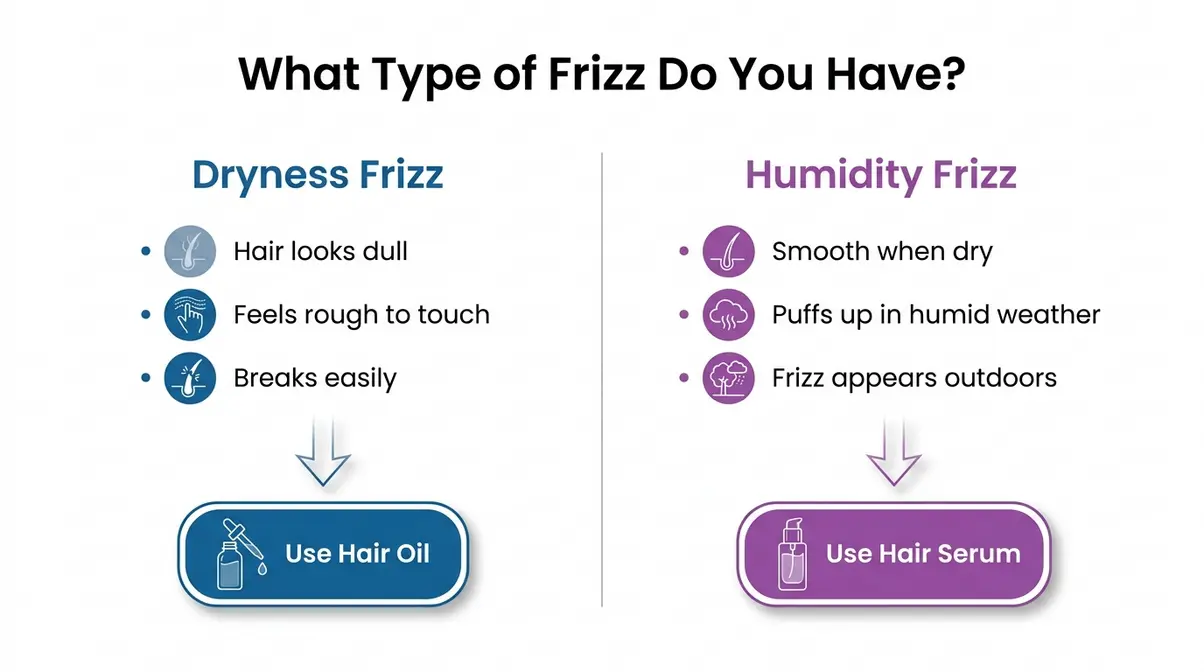
If your hair feels dry, brittle, or breaks easily, the damage is happening inside the strand. That’s a penetration problem. Reach for oil.
If your hair looks dull, frizzy, or feels rough to the touch, the issue is at the surface of the strand. That’s a protection problem. Reach for serum.
If both are happening — which is common — you use both products in the right order (oil first, serum second). That’s the whole game.
Texture, Weight, and Feel: What to Expect
One of the most common fears beginners have is making their hair greasy or weighed down. Here’s how to read each product’s texture before you apply it:
Hair oil feels exactly like you’d expect — oily. Some are thin and watery (argan, jojoba); others are thick and dense (castor, coconut when solid). The key is using the right amount: typically 2–4 drops for fine hair, 4–6 drops for medium hair, and up to 8–10 drops for thick or coarse hair. Too much of any oil will make hair look greasy. Start with less than you think you need.
Hair serum usually feels slippery or silky — almost like a thin gel or a very light lotion. It spreads easily and should not feel heavy. If your serum feels thick or tacky, you’ve used too much. A pea-sized amount is enough for most hair lengths. Serums are designed to be lightweight frizz control tools, not heavy coating agents.
Timing: When to Reach for Each Product
Timing is everything with these two products:
- Hair oil before washing (pre-poo): Coat dry hair with oil 30 minutes to overnight before shampooing. This creates a protective barrier that reduces protein loss during washing — the technique backed by the coconut oil penetration research above.
- Hair oil on damp hair (post-wash treatment): Apply 2–6 drops to towel-dried hair before air-drying or blow-drying. The moisture in the hair helps the oil distribute evenly.
- Hair serum on damp hair (post-wash): Apply after your oil (if using both) on damp hair before styling. The serum locks in the oil’s moisture and adds its protective film.
- Hair serum on dry hair (touch-up): A small amount smoothed over dry hair tames flyaways, adds shine, and protects before heat styling.
Which Product Is Right for Your Hair Goals?
Now that you understand the science, let’s get specific. Here’s how to choose between hair oil vs. hair serum based on your exact concern.
Battling Frizz: Oil vs. Serum for Frizzy Hair
For frizzy hair, serum is usually your first line of defense. Frizz is caused primarily by humidity — water vapor from the air penetrates the hair shaft, causing it to swell unevenly. Silicone-based serums create a hydrophobic (water-repelling) barrier that physically blocks humidity from reaching the strand. The American Academy of Dermatology recommends using leave-in conditioners and smoothing serums as part of a frizz-reduction routine, particularly for chemically treated or heat-damaged hair (AAD, 2026).
That said, oil has a role here too. If your frizz comes from dryness rather than humidity — meaning your hair is parched and the cuticle is raised because it’s desperately seeking moisture — a penetrating oil like argan or coconut can address the root cause. Across professional styling communities, the consistent recommendation is to combine both: oil for internal moisture, serum for external humidity defense.
The bottom line: serum controls frizz on the surface; oil prevents frizz from forming due to dryness. Dry + frizzy hair benefits from both.
Repairing Damage: Oil vs. Serum for Damaged Hair
For damaged hair, oil is the treatment and serum is the maintenance. Damage happens inside the hair shaft — heat styling, chemical processing, and over-washing break down the hair’s internal protein structure (keratin) and strip away the natural lipid layer that keeps strands flexible and strong.
Hair oil addresses this directly. Coconut oil’s ability to penetrate the cortex and reduce protein loss by up to 39% makes it one of the most evidence-backed tools for damaged hair repair (Rele & Mohile, Journal of Cosmetic Science, 2003). Regular pre-wash oil treatments — applying oil to dry hair before shampooing — can meaningfully reduce the cumulative damage from washing over time.
Serum, on the other hand, doesn’t repair existing damage. But it prevents new damage from occurring. Used before heat styling, a silicone serum forms a thermal buffer that reduces the direct heat load on the strand. For damaged hair, the ideal routine is: oil treatment to repair, serum to protect going forward.
Promoting Growth: Oil vs. Serum for Hair Growth
For hair growth, oil wins clearly — but the type of oil matters. Hair growth serums exist, but most commercial serums are surface-coating products that don’t affect the scalp or follicle. Hair growth happens at the follicle level, which is beneath the scalp — surface coating does nothing there.
Rosemary oil, however, has real research behind it. A 2015 randomized controlled trial published in Skincare Dermatology found that rosemary oil applied to the scalp performed comparably to 2% minoxidil (a common hair-loss treatment) in promoting hair growth over a 6-month period, with fewer side effects like scalp itching (Panahi et al., 2015, NCBI PMC). This makes rosemary oil one of the most evidence-backed natural options for thinning hair.
Other oils that show scalp benefits include peppermint oil (shown to increase follicle depth in animal studies) and castor oil (widely used in professional communities for scalp massage, though human clinical data is limited). The key is consistent scalp application — not just running oil through the lengths.
Quick Decision Guide: Which One Do You Need?
Use this simple decision path:
- Start here → Is your main concern dryness, breakage, or hair growth?
- Yes → Use hair oil (penetrating treatment for internal nourishment)
- No → Is your main concern frizz, dullness, heat damage, or styling?
- Yes → Use hair serum (protective coating for surface results)
- Both apply → Use both — oil first, serum second (layering guide below)
By hair type:
| Hair Concern | Best Choice | Why |
|---|---|---|
| Dry, brittle, breaking | Hair Oil | Penetrates to restore internal lipids |
| Frizzy in humidity | Hair Serum | Blocks humidity at the cuticle surface |
| Damaged from bleach/heat | Both (oil first) | Oil repairs; serum protects from future damage |
| Fine, limp, no shine | Lightweight Serum | Adds shine without weight |
| Thinning or slow growth | Scalp Oil (rosemary) | Stimulates follicles beneath the scalp |
| Color-treated | Serum + light oil | Serum preserves color; oil restores moisture |
How to Layer Hair Oil and Serum Correctly
The most common question after understanding the difference is: which one goes first? The answer follows directly from the Penetrate-or-Protect Principle — and it’s non-negotiable if you want both products to work.
The Step-by-Step Layering Routine (for All Hair Types)
You’ll need: Your chosen hair oil, your chosen hair serum, a wide-tooth comb, and a towel. Total time: ~5 minutes.
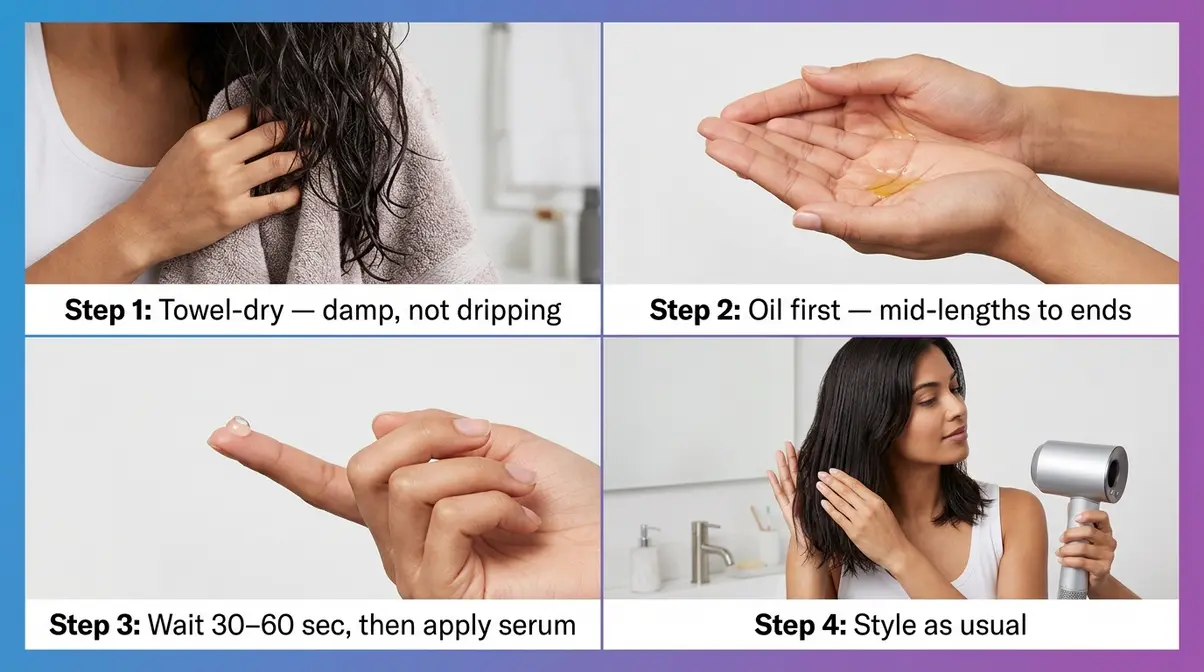
- Wash and condition your hair as normal. Towel-dry gently — press, don’t rub. Hair should be damp (not dripping wet) before applying either product.
- Apply hair oil first. Warm 2–6 drops between your palms and smooth through the mid-lengths and ends of your hair. Avoid the roots if your scalp gets oily easily. The oil absorbs into the damp strand and begins its penetrating work.
- Wait 30–60 seconds. This gives the oil time to begin absorbing before you layer the serum on top. Applying serum immediately can prevent the oil from penetrating fully.
- Apply hair serum second. Dispense a pea-sized amount (about the size of a small grape) onto your fingertips and work through the same sections — mid-lengths to ends. The serum coats over the oil, locking in moisture and adding its protective film.
- Style as usual. Blow-dry, air-dry, or use heat tools. The oil has nourished the inside; the serum is now protecting the outside.
Why this order matters: If you apply serum first, the silicone film forms a barrier on the cuticle — and then the oil you apply second can’t get through. You’ve just trapped your oil on the outside where it sits and makes hair greasy. Oil in, serum out. Always.
Applying on Damp Hair vs. Dry Hair
Both products can be used on dry hair, but they work differently depending on timing:
- On damp hair (recommended):
- Oil distributes more evenly and absorbs more readily when the cuticle is slightly open from washing.
- Serum locks in the moisture from the damp hair as it dries, boosting hydration.
- This is the optimal window for the full oil-then-serum routine.
- On dry hair (touch-up use):
- Oil on dry hair is best used sparingly for scalp massage, overnight treatments, or smoothing split ends. Apply too much and it looks greasy.
- Serum on dry hair works well for taming flyaways, adding shine before an event, or creating a heat-protection layer right before styling. Use half the amount you’d use on damp hair.
When applying hair serum after a hair wash, the sweet spot is towel-dried, still-damp hair — not soaking wet, not fully dry.
Layering by Hair Porosity: Low, Normal, and High
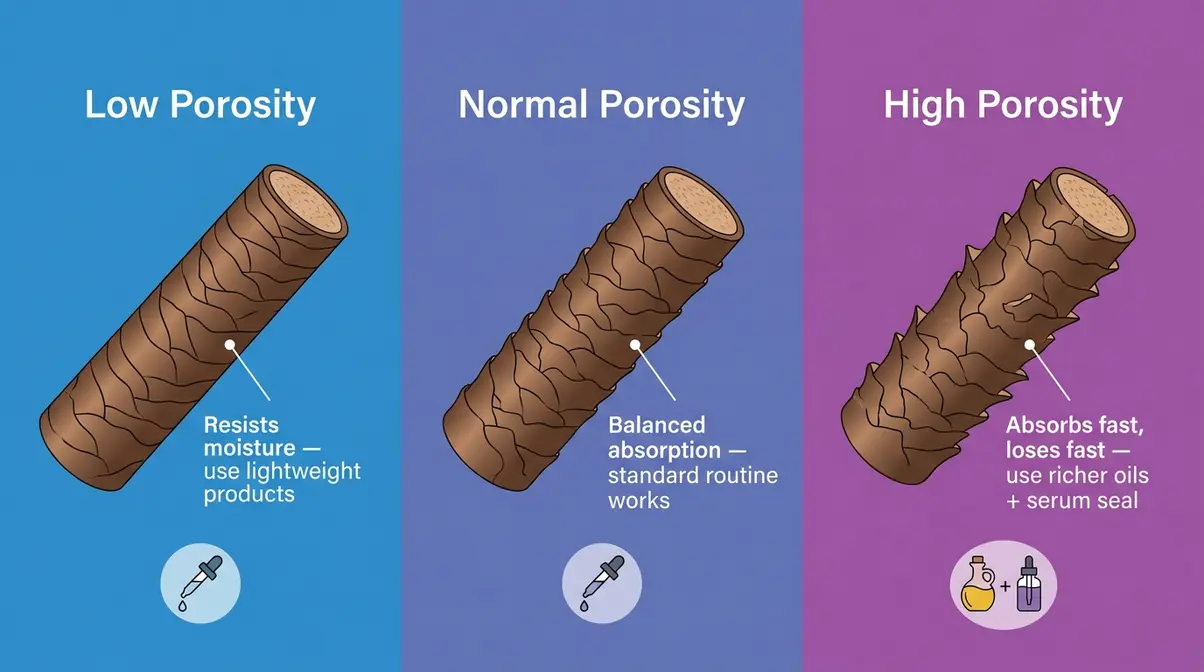
Hair porosity (how easily your hair absorbs and retains moisture) is one of the most important — and most ignored — factors in choosing between oil and serum. The Cleveland Clinic notes that hair porosity affects how well products penetrate the hair shaft and should guide product selection for best results (Cleveland Clinic, Hair Care Guide, 2026).
Here’s how to adjust your routine by porosity:
- Low-porosity hair (tightly closed cuticles that resist moisture absorption):
- Your cuticle doesn’t let much in — heavy oils will just sit on top and make hair greasy.
- Best approach: Use lightweight oils only (jojoba, a few drops of argan). Apply on warm, damp hair (heat opens the cuticle slightly). Prioritize serum for daily use.
- Routine: Light oil on damp hair → lightweight serum → style.
- Normal-porosity hair (balanced absorption and retention):
- The standard layering routine works perfectly for you. Use the oil-then-serum approach described above.
- Routine: 3–5 drops of your preferred oil → pea-sized serum → style.
- High-porosity hair (gaps in the cuticle from damage, bleaching, or genetics — absorbs quickly but loses moisture just as fast):
- Your hair drinks up oil readily, which is good. But it also loses that moisture quickly.
- Best approach: Use richer oils (coconut, castor, argan). The LCO method works well here: Leave-in conditioner → Cream or oil → Oil sealant. Finish with a serum to seal everything in.
- Routine: Leave-in conditioner → richer oil → smoothing serum → style.
Popular Brand and Ingredient Comparisons
Understanding the science is one thing. Knowing which specific products to reach for — and how popular options actually compare — is where theory becomes a real routine. For a deeper dive into specific formulated options, check out our Wella Professionals Oil Reflections Luminous Smoothing Oil review.
Trader Joe’s Hair Serum vs. Hair Oil: What Reddit Users Say
Trader Joe’s has developed a cult following for its affordable hair care line, and the serum vs. oil debate is one of the most-discussed topics in beauty communities. Across Reddit threads in r/HaircareScience and r/beauty, the consistent pattern is that users with fine or oily hair prefer the Trader Joe’s Nourish Spa Argan Oil Serum for daily use (lightweight, non-greasy, adds shine), while those with dry or coarse hair find the Trader Joe’s Marula Oil more effective for deep moisture.
User consensus from these communities consistently shows that the serum is better as a finishing product for quick smoothing, while the oil works better as an overnight or pre-wash treatment. Neither product is “better” in absolute terms — they serve different functions, which is exactly what the Penetrate-or-Protect Principle predicts. The serum is a surface protector; the oil is a penetrating nourisher.
The Ordinary Multi-Peptide Serum vs. Rosemary Oil
This comparison is particularly interesting because it illustrates the difference between a formulated serum and a pure functional oil. The Ordinary Multi-Peptide Serum for Hair Density contains peptides (short chains of amino acids) and caffeine designed to support scalp health and hair density — it’s applied directly to the scalp, not the hair lengths. This makes it functionally different from a styling serum.
Rosemary oil, by contrast, is a single-ingredient scalp treatment with direct research backing. The 2015 randomized trial published in Skincare Dermatology (Panahi et al.) that compared rosemary oil to 2% minoxidil found comparable results in hair count after 6 months, with fewer side effects (published study in PMC). For someone focused on hair density and growth, rosemary oil offers strong evidence-based support at a fraction of the cost.
If you’re choosing between these two for hair growth: rosemary oil has more robust clinical evidence; The Ordinary serum offers a multi-ingredient approach that may complement it but isn’t a replacement.
Formulated Serums vs. Pure Oils: Coconut, Argan, and Beyond
The market offers two broad categories: pure single-ingredient oils (100% coconut oil, 100% argan oil) and formulated blends (products that combine multiple oils or add other active ingredients). Each has trade-offs:
| Type | Examples | Pros | Cons |
|---|---|---|---|
| Pure oils | Coconut, argan, jojoba | Minimal ingredients, well-studied | May need mixing for full benefit |
| Formulated oil blends | Moroccanoil Treatment, Olaplex No.7 | Optimized for specific results | More expensive, harder to assess each ingredient |
| Silicone serums | TRESemmé Keratin Serum, CHI Silk Infusion | Instant results, heat protection | Can build up without clarifying shampoo |
| Serum-oil hybrids | Some “hair oil serums” | Dual function in one step | May not do either job as well as dedicated products |
A study published in PMC reviewing hair cosmetics noted that coconut oil is uniquely effective among plant oils due to its lauric acid content and ability to bind to hair proteins — making it the most evidence-backed pure oil for damage prevention (Gavazzoni Dias, Int J Trichology, 2015). Argan oil, while less studied for internal penetration, consistently outperforms in shine and manageability metrics in user testing.
For most beginners, the practical advice is: start with a quality argan oil and a lightweight silicone serum. These two products cover the full Penetrate-or-Protect spectrum without overwhelming your routine or your budget.
When Hair Oil or Serum Might Not Work as Expected
Common Pitfalls
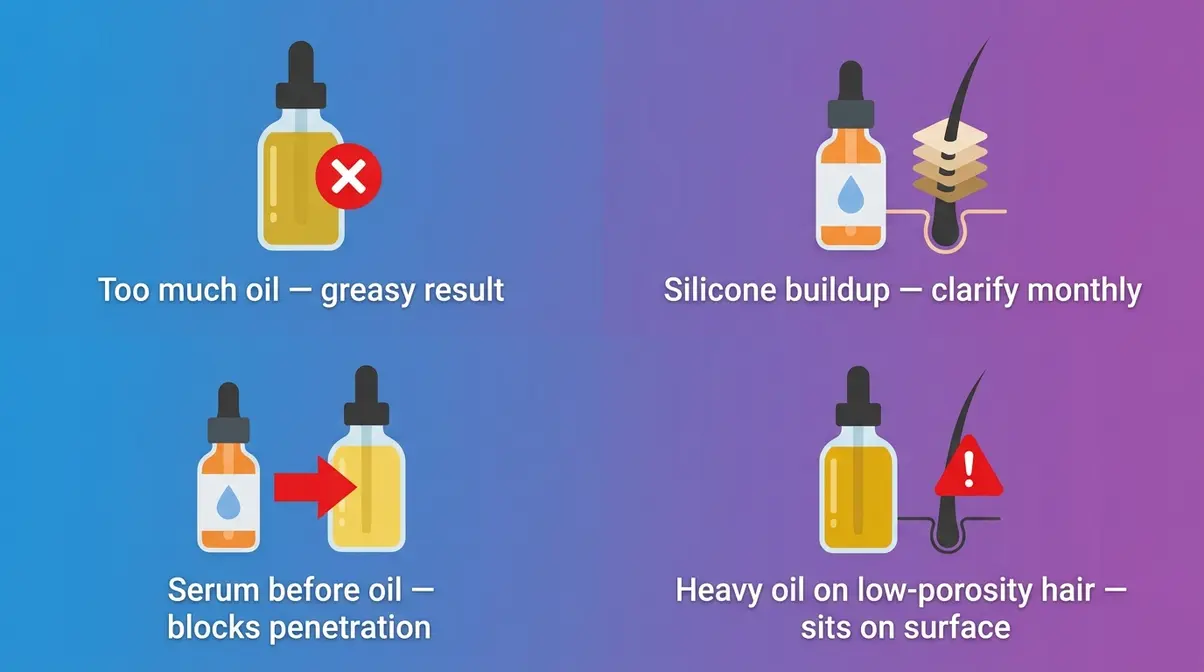
1. Using too much oil and making hair greasy.
This is the most frequent complaint, and it’s almost always a dosage problem. One or two drops too many — especially with heavier oils like coconut or castor — coats the outside of the strand rather than absorbing in. Fix it: start with 2 drops, assess after drying, and only increase if hair still feels dry.
2. Silicone buildup from daily serum use.
Silicone doesn’t wash out with regular shampoo. Over time, daily serum use without a clarifying wash creates buildup that makes hair feel heavy, dull, and unresponsive to other products. Research on hair cosmetic ingredients confirms that silicone polymers accumulate on the fiber surface with repeated use (Draelos, Int J Trichology, 2010). Fix it: use a clarifying shampoo once every 2–4 weeks to reset.
3. Applying serum before oil.
As explained in the layering section, this traps the oil on the surface and prevents penetration. The result: greasy-looking hair with none of the nourishing benefit. Always oil first, serum second.
4. Using heavy oil on low-porosity hair.
Thick oils on tightly closed cuticles have nowhere to go — they just sit on the surface and create grease. If you have low-porosity hair (hair that takes forever to get wet in the shower), stick to lightweight oils and apply them on warm, damp hair.
When to Choose Alternatives
When serum isn’t the right call: If your hair is severely dehydrated or damaged at a structural level, serum will improve the appearance temporarily but won’t address the underlying issue. In this case, prioritize a protein treatment or deep conditioning mask alongside your oil routine before adding serum back in.
When oil isn’t the right call: If your scalp is naturally oily or you have seborrheic dermatitis (a flaky, itchy scalp condition), adding more oil — especially heavy oils — can worsen symptoms. In this case, choose a lightweight scalp serum formulated for sensitive or oily scalps instead. Consult a dermatologist if scalp issues persist.
When to Seek Expert Help
If you’re experiencing significant hair loss, scalp pain, or hair thinning that doesn’t respond to product changes within 3–4 months, the issue may be medical rather than cosmetic. A board-certified dermatologist or trichologist (a specialist in hair and scalp health) can diagnose underlying conditions — like alopecia, thyroid imbalance, or nutritional deficiency — that no hair oil or serum can fix.
Frequently Asked Questions
Which is better, hair oil or hair serum?
Neither product is universally better — they serve different purposes. Hair oil penetrates the hair shaft to nourish from within, making it better for dryness, damage, and hair growth. Hair serum coats the cuticle surface to protect from humidity, heat, and friction, making it better for frizz control and shine. For most people, using both in sequence delivers the best results. The right choice depends entirely on your primary hair concern.
Can I use both hair oil and hair serum?
Yes — using both hair oil and hair serum together is not only safe but recommended for most hair types. The key is applying them in the correct order: oil first on damp hair, serum second. Oil penetrates the strand to nourish from within; serum then coats the surface to lock in that moisture and add protection. Applying them in the wrong order (serum first) prevents the oil from absorbing properly and can leave hair greasy.
What comes first, hair oil or hair serum?
Hair oil always goes first, hair serum always goes second. Apply oil to damp hair and wait 30–60 seconds before adding serum on top. This sequence works because oil needs an open pathway to penetrate the cuticle. If you apply silicone-based serum first, it forms a barrier on the cuticle that blocks the oil from absorbing. Think of it this way: oil is the treatment, serum is the seal.
What are the disadvantages of hair serum?
The main disadvantage of hair serum is silicone buildup with regular use. Silicone molecules don’t wash out with standard shampoo — they accumulate on the hair fiber over time, eventually making hair feel heavy, dull, and product-saturated (Draelos, Int J Trichology, 2010). The fix is a clarifying shampoo every 2–4 weeks. Other drawbacks: serum doesn’t repair damage (it only masks it), and too much can make fine hair limp and flat.
Do I need both hair serum and oil?
Whether you need both depends on your hair’s specific needs. If your hair is only dry or damaged, oil alone may be sufficient. If your hair is only frizzy or needs heat protection, serum alone may be enough. However, most people have more than one concern — dry and frizzy, or damaged and needing styling hold. In those cases, using both products in the oil-first, serum-second sequence covers all bases without adding much time to your routine.
Is oil good for high-porosity hair?
Yes — oil is particularly beneficial for high-porosity hair. High-porosity hair has gaps or damage in the cuticle layer that cause it to absorb moisture quickly but lose it just as fast. Penetrating oils like coconut and argan fill in those gaps and help the hair retain moisture longer. The Cleveland Clinic notes that hair with higher porosity benefits from richer, heavier products that can seal the cuticle (Cleveland Clinic, 2026). Follow with a serum to lock in the oil’s moisture-sealing effect.
The Penetrate-or-Protect Principle
Hair oil and hair serum are not competing products — they’re partners that work at different levels of the same strand. Hair oil penetrates deep into the hair shaft to restore moisture, reduce protein loss, and support scalp health; serum coats the cuticle surface to repel humidity, protect from heat, and deliver instant shine. For most hair types, combining both in the right order — oil first, serum second — delivers results neither product can achieve alone.
The Penetrate-or-Protect Principle gives you a simple decision filter for any hair product you encounter: does it work inside the strand, or outside it? Once you know which layer your hair needs help at, the choice is never confusing again. Dry and damaged hair needs penetration. Frizzy and dull hair needs protection. Hair that’s both needs both.
Start tonight with the basic layering routine: two to four drops of a lightweight oil on damp hair, followed by a pea-sized amount of serum on the same sections. Give it two weeks of consistent use. Across professional styling communities, the consistent finding is that most people see a noticeable improvement in texture and manageability within 10–14 days of adding both products in the correct sequence — not because the products are magical, but because they’re finally being used the way they were designed to work. Ultimately, mastering the hair oil vs hair serum dynamic transforms your routine from guesswork into a targeted science.

Dave King
Writes evidence-based hair-care guides for Care About Your Hair — for every hair type, jargon-free and independent.