 Dave King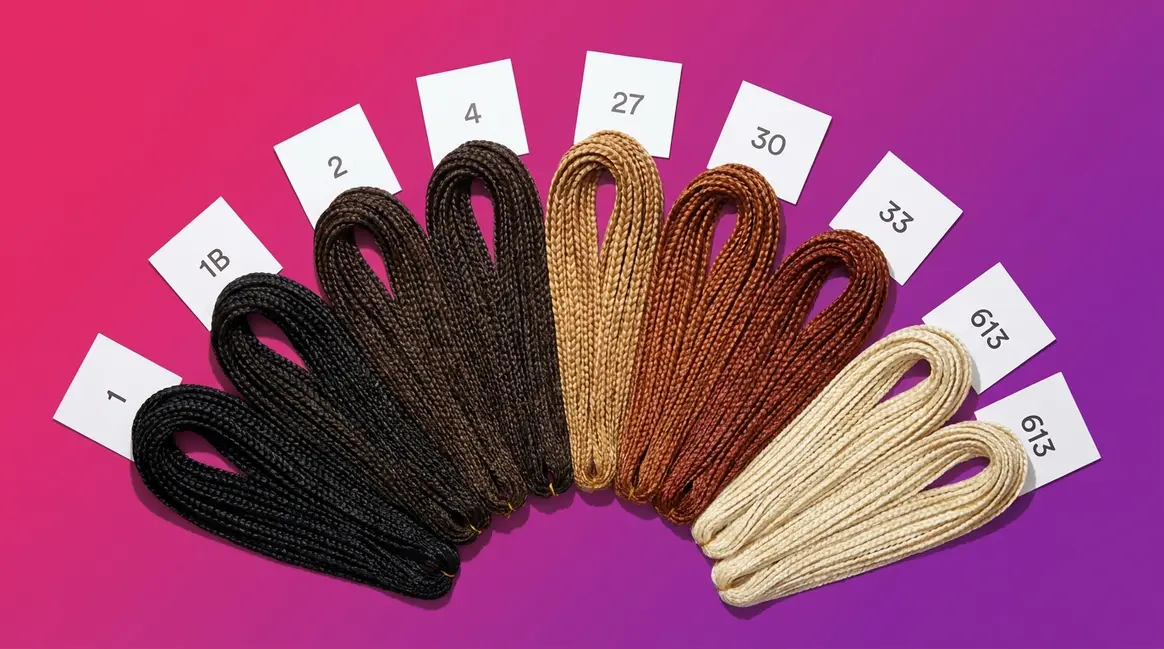
You’re standing in the beauty supply store. The entire wall is stacked with braiding hair — Kanekalon bundles, Xpression packs, Outre boxes — and every single package has a code on it. 1B. 27. 30. 613. T1B/30. You know the style you want, but you have no idea which of those numbers will actually match your vision.
Picking the wrong color is a real problem. Most beauty supply stores don’t accept returns on opened hair. You could spend 6 hours installing a style only to realize the color is nothing like what you imagined. That’s time, money, and frustration you don’t need.
“The most popular color for any twists or braid extensions is 1b, which is black. Next is 27, which is strawberry blonde or honey blonde.”
This guide gives you a complete braiding hair color chart — every standard shade decoded, blend formulas explained, and a brand-by-brand breakdown of the charts from Xpression, Outre, and Sensationnel. By the time you finish reading, you’ll be able to look at any color code on any package and know exactly what you’re getting. The global hair extensions market was valued at over $5.8 billion (Statista, 2023) — that scale of demand is exactly why a universal color numbering system exists, and why learning it pays off every single time you shop.
The braiding hair color chart follows one simple rule — The Shade Spectrum Scale: numbers run from 1 (jet black) to 613 (platinum blonde), with letters like “T” and “B” indicating blends.
- 1B (off-black) is the most popular braiding hair color for protective styles
- Color 27 (honey blonde) is lighter than Color 30 (light auburn/copper)
- Blend codes like T1B/30 mean the color is tipped — dark roots, lighter ends
- Brand charts vary slightly — always check the specific brand’s chart before buying
- Skin undertone matters — warm undertones suit colors 27, 30, and 33; cool undertones suit 1B, 2, and 350
Preparation: What You Need Before Choosing
- Estimated Time: 10-15 minutes to review color charts and match your skin undertone.
- Tools & Materials: A mirror in natural daylight, reference photos of your desired braid style, and access to this braiding hair color chart guide.
What Is the Braiding Hair Color System?
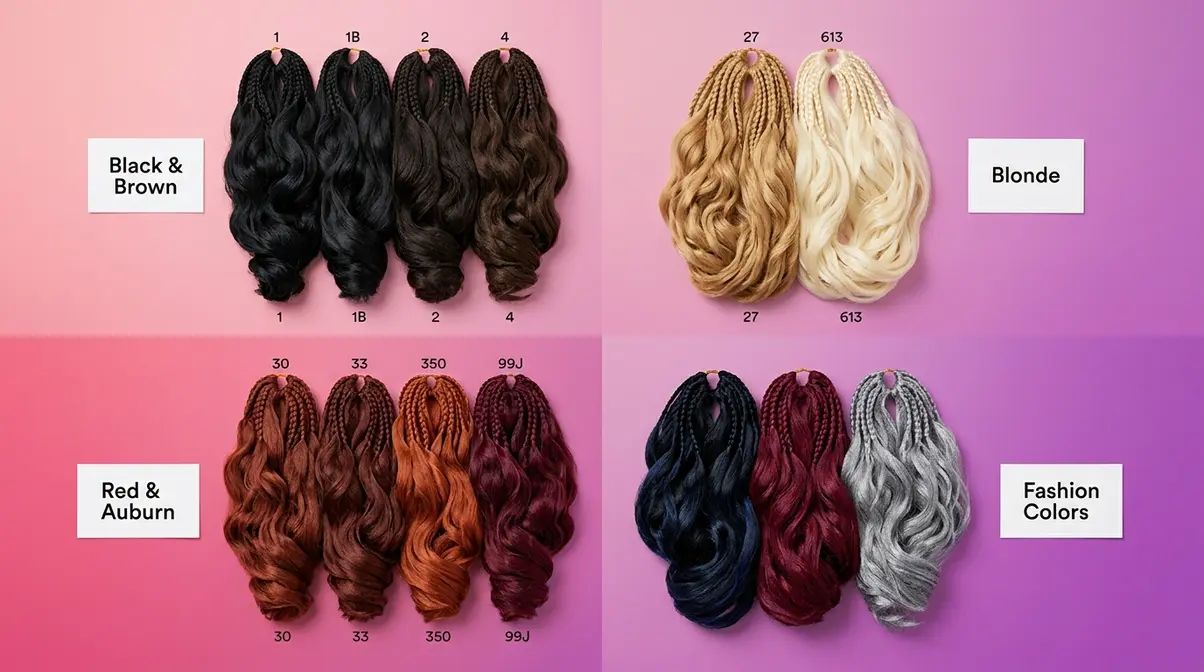
The braiding hair color system is a universal numbering scale — sometimes called The Shade Spectrum Scale — that runs from 1 (the darkest, jet black) to 613 (the lightest, platinum blonde). Every color code you see on a braiding hair package fits somewhere on that scale. Once you understand it, every number becomes readable at a glance, no matter which brand you’re holding.
This system was standardized largely by Kanekalon (the modacrylic fiber brand that established the universal color coding system for synthetic braiding hair). Today, brands like Xpression (one of the most widely available synthetic braiding hair brands), Sensationnel (a leading synthetic hair manufacturer), and Outre (a major braiding hair brand) all use the same core numbering system — with minor brand-specific variations.
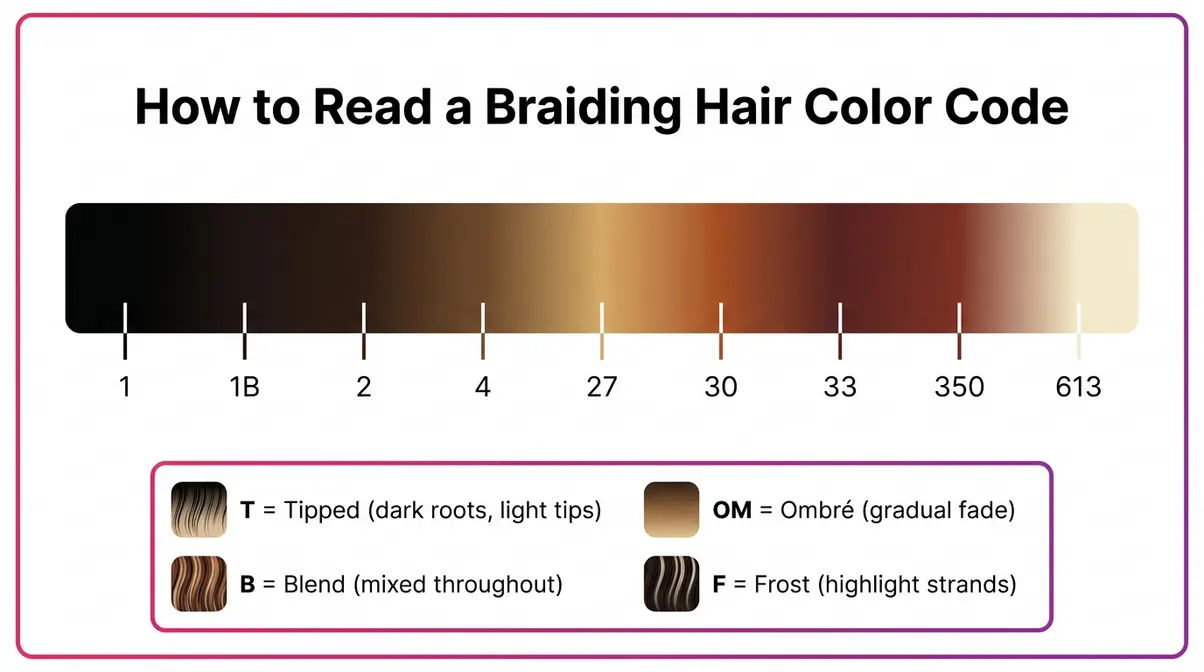
How the Number Scale Works (1 to 613)
Think of the braiding hair color chart numbers like a brightness dial. The lower the number, the darker the shade. The higher the number, the lighter it gets. Here’s the practical breakdown:
- 1–4: Deep black to dark brown (the darkest range)
- 27–33: Medium to warm tones — honey blonde, auburn, copper
- 99J–350: Rich reds, burgundies, and warm auburn-reds
- 613: Platinum blonde — the lightest shade in the standard system
The number alone tells you the base shade. The letters that appear before or after the number tell you how the color is mixed or blended. That combination — number + letter — is everything you need to decode any package.
One important note: the same number can look slightly different between brands. Color 30 from Xpression may read as a deeper auburn than color 30 from Outre, because each manufacturer mixes their dyes independently. The number gives you a reliable starting point, but always check the brand’s specific swatch before buying.
Understanding Prefixes: 1B, T, OM, and More
This is where most beginners get confused — and where most competitors offer zero help. Here’s every prefix type you’ll encounter on a synthetic braiding hair color chart, defined plainly:
| Prefix | What It Means | Example | What You See |
|---|---|---|---|
| B (as in 1B) | Off-black — a softer, warmer black with subtle brown undertones | 1B | Near-black with warmth; mimics natural hair |
| T | Tipped — dark at the roots, lighter color at the tips | T1B/30 | Dark roots fading to auburn at the ends |
| B (blend, as in B27/30) | Two colors mixed evenly throughout the entire strand | B27/30 | Honey blonde and copper woven together |
| OM | Ombré — a gradient that transitions from dark to light | OM1B/27 | Smooth fade from off-black to honey blonde |
| F | Frost — lighter highlight strands woven through a base color | F27/613 | Honey blonde with platinum highlight pieces |
Why does “1B” exist alongside plain “1”? Synthetic hair manufacturers needed to distinguish between true jet black (1) — which reads as very stark and flat — and the softer, warmer off-black (1B) that most people’s natural hair actually looks like. Color 1B mimics the depth and dimension of real hair far better than a flat 1. That’s why user consensus across braiding communities consistently confirms that 1B outsells color 1 by a significant margin for everyday protective styles.
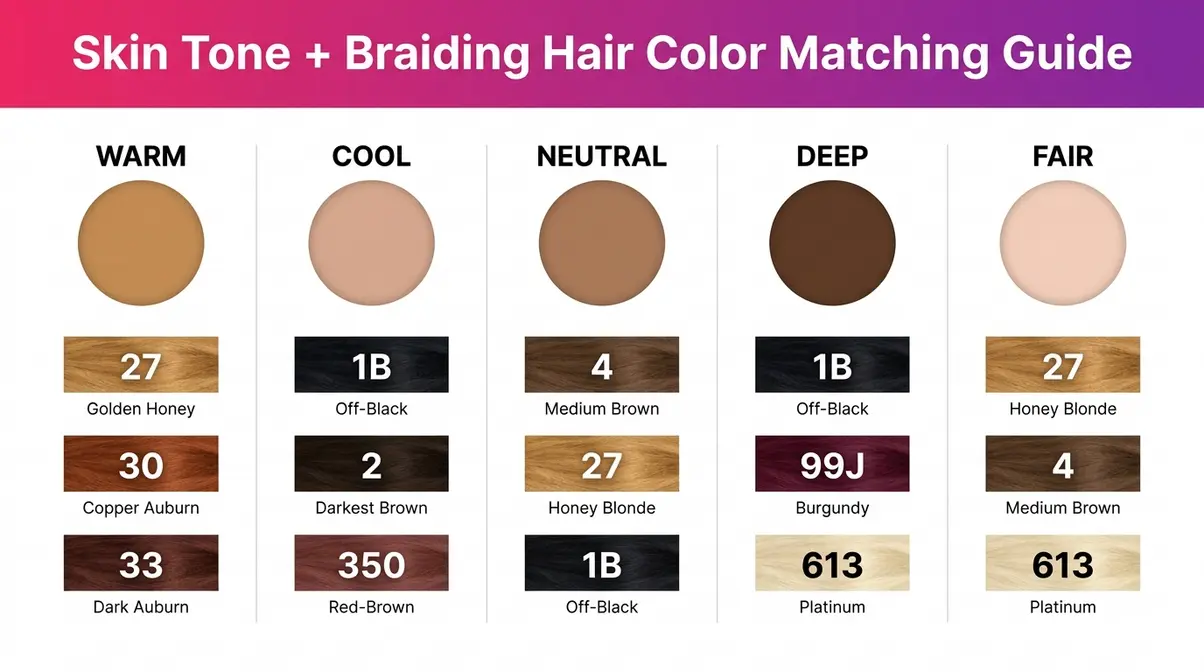
How to Match Colors to Your Skin Tone
Your skin’s undertone — the warm, cool, or neutral quality beneath the surface — has a big influence on which braiding hair colors will look most harmonious on you. Here are five specific recommendations based on undertone type:
Warm undertones (golden, peachy, or olive skin): Colors 27 (honey blonde), 30 (light auburn/copper), and 33 (dark auburn) complement your natural warmth. The golden and red tones mirror your skin’s glow rather than fighting it.
Cool undertones (pink, rosy, or bluish skin): Colors 1B (off-black), 2 (dark brown), and 350 (a deep red-brown with cool burgundy notes) work beautifully. Avoid strong orange-based tones like 30, which can clash with pink-toned skin.
Neutral undertones (a mix of warm and cool): You have the most flexibility. Colors 4 (medium brown), 27, and 1B all work well. Neutral undertones can also pull off fashion colors — like blue-black or burgundy — more easily than either warm or cool types.
Deep skin tones: Rich, high-contrast colors like 1B, 99J (burgundy), and bold fashion colors pop most dramatically. Color 613 (platinum blonde) also creates a striking contrast that many deep-toned clients love.
Fair or light skin tones: Softer shades like 27, 4, or 613 tend to look most natural. Very dark shades like 1 can create a stark, costume-like contrast unless that’s intentional.
Braiding Hair Color Chart: All the Standard Shades
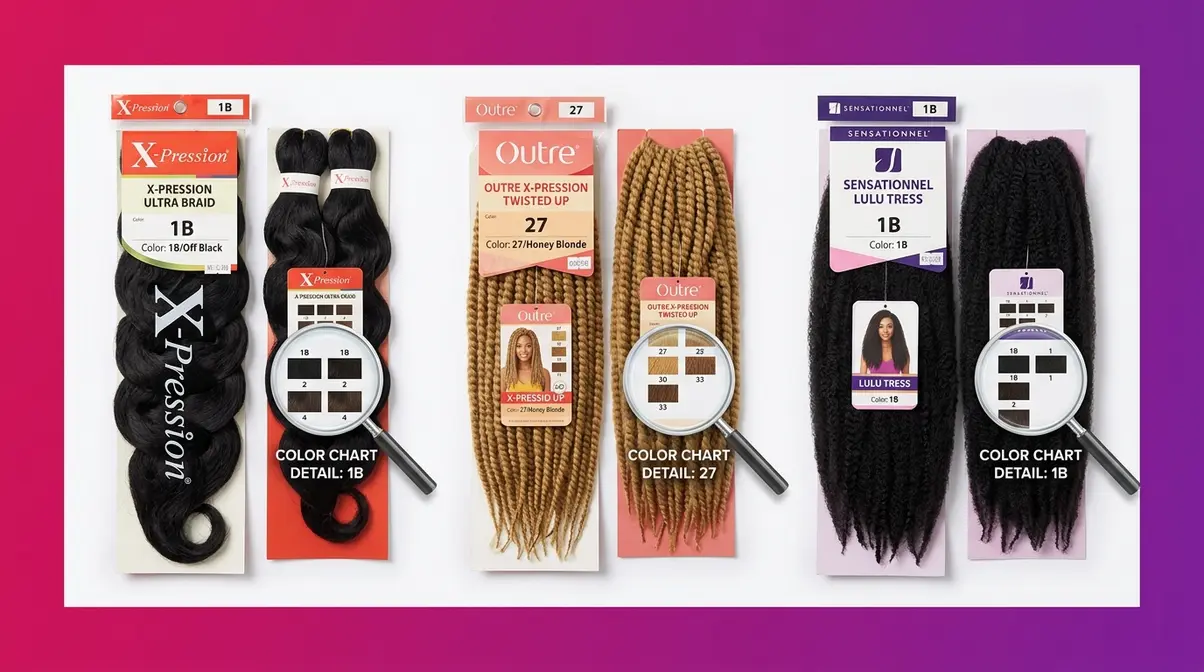
Our analysis of color charts from Xpression, Outre, and Sensationnel shows that roughly 20 core color codes appear across every major brand. These are the shades you’ll encounter on any hair braiding color chart, organized by depth from darkest to lightest.
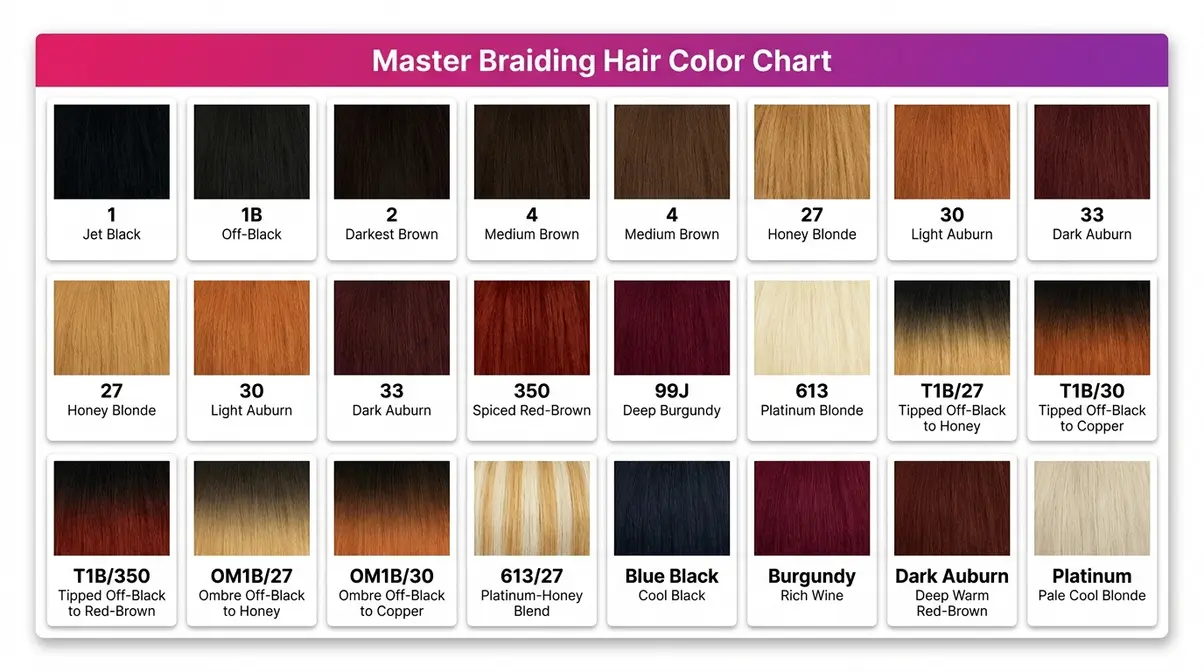
Dark Shades: Colors 1, 1B, 2, and 4
The dark end of the Shade Spectrum Scale covers true blacks and rich browns. These are the most widely purchased colors in braiding hair — and the most important to distinguish from each other.
| Color Code | Plain-English Name | What It Looks Like | Best For |
|---|---|---|---|
| 1 | Jet black | Flat, very dark black — no warmth | High-contrast, bold styles |
| 1B | Off-black / Natural black | Soft black with subtle brown warmth | Everyday protective styles |
| 2 | Darkest brown | Very deep brown — reads nearly black | Natural-looking brown tones |
| 4 | Medium dark brown | Rich, visible chocolate brown | Warm brown braids and twists |
Color 2 in braiding hair is a shade many beginners overlook. It sits right between 1B and a true brown — dark enough to read as near-black in low light, but with enough warmth to look distinctly brown in sunlight. It’s an excellent choice when you want dimension without going fully brown.
Color 4 is your classic chocolate brown. It’s warm, rich, and works especially well on medium to deep skin tones with warm undertones. User consensus across braiding communities confirms that colors 1B and 4 are frequently mixed together to create a natural-looking dark brown ombré effect.
What Color is 2 in Braiding Hair?
Color 2 is the darkest brown in the standard braiding hair system — a very deep, rich brown that reads as nearly black in low light but shows its warm brown quality in daylight. It sits just above 1B on the Shade Spectrum Scale. Color 2 is a popular choice for clients who want a natural-looking dark brown without the starkness of a true black. It blends seamlessly with 1B for a dimensional dark-brown look.
Medium Shades: Colors 27, 30, 33, and 350
This is the most searched section of any braiding hair color chart — and for good reason. Colors 27, 30, 33, and 350 are the heart of the warm-tone range, and they’re close enough together that many people confuse them.
| Color Code | Plain-English Name | Undertone | What It Looks Like |
|---|---|---|---|
| 27 | Honey blonde / Strawberry blonde | Warm golden | Light golden-amber; the classic “blonde” for braids |
| 30 | Light auburn / Medium copper | Warm orange-red | Richer and darker than 27; distinctly copper-red |
| 33 | Dark auburn | Deep warm red-brown | Noticeably darker than 30; rich reddish-brown |
| 350 | Red-brown / Medium auburn | Warm red | Between 30 and 33 in depth; a spiced auburn |
Color 27 braiding hair is the shade most people picture when they say “honey blonde.” It’s warm, golden, and reads as a light blonde in most lighting. It’s one of the top three most purchased braiding hair colors alongside 1B and 30.
Color 30 braiding hair is often described as “medium auburn” or “copper.” It’s warmer and darker than 27 — closer to a cinnamon or light ginger tone than a blonde. In bright light, it reads as a vibrant copper-red. In lower light, it can look like a rich dark auburn.
What Color is 27 Braiding Hair?
Color 27 is honey blonde — sometimes called strawberry blonde — a warm, golden-amber shade that reads as a light blonde in most lighting. It’s one of the most popular braiding hair colors after 1B, known for its warm, sun-kissed quality. Color 27 works especially well on warm and neutral skin undertones. It’s the lighter of the two most-compared shades (27 vs. 30) and the go-to choice when you want a bright, golden look without going as light as 613 (platinum blonde).
Light Shades: Color 613 and Platinum Tones
Color 613 is the lightest standard shade in the braiding hair numbering system — a cool, pale platinum blonde. It sits at the top of the Shade Spectrum Scale and is the go-to base for any color that needs to read as truly light.
613 is frequently used on its own for a bold platinum look, but it’s even more commonly used as the lighter component in blend codes. When styling with 613 hair color, remember that the 613 is often acting as the highlight or fade-out color. On deep skin tones, 613 creates a high-drama contrast that’s become a staple of editorial and festival braiding styles.
One important note for beginners: color 613 can look very different depending on the brand. Some manufacturers produce a warm, creamy platinum; others go cooler and ashier. If you’re going platinum, always check the brand’s specific swatch or ask your stylist to show you a real-life example before committing.
How to Compare and Blend Braiding Hair Colors
Knowing individual colors is only half the skill. The other half is understanding how colors work together — and how to read the blend codes that tell you exactly what a mixed package contains. This is the section of any color chart for braiding hair that most guides skip entirely.
Color 27 vs. Color 30: Which Is Lighter?
This is one of the most searched questions in the braiding hair community — and the answer is clear: Color 27 is lighter than Color 30.
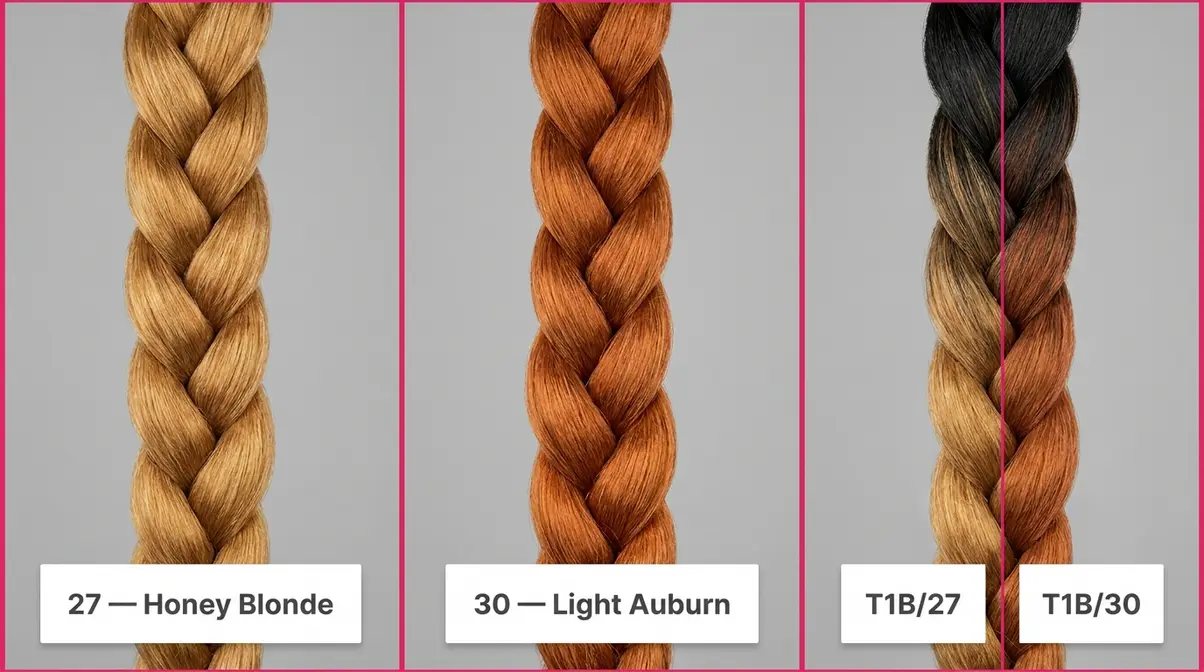
Here’s the direct breakdown:
- Color 27 = honey blonde. Warm, golden, reads as “blonde” in most light. Think of ripe wheat or warm honey.
- Color 30 = light auburn/copper. Darker and redder than 27. Think cinnamon, copper, or light ginger.
The confusion happens because both are in the warm-tone family. But in side-by-side comparisons, color 30 is consistently darker and more orange-red, while color 27 stays in the golden-yellow range. If you’re unsure which to choose, color 27 gives you a lighter, softer result; color 30 gives you more warmth and depth.
Which Is Darker, 27 or 30?
Color 30 is darker than Color 27. On the Shade Spectrum Scale, 30 sits lower (closer to the dark end) than 27. Color 27 is a light honey blonde. Color 30 is a medium copper-auburn. The difference is clear in side-by-side comparisons: 27 has a golden, blonde quality while 30 has a distinctly reddish-orange depth. This is one of the most common points of confusion in the braiding hair community — the answer is consistent across all major brands.
Is Color 30 Ginger or Brown?
Color 30 is closer to ginger than to brown — specifically a warm, light auburn-copper that most people describe as cinnamon or light ginger. It’s not a true brown (that’s color 4 or 33) and not a bright ginger-red (that’s closer to color 130). Color 30 sits right in the middle: a copper-auburn with strong orange-red warmth. In direct sunlight it reads as distinctly ginger. In dimmer indoor light it shifts toward a warm medium brown.
How to Read Blend Codes Like 27/30 and T1B/30
Blend codes are the second language of braiding hair — and once you learn them, every package becomes transparent. Here’s how each notation breaks down:
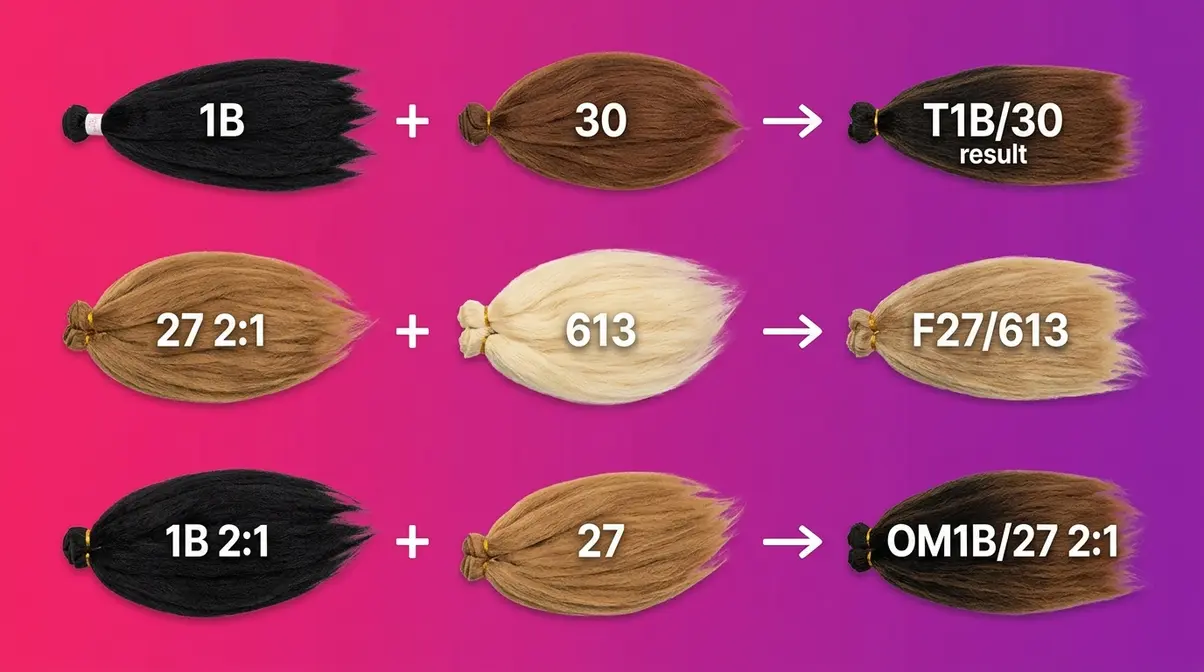
T1B/30 (Tipped): The “T” means tipped. The first color (1B, off-black) runs through most of the strand. The second color (30, light auburn) appears only at the tips — roughly the bottom third of each strand. The result is dark roots with a warm copper fade at the ends. This is one of the most popular ombre blends in braiding hair.
B27/30 (Blended): The “B” means blend. Colors 27 and 30 are mixed evenly throughout the entire strand — you see both tones from root to tip, woven together. The effect is multi-tonal and dimensional, similar to a balayage.
OM1B/27 (Ombré): The “OM” means ombré. The color transitions smoothly from 1B (off-black) at the roots to 27 (honey blonde) at the ends. Unlike tipped (T), which is abrupt, ombré is gradual.
F27/613 (Frosted): The “F” means frost. Thin highlight strands in color 613 (platinum) are woven through a base of color 27 (honey blonde). The result looks like natural sun-kissed highlights.
Top Color Blend Formulas for a Custom Look
These blend formulas come from community practice across braiding forums and professional stylists — they’re the combinations that consistently produce the most natural-looking results. Each formula lists a ratio and the visual effect you can expect.
| Blend Formula | Ratio | Visual Effect | Best Skin Tone Match |
|---|---|---|---|
| 1B + 30 | 2:1 (dark:light) | Dark base with warm copper ends | All tones |
| 1B + 27 | 2:1 | Off-black with honey blonde tips | Medium to deep |
| 27 + 30 | 1:1 | Rich honey-copper blend | Warm undertones |
| 4 + 27 | 1:1 | Chocolate brown with golden highlights | Warm to neutral |
| 1B + 4 | 1:1 | Dark natural brown dimension | All tones |
| 30 + 33 | 1:1 | Deep copper-auburn blend | Warm to deep |
| 1B + 350 | 2:1 | Dark base, warm auburn tips | Neutral to deep |
| 27 + 613 | 2:1 | Honey blonde with platinum highlights | Fair to medium |
| 613 + 27 | 1:2 | Platinum-dominant with golden warmth | Deep for contrast |
| 1B + 99J | 2:1 | Black with deep burgundy dimension | Deep to neutral |
How to use these formulas at the store: Buy the number of packs your stylist recommends (usually 5–8 for box braids), then split the ratio. For a 2:1 formula with 6 packs total, buy 4 packs of the first color and 2 packs of the second. Your stylist will alternate strands or sections during installation to achieve the blended effect.
Braiding Hair Colors by Family
If you know the vibe you want but not the specific number, shopping by color family is the fastest path to the right shade. Here’s how the braiding hair color numbers break down by family — a different way to navigate the same Shade Spectrum Scale.
Black and Brown Shades
The black-and-brown family covers colors 1, 1B, 2, and 4. These are the foundation shades — the most purchased, the most versatile, and the most forgiving if you’re unsure.
1 and 1B are your blacks. Use 1 for a stark, high-contrast look. Use 1B (off-black) when you want something that reads as natural and dimensional. For most protective styles — box braids, knotless braids, twists — 1B is the default recommendation because it mimics the depth of real hair better than a flat jet black. If you are specifically shopping for 1B hair, you will find it is the most abundant option in any beauty supply store.
2 and 4 are your browns. Color 2 is nearly black in low light but shows its warmth in sunlight. Color 4 is a clear, rich chocolate brown that works beautifully for a natural-looking brown braid install. Both are excellent base colors for blend formulas.
Blonde Shades for Braiding Hair
The blonde family in braiding hair runs from the warm, golden tones of color 27 through the bright copper of 30, all the way up to the pale platinum of 613. This is a wide family — “blonde” in braiding hair covers a much broader range than it does in traditional hair color.
Key blonde shades to know:
- 27 — honey blonde / strawberry blonde (warm golden)
- 613 — platinum blonde (cool, pale)
- F27/613 — frosted honey-platinum blend
- 144 — dark golden blonde (deeper than 27, warmer than 30)
A blonde braiding hair color chart from any major brand will typically show at least 6–8 shades in this family. If you are transitioning from a natural dark blonde hair color, a 27/613 blend is often the sweet spot. If you want a bright, light look, start with 27 or 613. If you want warmth without going too light, 144 or a 27/613 blend gives beautiful dimension.
Red, Auburn, and Burgundy Shades
The red family is one of the most dynamic on the Shade Spectrum Scale — and one of the most misunderstood. Here’s how the key shades stack up:
| Color Code | Family | Plain-English Name |
|---|---|---|
| 30 | Red | Light auburn / copper |
| 33 | Red | Dark auburn |
| 350 | Red | Medium red-brown / spiced auburn |
| 130 | Red | Bright copper-red |
| 99J | Burgundy | Deep wine-burgundy |
| Burgundy | Burgundy | Rich purple-red |
| Dark Auburn | Auburn | Deep warm brown-red |
99J is the star of the burgundy family. It’s a deep, jewel-toned wine color — dark enough to read as almost black in dim lighting, but rich and vivid in bright light. It’s a popular choice for fall installs and for clients who want color without going too far outside a natural-looking palette.
130 is the brightest red in the standard system — a vivid copper-red that reads as fire-engine adjacent. If you typically use a vibrant red hair dye on your natural hair, matching it with 350 or 130 braiding hair will give you the most seamless blend.
Fashion and Vibrant Colors
Beyond the numbered natural shades, most major braiding hair brands offer a fashion color range — shades that don’t follow the 1–613 numbering system and instead use descriptive names. These vary by brand but commonly include:
- Blue Black — a 1B base with a cool, deep blue sheen
- Midnight Blue — a vibrant, visible navy-blue
- Purple — ranges from soft lavender to deep violet
- Silver/Grey — a cool ash tone that’s become popular for “granny chic” styles
- Ombre Fantasy Colors — brand-specific blends like teal-to-purple or pink-to-blonde
Fashion colors are not part of the universal numbering system, so you’ll need to refer to each brand’s specific chart for these shades. The Outre color chart and Sensationnel color chart both include their fashion color ranges alongside the standard numbered shades.
Brand-by-Brand Braiding Hair Color Charts
The numbered color system is universal, but the execution is brand-specific. Our review of color charts from Xpression, Outre, and Sensationnel shows that the same color number can vary noticeably in warmth, depth, and saturation depending on the manufacturer. Here’s what to know about each major brand.
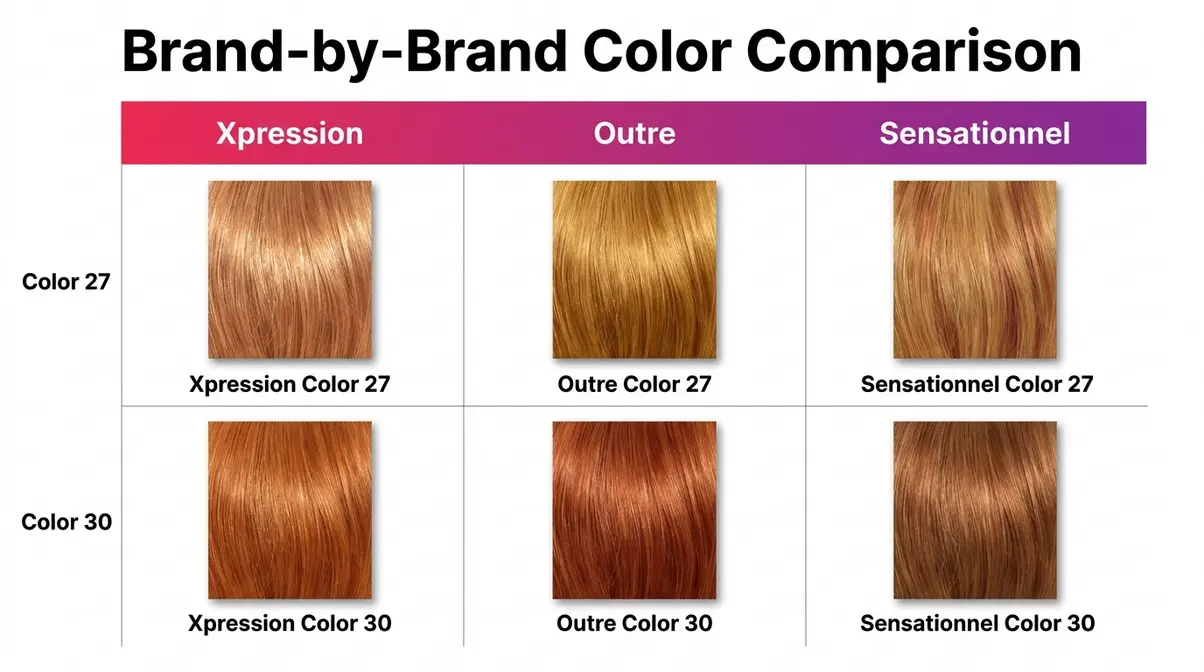
Xpression Braiding Hair Color Chart
Xpression is one of the most widely stocked braiding hair brands in the world, and its color range is the closest thing to a universal standard that the industry has. The Byrdie guide to the standard numbering system covers all core shades from 1 through 613, which perfectly illustrates the Xpression lineup.
What makes Xpression distinctive: the brand’s 1B tends to run slightly cooler and darker than some competitors — it’s a very clean off-black with minimal brown warmth. Its color 30 reads as a medium copper-auburn, slightly more orange than Outre’s version of the same shade. Xpression also offers a wide range of tipped (T) and ombré (OM) blends as standard stock items in most beauty supply stores.
Key Xpression shades to know: 1B, 27, 30, T1B/27, T1B/30, OM1B/27, 613, and 99J are typically available in all major retail locations.
Outre Braiding Hair Color Chart
Outre produces several braiding hair lines — including X-Pression Ultra Braid and Outre X-Pression Kanekalon — each with its own color range. The Outre color chart is available on their official website and shows swatches for every shade in their lineup.
Outre’s color 27 tends to run slightly more golden and less orange than Xpression’s version — many users describe it as a “true honey blonde” rather than a strawberry blonde. Outre’s 30 is a warm copper-auburn, very similar to Xpression but with slightly more red depth. The brand also offers a broader fashion color range than most competitors, including pastels and vivid fantasy shades.
Key Outre shades to know: 1B, 27, 30, 33, T1B/30, OM1B/27, 99J, Burgundy, and Blue Black.
Sensationnel Braiding Hair Color Chart
Sensationnel is known for its African Collection braiding hair, and its color chart reflects a strong focus on natural-looking shades alongside its fashion range. Sensationnel’s 1B is often noted in braiding communities as slightly warmer than Xpression’s — with a softer, more brown-leaning off-black quality.
One standout feature of the Sensationnel color system: the brand labels some of its shades with descriptive names alongside the numbers (e.g., “Honey Blonde” for 27, “Copper Auburn” for 30), which makes it slightly easier for beginners to navigate. If you’re shopping Sensationnel for the first time, this labeling system is a helpful bridge between the numbers and the plain-English names.
Key Sensationnel shades to know: 1B, 2, 4, 27, 30, 33, 350, 99J, T1B/27, T1B/30, and 613.
Other Popular Brands: Freetress, Rastafri, Ruwa, and More
Beyond the top three, several other brands have loyal followings and their own color charts worth knowing:
Freetress — Freetress uses the same standard numbering system and is known for consistent color accuracy. Its color 27 and 30 are considered reliable benchmarks by many DIY braiders. The Freetress braiding hair color chart is available through most major beauty supply retailers.
Rastafri — Rastafri is popular for its soft, lightweight texture and extensive color range. The Rastafri braiding hair color chart includes all standard shades plus several unique blend codes not found on other brands’ charts. Color 30 from Rastafri is noted for running slightly more auburn (less orange) than the Xpression version.
Ruwa — Ruwa braiding hair is a budget-friendly option with a standard color range covering 1B through 613. The Ruwa color chart is more limited than Xpression or Outre, but covers all the most popular shades reliably.
Janet Collection, Model Model, and Bobbi Boss — These brands all use the standard numbering system and offer official color charts on their websites. Color accuracy across these brands is generally consistent with the universal scale, though fashion colors vary significantly.
The consolidated takeaway: The numbered shades (1B, 27, 30, 613, etc.) are reliable across all these brands. The differences show up most in fashion colors and in the exact warmth or saturation of mid-range shades like 30 and 350. When in doubt, check the brand’s official swatch or compare in-store under good lighting.
Common Mistakes When Choosing Braiding Hair Colors
Even with a complete braiding hair color chart in hand, a few common errors trip up DIY braiders every time. Here’s what to watch for — and when the smartest move is to call in a professional.
3 Common Color Pitfalls to Avoid
Pitfall 1: Judging the color by the package photo alone.
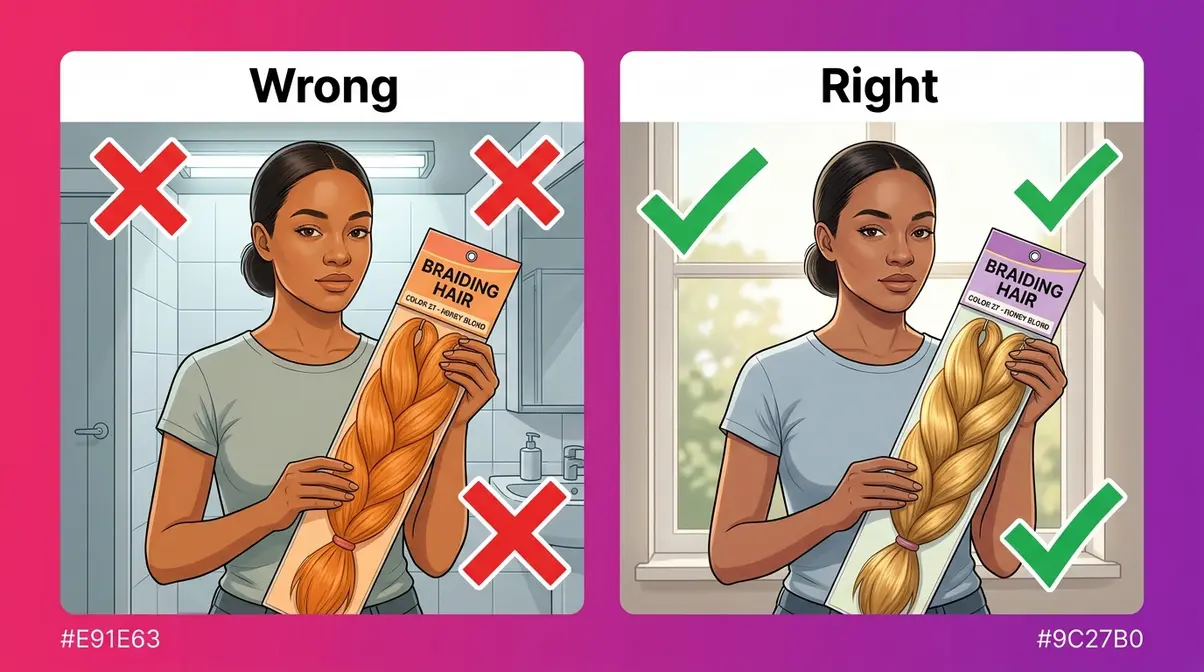
Package photos are shot under controlled studio lighting designed to make colors look their most vibrant. Color 30 on the package can look like a warm copper — but in your bathroom under fluorescent lighting, it might read as a flat, orange-ish brown. Always check the brand’s official color chart swatch online before buying, and if possible, view the hair under natural daylight in-store.
Pitfall 2: Buying all your packs from different batches.
Synthetic hair dye lots vary slightly from production run to production run. If you buy 4 packs of color 27 and two of them are from a different production batch, you may notice a slight variation in tone once the style is installed. When buying multiple packs for a single style, pull all packs from the same shelf section and check that the lot numbers or packaging dates match.
Pitfall 3: Confusing color 30 with color 33 or 350.
These three shades are close neighbors on the Shade Spectrum Scale, and their names — light auburn, dark auburn, and medium red-brown — don’t always make the differences obvious. Color 30 is the lightest and most copper-orange. Color 33 is the darkest and most brown-red. Color 350 sits between them with a spiced, red-auburn quality. If you’re aiming for a specific depth, compare the brand’s swatches for all three before deciding.
When to Ask Your Stylist Instead
The braiding hair color chart is a powerful tool — but it has limits. There are specific situations where the right move is to stop guessing and get a professional opinion.
- Ask your stylist when:
- You’re trying to match braiding hair to your natural hair color. Natural hair has dimensional tones that don’t map neatly to a single code. A stylist can assess your natural hair and recommend a blend formula that mimics your specific combination of tones.
- You’re installing a style for a special event. If the color has to be perfect for a wedding, graduation, or photoshoot, the stakes are too high to experiment. A professional can pull the right combination from experience.
- You’re working with fashion or vibrant colors for the first time. Colors outside the numbered system (blues, purples, pastels) vary dramatically between brands and are harder to predict without hands-on experience.
- The color you want requires mixing more than two shades. Blend formulas with three or more colors are difficult to balance without experience — a stylist can create the ratio that works.
Frequently Asked Questions
What color is 30 for braiding hair?
Color 30 is a light auburn or medium copper shade — often described as cinnamon or copper-red. It’s warmer and darker than color 27 (honey blonde) but lighter than color 33 (dark auburn). In bright natural light, color 30 reads as a vivid copper-orange. In lower indoor lighting, it shifts toward a rich warm brown. It’s one of the three most popular braiding hair colors alongside 1B and 27, per community consensus across braiding forums.
What are the colors for braiding hair?
The standard braiding hair color chart covers roughly 20+ core shades. The most common are: 1 (jet black), 1B (off-black), 2 (darkest brown), 4 (medium brown), 27 (honey blonde), 30 (light auburn), 33 (dark auburn), 350 (spiced red-brown), 99J (burgundy), and 613 (platinum blonde). Beyond these, brands offer blend codes (T1B/30, OM1B/27) and fashion colors (blue black, purple, silver). The Byrdie hair color chart guide provides additional context on the universal numbering system.
What color hair makes a 60-year-old look younger?
Warm, lighter shades like color 27 (honey blonde) and soft blend codes like T1B/27 tend to be the most flattering for clients over 60. These warm tones add brightness around the face, which can soften the appearance of fine lines and create a youthful glow. Very dark shades like 1 (jet black) can create a harsh contrast against lighter skin and grey hairlines. Color 4 (medium brown) is another popular choice — warm enough to add vibrancy without looking unnatural.
Can you mix different brands of braiding hair?
Yes, you can mix different brands of braiding hair, but it requires caution. Different manufacturers use slightly different synthetic fibers, meaning the texture and heat resistance might not match perfectly. If you are blending colors, it is always best to stick to the same brand (like using all Xpression or all Outre) to ensure a seamless, uniform finish when the braids are sealed.
Does synthetic braiding hair color fade in the sun?
High-quality synthetic braiding hair generally retains its color very well and resists fading much better than dyed human hair. However, prolonged exposure to harsh sunlight and chlorine can cause slight dullness over time, especially in vibrant fashion colors or bright reds like 350 and 130. For standard shades like 1B or 27, color fading is rarely an issue during a typical 4-to-6-week install.
How do you match braiding hair to your natural roots?
To match braiding hair to your natural roots, examine your hair in natural daylight rather than artificial bathroom lighting. Most natural dark hair is not a true jet black (color 1), but rather a very dark brown, making 1B or color 2 the most accurate match. If your roots have warm undertones, color 2 will blend seamlessly, while 1B provides a cooler, off-black finish.
What is the difference between T-colors and OM-colors?
Both T (Tipped) and OM (Ombré) indicate a transition between two colors on a single strand, but the gradient style differs. Tipped hair (e.g., T1B/30) has a harsh, abrupt line where the dark root suddenly changes to the lighter tip color. Ombré hair (e.g., OM1B/27) features a smooth, gradual fade that blends the two colors seamlessly down the length of the hair.
Can I dye synthetic braiding hair if I pick the wrong color?
No, you cannot use traditional hair dye on synthetic braiding hair. Standard hair dyes are formulated to penetrate the cuticle of human hair, but synthetic fibers like Kanekalon are essentially plastic and will not absorb the color. While some DIY methods exist using acrylic ink and alcohol, the results are often patchy and can ruin the texture of the hair.
Choosing Your Color with Confidence
The braiding hair color chart isn’t complicated once you see the logic behind it. The Shade Spectrum Scale gives you the master key: numbers run from 1 (jet black) to 613 (platinum blonde), and prefix letters — T, B, OM, F — tell you exactly how colors are blended. Every code on every package follows this same system. Our review of color charts from Xpression, Outre, and Sensationnel confirms that while the exact tone of a shade can vary slightly between brands, the numbering logic is consistent across the entire industry.
Use the formulas in this guide as your starting point. Whether you’re going for a clean 1B install, a warm 27/30 blend, or a bold 613 contrast style, the math is simple: find your shade on the scale, check your skin undertone against the matching guide, and verify against the brand’s specific swatch before you buy.
Next time you’re at the beauty supply store, you won’t need to guess. Pull up this guide, find your number, and walk to the checkout with confidence. If you’re planning a new protective style, share this guide with your stylist — the blend formula section alone can save a full consultation.

Dave King
Writes evidence-based hair-care guides for Care About Your Hair — for every hair type, jargon-free and independent.