 Dave King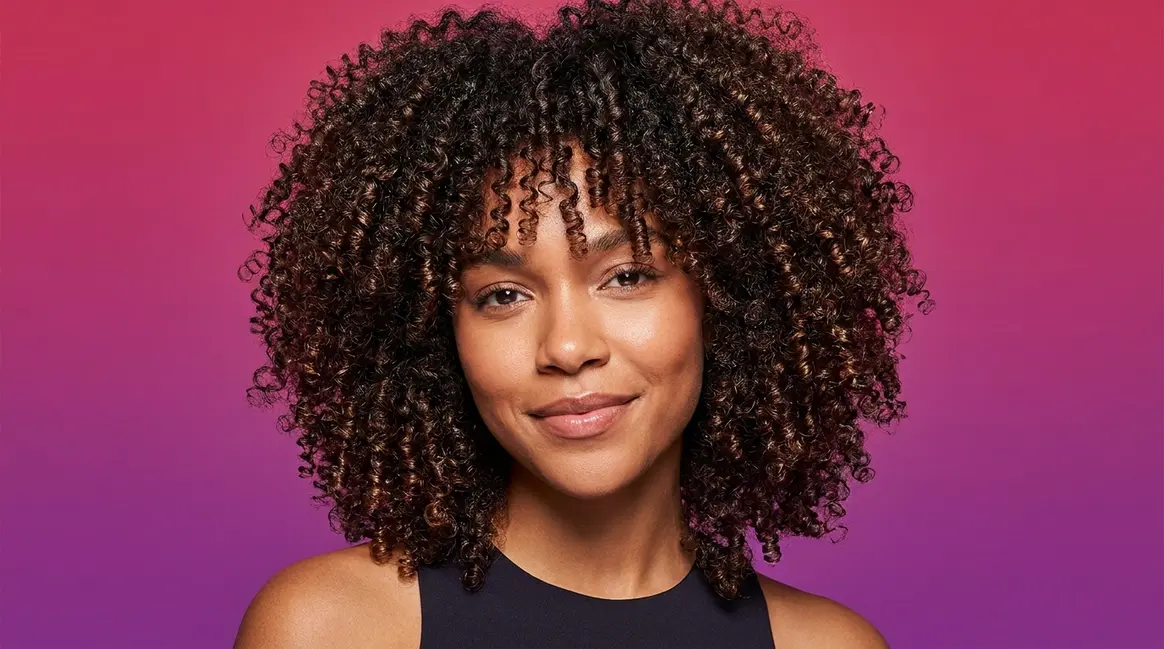
“4A HAIR ADVICE PLEASE — I HAVE NO CLUE WHAT I’M DOING.”
If you’ve ever posted something like that — or just thought it — you are not alone. Millions of people with this coily texture go through the same cycle: buying products that don’t work, watching tutorials that don’t match their curls, and wondering why their hair feels dry by Tuesday.
Every week you spend guessing is another week of breakage, wasted money, and frustration. The wrong shampoo strips your curls. The wrong conditioner leaves white flakes. And generic advice written for wavy or loosely curly hair simply doesn’t apply to your coils — because Type 4A has a specific structural reason for behaving the way it does.
By the end of this guide, you’ll know exactly what this hair type is, how to care for it step-by-step, and which products actually work — so you can stop guessing and start thriving. We’ll cover curl identification, wash-day routines, the LOC method, top product picks, styling tutorials, men’s care, growth strategies, and the most common mistakes to avoid.
4A hair is a tight, S-shaped coily hair type that’s prone to dryness because its curl pattern — “The Coil-Moisture Gap” — prevents natural scalp oils from reaching the ends.
- Curl pattern: Tight S-coils roughly the size of a crochet needle
- Biggest challenge: Chronic dryness requiring intentional moisture layering
- Best care method: The LOC method (Liquid, Oil, Cream) for lasting hydration
- Not the same as: 3C (looser corkscrew) or 4B (Z-shaped, less defined)
- Common for: People of African descent, though not exclusive to any ethnicity
Table of Contents
- What Is 4A Hair?
- Comparing 3C, 4A, 4B, and 4C Hair
- The Complete 4A Hair Care Routine: Step-by-Step
- Best Products for 4A Hair: What Actually Works
- 4A Hair Styling Guide: Tutorials and Hairstyle Ideas
- 4A Hair for Men
- How to Grow 4A Hair
- Common 4A Hair Mistakes to Avoid
- FAQ: Your 4A Hair Questions Answered
What Is 4A Hair? Characteristics & Texture
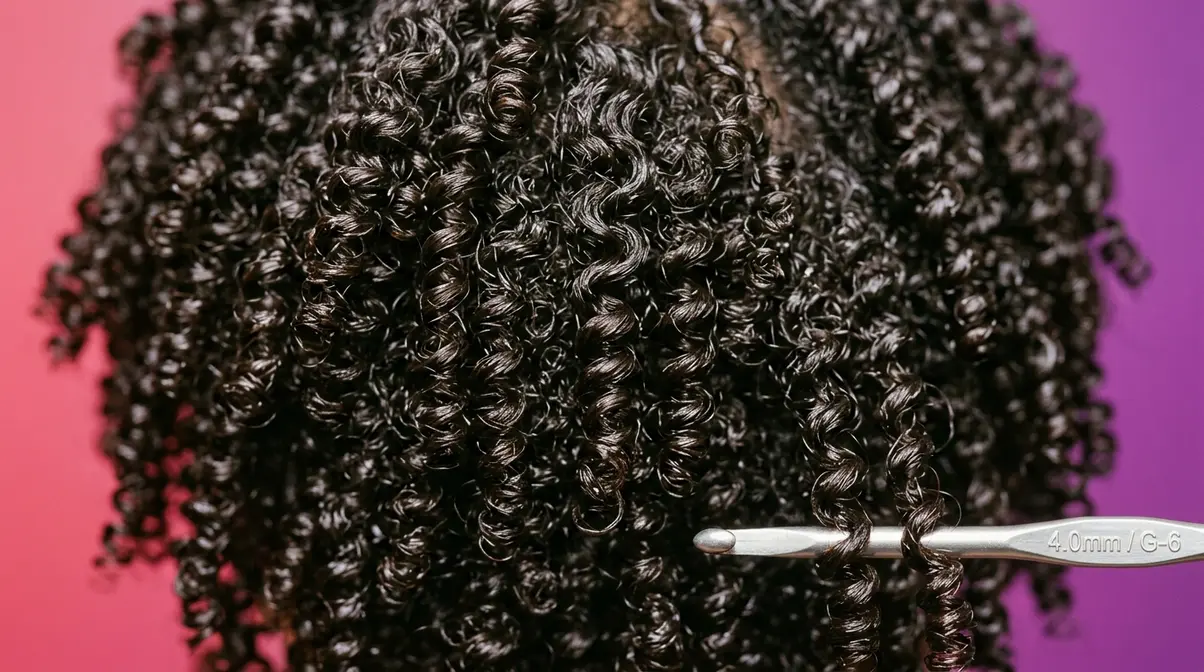
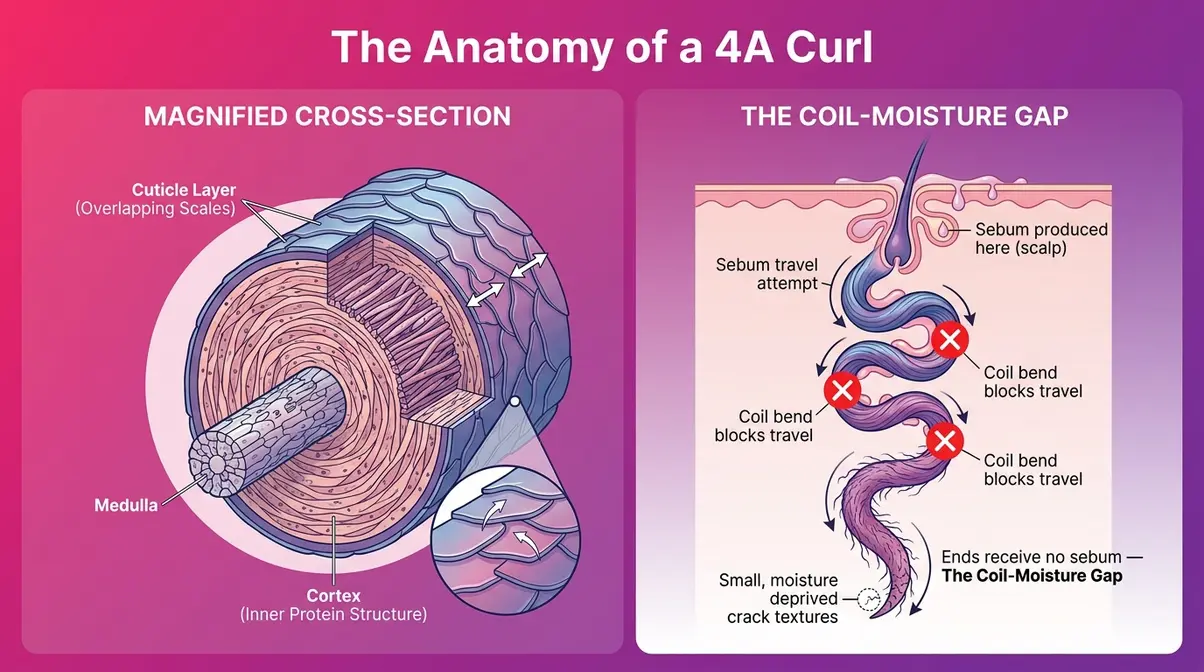
4A hair is a coily hair type defined by tight, S-shaped coils roughly the circumference of a crochet needle — approximately 4–6mm in diameter. It belongs to the Type 4 category of the André Walker Hair Typing System (the classification framework developed by Oprah Winfrey’s longtime hairstylist). What makes these coils unique isn’t just their shape — it’s the structural reality known as “The Coil-Moisture Gap”: the tight S-coil physically prevents sebum (your scalp’s natural conditioning oil) from traveling down the hair shaft, making intentional moisture layering non-negotiable, not optional.
Key characteristics at a glance:
- Tight S-shaped coils, approximately crochet-needle circumference
- High density — many strands per square inch, creating significant volume
- Prone to dryness and shrinkage (up to 75% of actual length when dry)
- Well-defined curl pattern when wet; more voluminous when dry
- Naturally fragile at the curl bends due to uneven moisture distribution
- Responds best to water-based products and sealed moisture layers
- Often confused with 3C (looser) or 4B (tighter, Z-shaped) curl types
What Does 4A Hair Look Like?
This texture shifts dramatically between wet and dry states — and understanding both is essential for identifying your curl type. When wet, the strands form tight, well-defined S-coils that spring back when stretched. When dry, those same coils shrink significantly — sometimes up to 75% of your hair’s actual length — and expand outward into a full, gravity-defying halo of volume.
The coil size benchmark most hair professionals use is a crochet needle (roughly 4–6mm diameter). This is noticeably tighter than 3C hair, which coils around a pencil or straw, but more visibly shaped than 4B hair, which forms a looser Z-pattern with less defined curl structure. Cleveland Clinic notes that Type 4A hair consists of dense, springy, S-shaped coils that require consistent moisture to maintain elasticity and prevent frizz (2026).
Density — the number of individual strands per square inch of scalp — is typically high in this curl type. This creates that characteristic fullness that people in the natural hair community describe as “bigger than expected.” High density combined with tight coils means products need to be applied generously and distributed thoroughly to reach every strand. Understanding 4A hair characteristics helps you choose the right products from the start.
Try the wet test: Wash your hair with no products. Let it air-dry slightly and observe your natural coil shape. If you see clear S-patterns roughly the size of a crochet needle, you very likely fall into this category.
The Science Behind 4A Curl Structure
Here’s what no generic hair guide explains: the curl isn’t just a visual feature. It’s a structural reality that determines how every product and routine should work.
Hair is made of a protein called keratin (the same protein in your fingernails). The shape of each strand is determined by the shape of the follicle — the tiny tube in your scalp from which hair grows. Research published in the Journal of Investigative Dermatology found that elliptical or asymmetrical follicle shapes produce curved and coiled hair, while round follicles produce straight hair. 4A follicles are highly curved, producing that signature S-coil from the root.
Why this matters for moisture: Your scalp produces sebum naturally — roughly 1–2 grams per day across the entire scalp (American Academy of Dermatology, 2026). In straight or wavy hair, sebum travels down the shaft easily, coating and conditioning it along the way. In these tight textures, the S-coil creates multiple sharp bends. Sebum gets “trapped” near the scalp, unable to navigate those bends efficiently. The result is what we call “The Coil-Moisture Gap” — your scalp may be producing enough oil, but your ends are chronically dry because the oil never arrives.
The tight S-coil physically prevents scalp sebum from reaching the ends — a structural reality that makes intentional moisture layering non-negotiable, not optional.
This is why every care recommendation in this guide — sulfate-free shampoo, deep conditioning, the LOC method — exists. They aren’t trends or marketing. They’re direct responses to a measurable structural challenge.
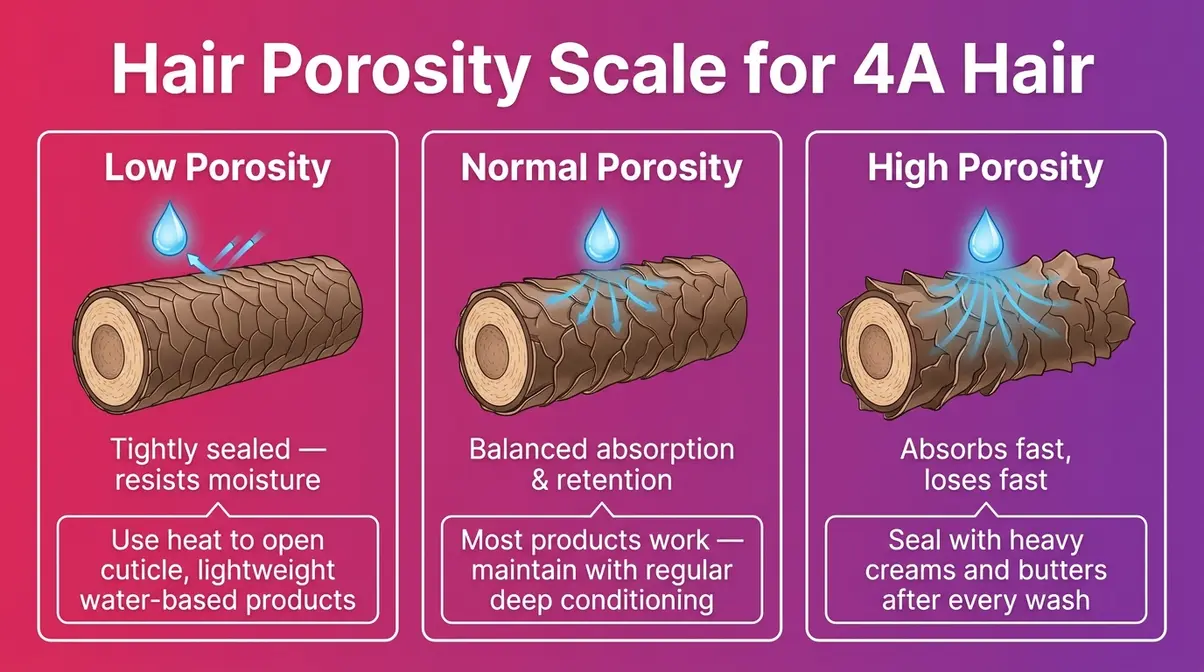
Porosity (how well your hair absorbs and retains moisture) also plays a role. These coils commonly have high porosity — meaning the outer cuticle layer is more open or damaged, absorbing moisture quickly but losing it just as fast. Some strands have low porosity, meaning the cuticle is tightly sealed and resistant to moisture absorption. Pattern Beauty’s guidance on 4A hair notes that identifying your porosity is as important as knowing your curl type.
How to Identify Your Curl Type
Identifying your hair type accurately takes two minutes and zero special tools. Hair care professionals recommend doing this on freshly washed, completely product-free hair.
The identification test:
- Wash your hair with a gentle, sulfate-free shampoo and rinse completely.
- Do not apply any conditioner, oil, or styling product.
- Allow your hair to air-dry for 10–15 minutes.
- Look at a single coil: Is the shape a clear S-curve or more of a Z/angular shape?
- Hold the coil next to a crochet needle. Does it match in diameter?
- If yes to both — you very likely have this texture.
Quick reference: Curl chart
| Characteristic | 4A | 4B | 3C |
|---|---|---|---|
| Curl Shape | S-coil | Z-pattern/angular | Loose corkscrew |
| Coil Size | Crochet needle (4–6mm) | Slightly wider, less defined | Pencil/straw |
| Shrinkage | Up to 75% | Up to 70% | 30–50% |
| Shine Level | Low-medium | Low | Medium-high |
| Porosity | Often high | Often high | Often normal |
Many people have multiple curl types across their head — 4A at the crown, 4B at the nape. This is completely normal. The André Walker system is a communication shorthand, not a rigid scientific category. Use it as a starting point, not a verdict.
Is This Curl Pattern Rare? Who Has It?
This texture is not rare — it is one of the most common hair types among people of African descent worldwide. However, it is significantly less represented in mainstream beauty media, which can make it feel rare or niche when you’re searching for relevant content.
It is most common among people of African, Afro-Caribbean, and African-American descent, though coily and curly hair types appear across many ethnic backgrounds, including some South Asian, Middle Eastern, and mixed-heritage populations. Hair typing is a physical characteristic, not an ethnic identifier — it describes follicle shape, not ancestry.
The natural hair movement, growing strongly since the early 2000s, has significantly increased visibility and representation for Type 4 hair. Today, the natural hair community is one of the most engaged beauty communities online, with dedicated spaces on YouTube, TikTok, and Reddit providing peer support and product reviews specifically for 4A, 4B, and 4C hair types.
3C vs 4A vs 4B vs 4C Hair: How to Tell the Difference
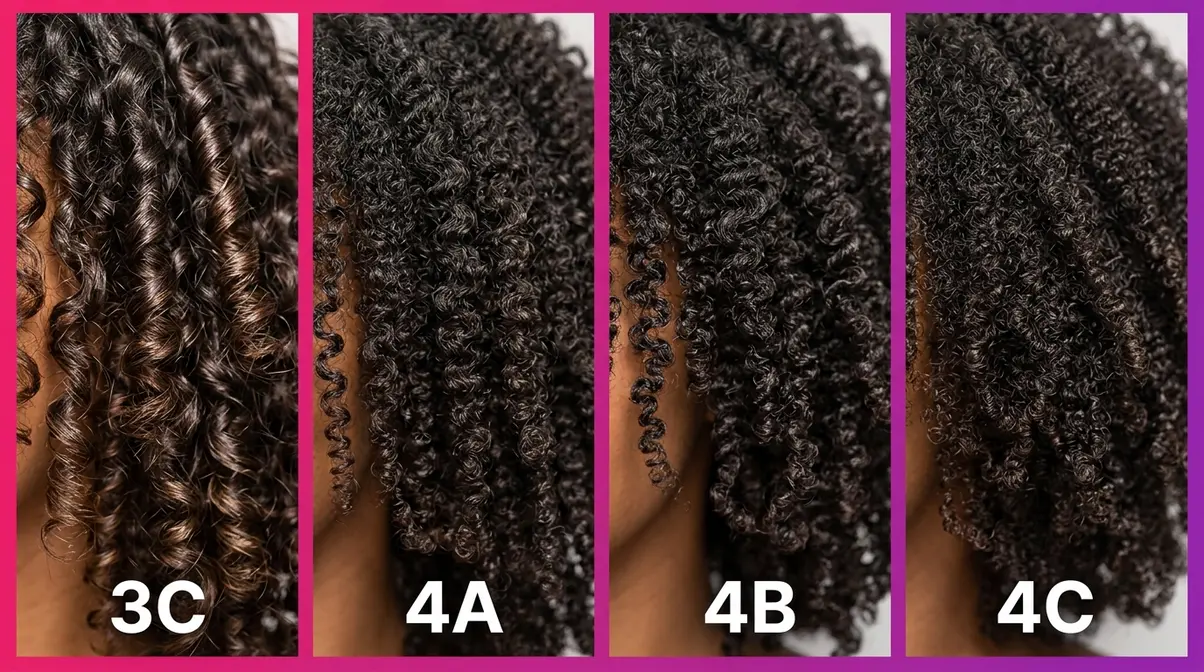
Distinguishing between curl types is one of the most common sources of confusion for people new to the natural hair typing system. The differences between 3C, 4A, 4B, and 4C are real and meaningful — they affect which products work, which routines apply, and which tutorials to follow. For a deeper dive into tighter textures, review our in-depth look at 4C hair or explore the differences between 4A and 4B hair.
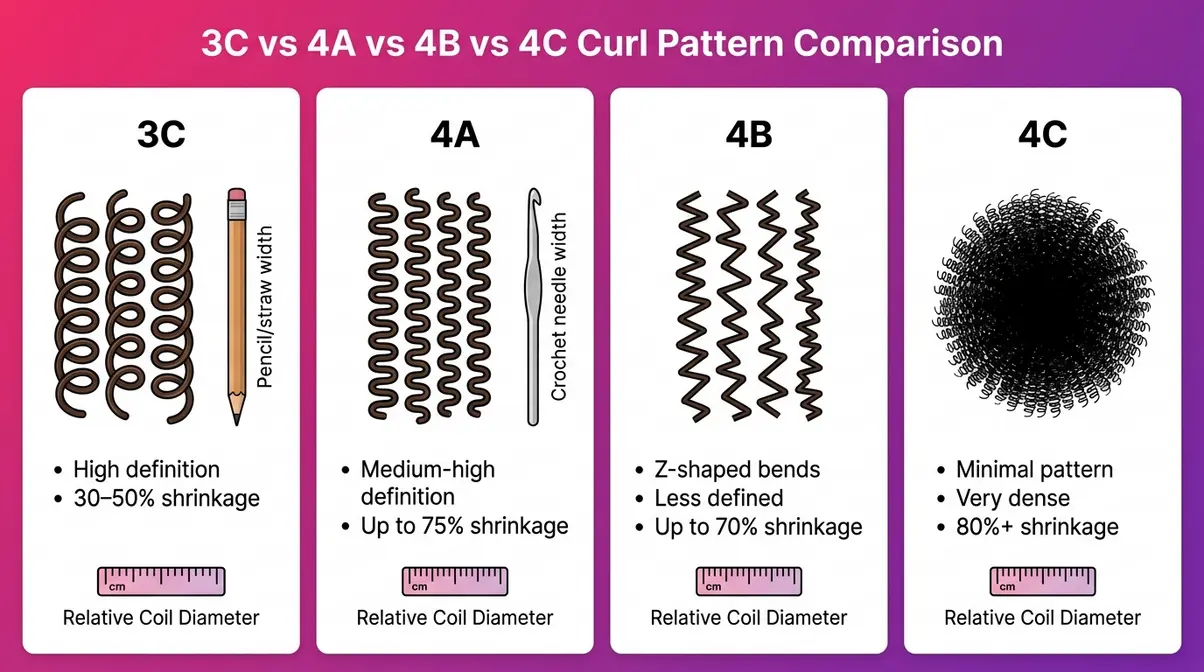
3C vs Type 4A: The Key Differences
The 3C vs 4A question is the most common identification dilemma — and it’s understandable. Both types have defined, springy coils. The difference comes down to tightness, definition, and moisture behavior.
3C hair forms tight corkscrew curls about the diameter of a pencil or drinking straw (roughly 7–10mm). The curls have strong definition even without products, and sebum can travel partway down the shaft — making 3C hair less prone to dryness than tighter coils. Byrdie’s type 4A hair guide notes that 3C curls tend to clump together naturally and show more shine due to better oil distribution (2026).
Type 4A coils tighter — around a crochet needle (4–6mm) — and The Coil-Moisture Gap means it needs significantly more intentional moisture than 3C. These tighter curls may lose definition faster when dry and shrink more dramatically.
| Feature | 3C | 4A |
|---|---|---|
| Coil size | Pencil/straw (7–10mm) | Crochet needle (4–6mm) |
| Definition when dry | High | Medium-high |
| Shrinkage | 30–50% | Up to 75% |
| Sebum distribution | Partial | Minimal (The Coil-Moisture Gap) |
| Frizz tendency | Moderate | High without moisture |
| Best product type | Light creams, gels | Heavier creams, butters, oils |
Quick test: Stretch a single dry coil gently and release. 3C hair springs back with a clear corkscrew. The tighter coil springs back with a smaller S-shape.
Type 4A vs 4B: Side-by-Side Comparison
Both 4A and 4B are coily hair types within the Type 4 family — but they behave differently enough that mixing up their routines causes real problems.
The looser of the two has a visible S-pattern even when dry. The coils are tight but defined. When you pull a strand and release it, it returns to its S-shape.
4B hair has a Z-shaped or angular pattern rather than a smooth S-curve. The coils are less defined and more tightly packed. 4B hair has even less natural sheen than its S-shaped counterpart because the Z-pattern creates more surface area for moisture to escape. 4B hair also tends to be more fragile at the angular bends and requires even heavier moisturizing products.
| Feature | 4A | 4B |
|---|---|---|
| Curl shape | S-coil | Z-pattern/angular |
| Definition | Visible, consistent | Less defined |
| Coil tightness | Tight | Very tight |
| Sheen | Low-medium | Very low |
| Product weight needed | Medium-heavy | Heavy |
| Shrinkage | Up to 75% | Up to 70% |
The key tell: Look at a single dry coil under good lighting. If you see a smooth S-curve, it’s 4A. If the strand bends at sharp angles with no smooth arc, it’s 4B. Many people have both types on different parts of their head — this is normal.
Type 4A vs 4C: Understanding the Coil Spectrum
4C hair is the tightest coil type in the André Walker system and requires the most intensive moisture care. Understanding where your texture falls on this spectrum helps you calibrate your routine appropriately.
4C hair has the least defined curl pattern of all Type 4 subtypes. Individual coils may not be visible at all — the hair appears as a tight, dense mass. Shrinkage can reach 80%+ of actual length. 4C hair is the most fragile of the curl types and requires the most protective care, the heaviest products, and the gentlest handling. Carol’s Daughter’s guide to 4A curls distinguishes 4A from 4C primarily by definition: 4A retains visible curl structure; 4C does not (2026).
| Feature | 4A | 4B | 4C |
|---|---|---|---|
| Pattern visibility | Clear S | Angular Z | Minimal/none |
| Shrinkage | ~75% | ~70% | ~80%+ |
| Fragility | Moderate-high | High | Very high |
| Product weight | Medium-heavy | Heavy | Very heavy |
| Detangling effort | Moderate | High | Very high |
If you’re unsure whether you have 4A, 4B, or 4C hair, look at a freshly washed, product-free strand under natural light. 4A shows a clear S. 4B shows angular bends. 4C shows very little defined pattern. When in doubt, treat your hair with the care level of the tighter type — it’s always safer to over-moisturize than under-moisturize Type 4 hair.
The Complete Care Routine: Step-by-Step
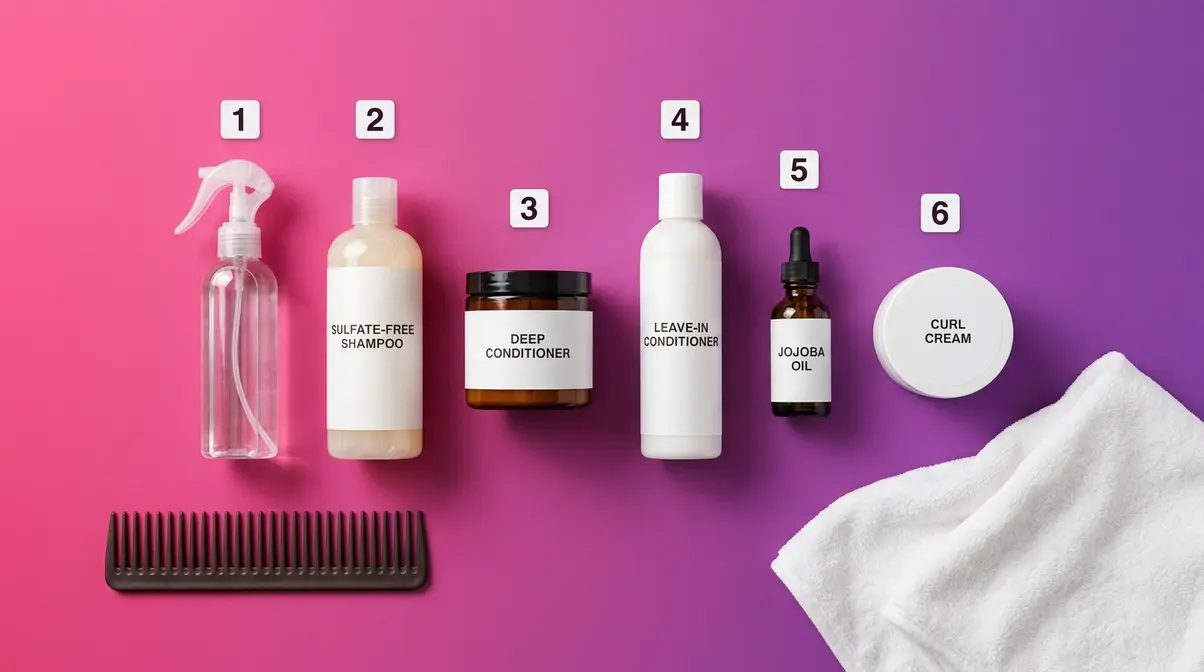
A consistent care routine is the single most impactful change you can make for your curls. Hair care professionals and trichologists agree that this texture thrives on routine predictability — your hair adapts and responds better when it receives consistent moisture signals rather than sporadic intensive treatments. If you need a broader foundation, check out these general curly hair care principles. This section walks you through every step, in order, with the “why” behind each one.
Prerequisites before you start:
- A spray bottle filled with water — your primary moisture tool
- A wide-tooth comb or detangling brush — never a fine-tooth comb on dry coils
- Sulfate-free shampoo (sulfates are harsh detergents that strip the small amount of sebum your scalp does have)
- A deep conditioner — not a regular rinse-out conditioner
- A leave-in conditioner, an oil, and a styling cream — the three layers of the LOC method
- A microfiber towel or cotton T-shirt — regular terrycloth towels cause frizz by roughing up the cuticle
- Patience — first wash days with a new routine take 60–90 minutes
Pre-Wash Prep: Detangling and Scalp Priming
Skipping pre-wash prep is one of the top reasons coily strands experience breakage on wash day. Wet hair is more elastic but also more vulnerable — detangling dry, tangled coils before adding water prevents the knot-tightening that happens when tangles get wet.
Pre-wash detangling steps:
- Divide your dry hair into four sections using hair clips. Working in sections makes the process manageable and prevents re-tangling.
- Apply a generous amount of a lightweight oil (such as jojoba or argan oil) to one section, starting at the ends and working upward toward the roots.
- Use your fingers first to gently separate large knots. Never pull from the root — always start at the tip and work up.
- Follow with a wide-tooth comb, starting at the ends and moving in short, gentle strokes toward the root.
- Once detangled, loosely twist or braid the section to keep it separated.
- Repeat for all four sections before wetting your hair.
Optional pre-poo treatment: A pre-poo (short for pre-shampoo) is an oil or conditioner applied to dry hair 30–60 minutes before washing. It creates a protective coating that prevents the shampoo from stripping too much moisture. Natural hair communities consistently report that pre-pooing with coconut oil or olive oil before wash day significantly reduces post-wash dryness and breakage.
How to Wash Your Curls: Choosing Your Cleanser
How you cleanse matters as much as what you cleanse with. For this texture, the goal is to clean the scalp without stripping the shaft.
Cleanser types explained:
- Sulfate-free shampoo (also called low-poo shampoo): Contains mild surfactants that clean without harsh stripping. Best for regular wash days (every 1–2 weeks).
- Co-wash (conditioner washing or no-poo): Cleansing with a lightweight conditioner instead of shampoo. Adds moisture while cleaning. Best used between shampoo wash days.
- Clarifying shampoo: A stronger cleanser used once per month to remove product buildup — the residue that accumulates from heavy creams, butters, and styling products. Use sparingly — too often causes dryness.
Wash day steps:
- Wet your hair thoroughly with warm (not hot) water. Hot water opens the cuticle aggressively and promotes moisture loss.
- Apply your moisturizing shampoo directly to your scalp — not your ends. The ends are the oldest, most fragile part of the strand.
- Massage your scalp with your fingertips (not nails) using circular motions for 2–3 minutes. This stimulates circulation and loosens buildup.
- Allow the shampoo to rinse down the length of your hair naturally — no need to scrub the shaft.
- Rinse completely with cool water to begin closing the cuticle.
Wash frequency: most hair care professionals recommend every 7–14 days. Washing too frequently strips the limited sebum your scalp does produce; washing too infrequently allows product buildup to block moisture absorption.
Deep Conditioning and Leave-In Application
Deep conditioning is the single most important step in your care routine. A regular rinse-out conditioner sits on the hair for 1–3 minutes. A deep conditioner penetrates the cortex (the inner layer of the hair shaft) over 20–45 minutes, restoring moisture and protein from the inside out.
Deep conditioning steps:
- After shampooing, gently squeeze excess water from your hair — don’t wring or twist.
- Apply your deep conditioner generously from roots to ends, working in sections.
- Use a wide-tooth comb to distribute the product evenly through each section.
- Cover your hair with a plastic processing cap (or a simple plastic bag). The heat from your scalp activates the conditioner.
- For additional penetration, sit under a hooded dryer or use a warm towel wrap for 20–30 minutes.
- Rinse thoroughly with cool water.
Leave-in conditioner follows immediately after rinsing. Unlike a deep conditioner (which you rinse out), leave-in conditioner stays in your hair as a moisture foundation layer. Apply it to soaking-wet hair — the water is your first moisture layer, and the leave-in helps seal it in. StyleSeat’s 4A hair guide notes that applying leave-in to wet (not damp) hair significantly improves moisture retention for coily types (2026).
The LOC Method: Liquid, Oil, Cream
The LOC method (Liquid, Oil, Cream) is the most widely recommended moisture-layering system for coily textures. Once you understand The Coil-Moisture Gap, you’ll see exactly why it works. Because sebum can’t travel down the shaft, you replicate that function manually with three layers.
LOC method steps:
- L — Liquid: Your hair should already be wet from the wash. If styling on a non-wash day, spritz thoroughly with water until hair is damp throughout. Water is the primary moisturizer — everything else seals it in.
- O — Oil: Apply a lightweight oil (jojoba, argan, or sweet almond oil) over the wet hair. The oil creates a semi-permeable barrier that slows water evaporation. Apply with your palms, smoothing over each section.
- C — Cream: Apply a moisturizing cream or butter (shea butter-based products work well) over the oil layer. The cream provides a heavier seal and defines the curl.
- Scrunch upward from the ends toward the roots after each layer to encourage curl clumping and definition.
- Allow to air-dry or use a diffuser on low heat.
LCO variation: Some curls respond better to LCO (Liquid, Cream, Oil) — cream first, then oil on top. If the LOC method leaves your hair feeling sticky or weighed down, try switching the order. The cream provides moisture; the oil seals it. Experiment over two or three wash days to find your version.
Best Products for Your Curls: What Actually Works
Our team evaluated products based on four criteria: ingredient quality (water-based first ingredient, no drying alcohols), performance on tight S-coils specifically, community consensus across natural hair forums and reviews, and value relative to cost. According to dermatological research on hair cosmetics, water-based leave-ins and sealed emollients are essential for maintaining elasticity in highly textured hair. These are not sponsored recommendations — they represent consistent performer patterns across the community.
Best Leave-In Conditioners
Leave-in conditioner is the most searched product category in this space — and for good reason. It’s the foundation layer of every moisture routine. The best leave-ins are water-based (water or aloe vera as the first ingredient), lightweight enough to absorb without buildup, and rich enough to provide lasting slip for detangling.
- What to look for on the label:
- First ingredient: water, aloe vera juice, or rose water
- Key humectants (ingredients that draw moisture in): glycerin, honey, aloe vera
- Key emollients (ingredients that soften): shea butter, jojoba oil, avocado oil
- Avoid: Mineral oil, petrolatum, and drying alcohols (alcohol denat., isopropyl alcohol) — these sit on top of your coils and block moisture
- Consistently recommended leave-ins:
- Kinky-Curly Knot Today — lightweight, water-based, excellent slip for detangling
- As I Am Leave-In Conditioner — coconut oil and green tea base; strong community support
- Pattern Beauty Leave-In Conditioner — formulated specifically for coily Type 4 hair; aloe vera base
- Cantu Shea Butter Leave-In Conditioning Repair Cream — widely available, affordable, shea butter-based
Apply to soaking-wet hair in sections. Use more than you think you need — high density means product must reach every strand.
Best Deep Conditioners
Your deep conditioner should do one of two things: restore moisture (hydrating conditioners) or restore protein (strengthening conditioners). Most coily textures need both, alternated. Hair care professionals recommend a moisture deep conditioner every wash day and a protein treatment every 4–6 weeks.
Signs you need a moisture deep conditioner: Hair feels dry, brittle, or rough to the touch.
Signs you need a protein treatment: Hair feels mushy, overly stretchy, or lacks bounce.
- Consistently recommended deep conditioners:
- Shea Moisture Manuka Honey & Mafura Oil Intensive Hydration Masque — moisture-focused; excellent for high-porosity strands
- Aphogee Two-Minute Reconstructor — protein treatment; use when hair feels weak or breaks easily
- Briogeo Don’t Despair, Repair! Deep Conditioning Mask — balanced protein and moisture; gentle formula
- Mielle Organics Babassu Oil & Mint Deep Conditioner — scalp-stimulating formula with strong moisture profile
Deep condition for a minimum of 20 minutes with heat. Thirty to forty-five minutes is optimal for very dry or high-porosity strands.
Best Shampoos
The best moisturizing shampoo cleans the scalp without stripping the shaft. Look for sulfate-free formulas — sodium lauryl sulfate (SLS) and sodium laureth sulfate (SLES) are the primary culprits in post-wash dryness for coily hair types.
- Consistently recommended shampoos:
- Shea Moisture Jamaican Black Castor Oil Strengthen & Restore Shampoo — sulfate-free; strengthening formula
- As I Am Curl Clarity Shampoo — lightweight clarifying formula for removing product buildup without harsh stripping
- Camille Rose Cucumber & Green Tea Clarifying Rinse — gentle monthly clarifier; removes buildup while maintaining moisture
- Maui Moisture Heal & Hydrate + Shea Butter Shampoo — widely available drugstore option; sulfate-free
Use a clarifying shampoo (which may contain gentle sulfates) once per month to fully remove product buildup. Use your regular sulfate-free formula for all other wash days.
Best Styling Products
Styling products need to define the curl without stiffness and hold moisture without buildup. The most effective styling products combine humectants (to attract moisture) with film-forming agents (to define and hold).
Product categories and top picks:
| Category | Recommended Product | Key Benefit |
|---|---|---|
| Curl defining cream | Camille Rose Curl Maker | Strong definition, no crunch |
| Styling gel | Eco Styler Olive Oil Gel | Firm hold, curl clumping |
| Twist butter | Shea Moisture Curl Enhancing Smoothie | Rich moisture for twist-outs |
| Edge control | Mielle Organics Edge Gel | Firm hold without flaking |
| Curl refresher | TGIN Honey Miracle Hair Mask (diluted) | Revives day-2 and day-3 curls |
The “white flake” problem: If products are leaving white residue on your strands, the cause is almost always one of three things: (1) the product contains too much protein for your hair’s current needs, (2) you’re applying products to hair that isn’t wet enough, or (3) you’re layering incompatible products (water-based over silicone-based). Always apply styling products to soaking-wet hair and check for silicone ingredients (anything ending in “-cone” or “-xane”) that block water absorption.
Styling Guide: Tutorials and Hairstyle Ideas
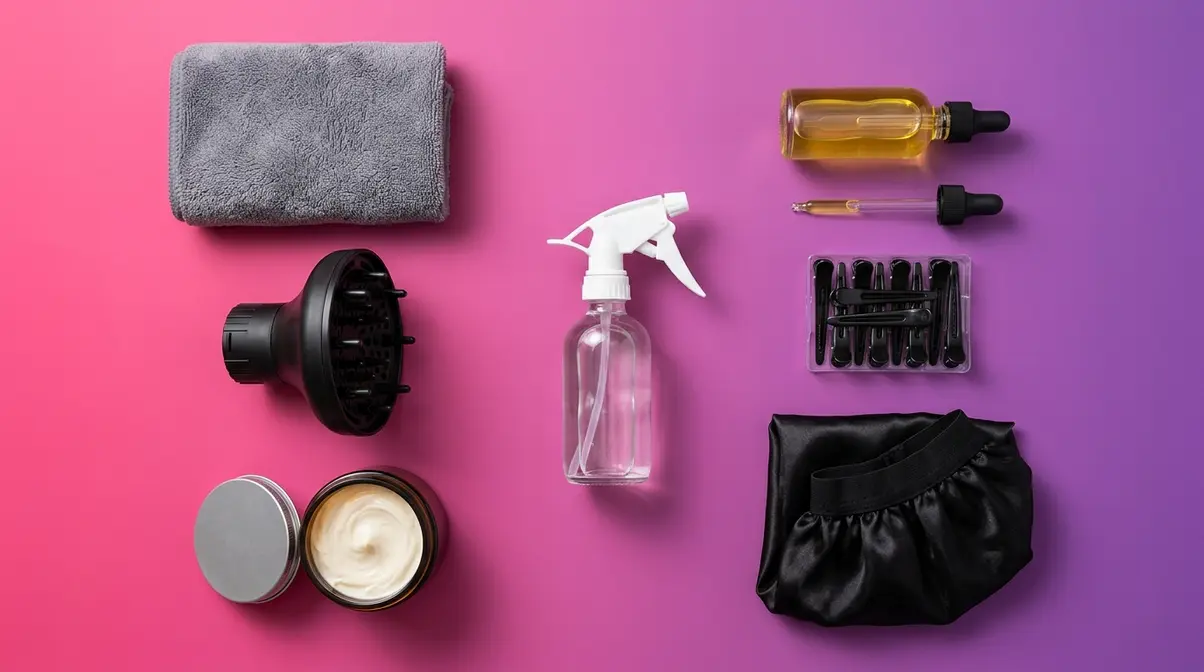
Styling becomes genuinely enjoyable once you have the right foundation — moisturized, defined coils respond to styling in ways that dry, product-stripped hair simply cannot. The three tutorials below represent the most requested styles in the natural hair community, each with step-by-step instructions and the specific products that work best for each method.
The Wash-and-Go: Step-by-Step Tutorial
The wash-and-go is the most natural expression of your natural texture — no manipulation, just defined coils. It works best on freshly washed, well-conditioned hair.
What you’ll need: Leave-in conditioner, lightweight oil, curl defining gel or cream, microfiber towel, diffuser (optional)
Wash-and-go steps:
- Complete your full wash day routine (shampoo, deep condition, rinse).
- Do not towel-dry aggressively. Gently blot with a microfiber towel to remove dripping water, leaving hair soaking-wet.
- Divide hair into four sections. Work one section at a time to ensure even product distribution.
- Apply leave-in conditioner to the first section, smoothing from roots to ends.
- Apply a small amount of lightweight oil over the leave-in, using your palms to seal.
- Apply curl defining gel or cream, scrunching upward from ends to roots with cupped hands. This motion encourages curl clumping.
- Repeat steps 4–6 for each section.
- Allow to air-dry completely — do not touch or disturb curls while drying. Touching wet coils causes frizz by disrupting curl clumping.
Optional: Use a diffuser attachment on your blow dryer on the lowest heat setting to speed drying without frizz. Cup sections of hair into the diffuser and hold without moving for 30–45 seconds per section.
Expected result: Defined, springy S-coils with minimal frizz. Shrinkage is normal and expected — your wash-and-go will look “shorter” than your stretched length.
The Twist-Out: Step-by-Step Tutorial
The twist-out is a community staple — it stretches your coils, reduces shrinkage, and creates a defined, voluminous style that lasts 3–5 days with proper maintenance.
What you’ll need: Leave-in conditioner, twist butter or styling cream, lightweight oil, hair clips, satin bonnet or scarf
Twist-out steps:
- Start on freshly washed, leave-in-applied hair (damp, not dripping).
- Divide hair into 6–8 sections depending on how large you want your final twists to be. More sections = smaller, tighter twist-out pattern. Fewer sections = larger, looser result.
- Apply a generous amount of twist butter or styling cream to one section, distributing evenly.
- Divide that section into two equal parts.
- Twist the two parts around each other from root to tip, keeping tension consistent. Coil the end around your finger to prevent unraveling.
- Secure the twist with a hair clip at the root if needed.
- Repeat for all sections.
- Allow twists to dry completely — this is critical. Unraveling twists before they’re fully dry causes frizz and shortens the style’s lifespan. Air-dry overnight under a satin bonnet, or sit under a hooded dryer for 45–60 minutes.
- Once fully dry, apply a small amount of oil to your fingers and gently unravel each twist by separating it into two or three sections. Do not use a comb or brush.
- Shake things up gently at the roots to add volume.
Maintenance: At night, pineapple your hair (gather all hair into a loose high ponytail with a satin scrunchie) and cover with a satin bonnet. This preserves the twist-out pattern for 3–5 days.
Protective Styles (Short & Long)
Protective styling keeps your ends tucked away from friction, manipulation, and environmental dryness — the three primary causes of breakage and length stagnation in coily textures. For both short and long lengths, protective styles are a growth strategy, not just an aesthetic choice.
Protective style options by length:
| Length | Style Options | Duration | Key Benefit |
|---|---|---|---|
| Short (TWA — teeny weeny afro) | Finger coils, flat twists, mini twists | 1–2 weeks | Defines coils, minimal manipulation |
| Medium (shoulder-length stretched) | Box braids, Senegalese twists, cornrows | 4–8 weeks | Maximum length retention |
| Long | Faux locs, Marley twists, jumbo braids | 6–8 weeks | Protects length from breakage |
Protective styling rules:
- Moisturize before installing. Protective styles lock in whatever moisture state your hair is in. Install on well-conditioned, moisturized hair.
- Don’t install too tightly. Tension at the hairline causes traction alopecia (hair loss from repeated pulling). You should be able to lay a finger flat at your hairline without feeling tightness.
- Maintain moisture inside the style. Use a light oil spray or water-based leave-in spray on your scalp and visible hair every 2–3 days.
- Don’t leave in too long. Styles kept beyond 8 weeks cause matting, tangling, and breakage during removal. Set a removal date before you install.
- Moisturize and deep condition immediately after removal. Your hair will be thirsty — this is the most important wash day of your protective style cycle.
Care Routine, Styles, and Products for Men
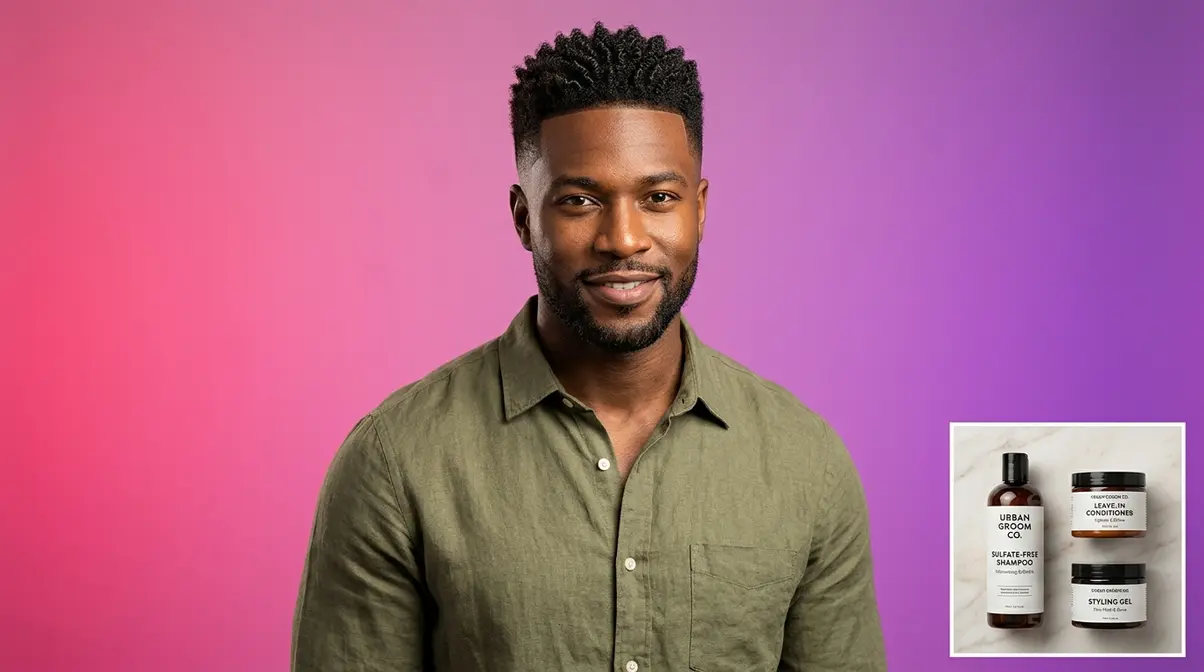
Coily hair care content has historically been written almost exclusively for women — which means men with coily hair have been navigating a space that largely ignores their specific needs, preferred styles, and lifestyle realities. This section addresses men with this hair type directly, with a care routine and style guide built around male-specific context. For more specific recommendations, explore the top curly hair products for men and browse these curly hairstyles for men.
Does the Texture Look Different on Men?
The hair itself has the same structural characteristics regardless of sex — the tight S-coil, the Coil-Moisture Gap, the shrinkage, and the density are all identical. What differs is typically length, styling preference, and grooming context.
Men with these curls most commonly wear their hair at shorter lengths — from a teeny weeny afro (TWA) close to the scalp, to a medium-length coil that can be shaped and defined. At shorter lengths, the S-pattern creates a distinct, textured look with natural volume. The coils hold shape well without heavy products, and shorter lengths often require less daily maintenance than longer lengths.
The primary care challenge for men is the same as for women: the Coil-Moisture Gap means the hair is chronically dry without intentional moisture. However, because many men use shorter routines and may be coming from a background of using regular (often sulfate-heavy) shampoos, the adjustment to a specific routine can feel like a significant shift.
Care Routine for Men
Hair care professionals who specialize in textured men’s hair note that the core routine is the same regardless of gender — the key variables are product quantity (less needed for shorter hair) and frequency (shorter hair can often be co-washed more frequently without buildup).
Men’s care routine:
- Cleanse: Use a sulfate-free shampoo 1–2 times per week. For very short hair (under 2 inches), a co-wash between shampoo days keeps the scalp clean and the hair moisturized without stripping.
- Condition: Apply a rinse-out conditioner after every wash. For men with longer hair, add a deep conditioning treatment every 2 weeks.
- Moisturize: Apply a lightweight leave-in conditioner or a water-based moisturizer daily or every other day. Short hair dries out quickly because there’s less length to distribute moisture through.
- Seal: Apply a lightweight oil (jojoba or grapeseed oil work well for shorter styles) to seal in moisture after your leave-in.
- Style: Use a water-based styling gel or cream to define coils. For a clean, shaped look, apply with a curl sponge — a tool specifically designed to create defined coils on short coils.
- Products particularly well-suited for men:
- SheaMoisture Men’s Maracuja Oil & Shea Butter Styling Cream — lightweight, non-greasy, designed for male grooming routines
- Cantu Men’s Collection Leave-In Conditioner — specifically marketed for textured men’s hair; lightweight formula
- Eco Styler Olive Oil Gel — firm hold for short defined styles; widely available
Best Hairstyles for Men
Hairstyles range from close-cropped to medium-length styles, all of which work with the natural coil rather than against it.
Popular styles:
| Style | Length Required | Maintenance Level | Description |
|---|---|---|---|
| Coil sponge afro | 1–3 inches | Low | Defined coils shaped with a curl sponge |
| Tapered fade with coils | 1–4 inches | Low-Medium | Fade on sides, defined coils on top |
| Twist-out | 3+ inches | Medium | Defined stretched coils with volume |
| High-top fade | 3–5 inches | Medium | Classic shape-up with natural coil texture on top |
| Mini twists | 2–4 inches | Medium | Protective style with defined texture |
| Loc starter | 4+ inches | Low (once set) | Intentional locking of coils |
The tapered fade with natural coils is consistently the most requested style for men in barbershop settings. The fade removes bulk at the sides while allowing the natural coil texture to shine on top. Maintain it with a daily moisture spray and a weekly curl sponge session to refresh the coil definition.
Barbershop tip: When visiting a barber for the first time, bring a reference photo and specifically request a stylist experienced with textured or natural hair. Not all barbers are trained in working with coily textures, and the wrong technique can cause significant breakage.
How to Grow Coily Hair: Length Retention and Growth Tips
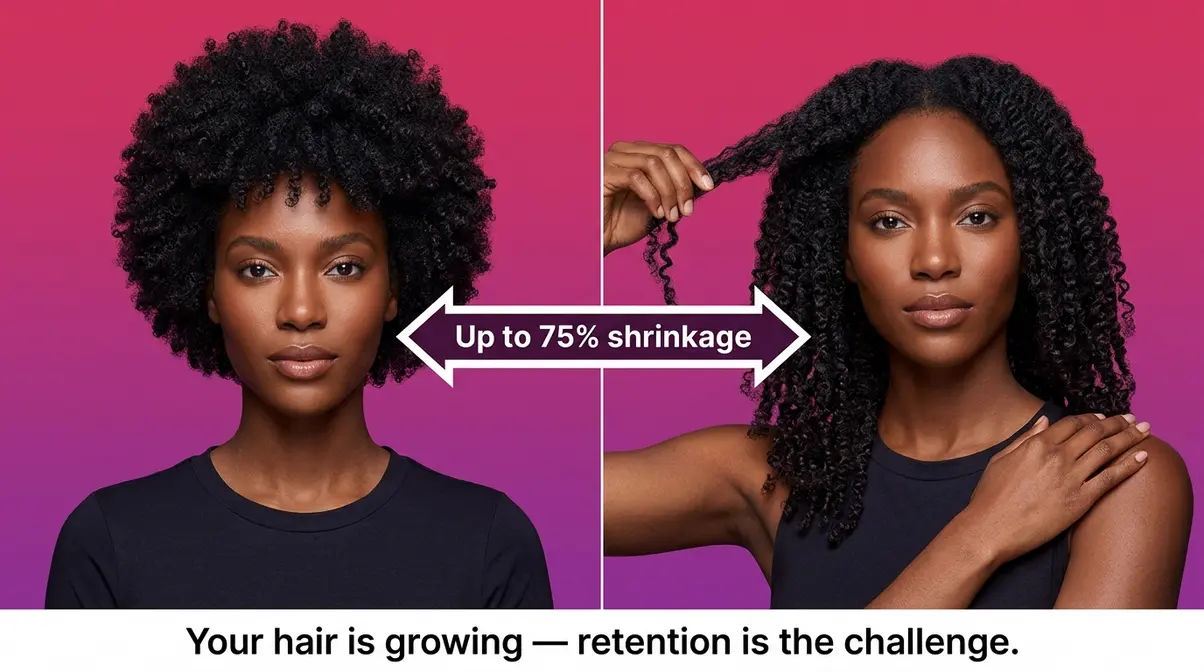
Your hair grows at roughly the same rate as any other hair type — approximately half an inch per month on average (American Academy of Dermatology, 2026). The reason it often appears to “not grow” is not a growth problem — it’s a retention problem. Your hair is growing; it’s breaking off at the same rate it grows, leaving you stuck at the same length. Building a science-backed hair growth routine takes time. Also, don’t overlook the benefits of scalp massage for hair growth.
Why Length Retention is a Struggle
The Coil-Moisture Gap is the root cause of most length retention challenges. When the ends of your hair are chronically dry and undernourished, they become brittle. Brittle ends break. Every broken inch is an inch your hair grew but couldn’t keep. Indique Hair’s breakdown of Type 4A, 4B, and 4C hair notes that mechanical damage from detangling is the second leading cause of length loss in Type 4 hair after chronic dryness (2026).
The five main causes of length loss:
- Chronic dryness — brittle ends snap at the curl bends (direct result of The Coil-Moisture Gap)
- Mechanical damage — aggressive detangling, especially on dry hair
- Heat damage — repeated use of flat irons or blow dryers without heat protection
- Manipulation — daily styling, touching, and restyling breaks fragile ends
- Tension — tight styles, tight ponytails, and tight protective styles cause traction alopecia over time
Length retention strategy: Reduce manipulation. The less you touch, comb, and restyle your hair, the more length you retain. Protective styles, stretched styles (like twist-outs), and low-manipulation routines are growth strategies, not just style choices.
Scalp Care and Massage for Growth
A healthy scalp is the foundation of healthy growth. Hair care professionals and trichologists emphasize that the follicle environment — blood circulation, sebum balance, and absence of buildup — directly influences growth rate and hair thickness.
Scalp massage routine:
- Apply a lightweight scalp oil (peppermint oil diluted in a carrier oil like jojoba is widely used in the natural hair community for its circulation-stimulating properties).
- Using your fingertips (not nails), apply gentle circular pressure across your scalp for 4–5 minutes.
- Focus extra time at the hairline and nape — areas most prone to thinning due to friction from clothing and protective style tension.
- Massage 2–3 times per week, ideally on wash days and between wash days.
Research published in ePlasty (2016) found that a 4-minute daily scalp massage over 24 weeks increased hair thickness in participants. While this study focused on straight hair, trichologists note the circulation-stimulating mechanism applies across hair types.
Scalp buildup is a significant barrier to growth. Heavy creams, butters, and styling products accumulate on the scalp over time, blocking follicles and potentially impeding growth. Use a clarifying shampoo or scalp scrub once per month to remove buildup fully.
Products That Support Growth
No product can make hair grow faster than its genetic rate — but the right products create the scalp and strand conditions that allow your hair to reach its full growth potential without breaking off.
Growth-supporting product categories:
| Product Type | Key Ingredients to Look For | Function |
|---|---|---|
| Scalp oil | Peppermint, rosemary, jojoba | Stimulates circulation, moisturizes follicle |
| Protein treatment | Hydrolyzed keratin, rice protein | Strengthens strand to prevent breakage |
| Deep conditioner | Shea butter, aloe vera, glycerin | Restores moisture to prevent brittle ends |
| Scalp serum | Biotin, caffeine, saw palmetto | Supports follicle health over time |
| Protective styling product | Shea butter, castor oil | Seals ends during low-manipulation periods |
Rosemary oil for growth: Across natural hair communities, rosemary oil has emerged as one of the most consistently recommended growth-support ingredients. A 2023 clinical study published in Skincare found rosemary oil comparable to minoxidil (a pharmaceutical hair growth treatment) for stimulating hair growth in participants with androgenetic alopecia. Dilute 5–10 drops of rosemary essential oil in 1 tablespoon of a carrier oil (jojoba or coconut) and apply to the scalp 2–3 times per week.
Common Mistakes to Avoid
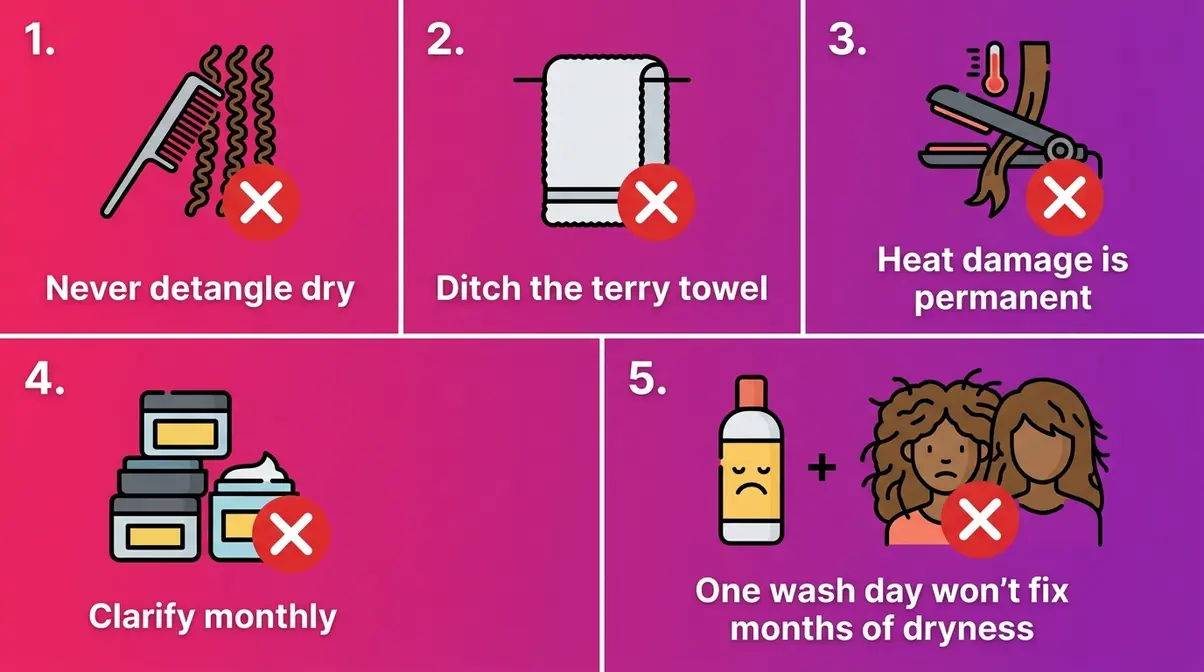
Even with the best intentions, certain habits consistently undermine curl health. Our team evaluated the most common complaints from natural hair communities and identified the patterns that cause the most damage.
The 5 Most Common Mistakes
Mistake 1: Skipping the deep conditioner. Using a regular rinse-out conditioner and calling it a wash day is the single most common reason strands stay dry. Regular conditioners coat the surface; deep conditioners penetrate the cortex. For this texture, deep conditioning is not optional — it’s the primary moisture delivery system.
Mistake 2: Detangling dry hair without lubrication. Running a comb through dry, product-free coils causes immediate breakage at the curl bends. Always detangle on wet, conditioner-coated hair or with a generous application of oil. Start at the ends. Never start at the root.
Mistake 3: Using too much heat, too often. Flat irons and blow dryers used at high heat without a heat protectant alter the protein bonds in your hair shaft permanently. Heat damage presents as straight or wavy sections that no longer coil — once the protein bonds are altered, the curl pattern doesn’t return. Use heat sparingly, always with a heat protectant spray, and on the lowest effective setting.
Mistake 4: Products building up without clarifying. Heavy creams and butters are essential for tight curls — but without regular clarifying, they accumulate on the scalp and strand, blocking moisture absorption. If your hair feels like products aren’t working anymore, clarify first. Use a clarifying shampoo once per month to reset.
Mistake 5: Expecting results in one wash day. Hair that has been under-moisturized for months doesn’t recover in a single routine. Hair care professionals recommend allowing 4–6 consistent wash days before evaluating whether a new routine is working. Patience is part of the protocol.
When to See a Trichologist
A trichologist (a specialist in scalp and hair health) is the appropriate professional when your hair concerns go beyond routine care. Seek professional evaluation if you notice:
- Significant hair loss — more than 100 hairs per day, or visible thinning patches
- Scalp conditions — persistent itching, scaling, redness, or pain that doesn’t respond to gentle cleansing
- No growth despite consistent routine — if you’ve maintained a solid routine for 6+ months and see no length retention, a trichologist can identify underlying causes (hormonal, nutritional, or follicle-level)
- Breakage at the scalp — breakage that occurs at the root rather than the ends may indicate a structural hair weakness requiring professional treatment
Trichologists can perform scalp analyses, recommend targeted treatments, and identify whether hair loss is related to styling damage, hormonal changes, nutritional deficiencies, or medical conditions. Many work alongside dermatologists for comprehensive scalp care.
FAQ: Your 4A Hair Questions Answered
What is a Type 4A hair type?
Type 4A hair is a coily hair type characterized by tight, S-shaped coils roughly the circumference of a crochet needle (approximately 4–6mm in diameter, according to Cleveland Clinic). It belongs to the Type 4 category of the André Walker Hair Typing System. 4A hair is defined by high density, significant shrinkage, and chronic dryness caused by The Coil-Moisture Gap — the structural reality that prevents scalp sebum from reaching the hair ends. It requires intentional moisture layering, such as the LOC method, to stay hydrated.
Am I 3C or 4A?
The key difference between 3C and 4A hair is coil tightness and moisture behavior. 3C hair forms loose corkscrew curls around a pencil or straw (7–10mm diameter) with relatively good sebum distribution. 4A hair coils tighter — around a crochet needle (4–6mm) — and experiences significant moisture loss due to the tight S-bends. To identify your type, wash your hair with no products and observe the natural coil shape when damp. A loose corkscrew = 3C. A tight S-coil = 4A. Many people have both types on different sections of their head.
Is my hair 4A, 4B, or 4C?
The difference between 4A, 4B, and 4C lies in curl definition and coil shape. 4A has a visible S-pattern with defined coils. 4B has an angular Z-pattern with less definition. 4C has minimal visible curl pattern — the hair appears as a dense mass with up to 80%+ shrinkage. The wash test is the most reliable method: after washing with no products, 4A hair forms visible S-coils, 4B hair forms angular bends, and 4C hair shows very little defined pattern. If you’re between types, treat your hair as the tighter type — it’s always safer to over-moisturize than under-moisturize.
What does 4A hair look like?
4A hair looks like tight, springy S-shaped coils roughly the circumference of a crochet needle. When wet, the coils are well-defined and bouncy. When dry, the hair shrinks significantly — up to 75% of its actual length based on Pattern Beauty’s curl metrics — and expands into a full, voluminous halo. 4A hair has high density, meaning many strands per square inch, which creates that characteristic gravity-defying volume. The coils show a clear S-pattern when a single strand is stretched and released. It’s distinct from 3C (looser curls) and 4B (angular Z-pattern with less definition).
What ethnicity has 4A hair?
4A hair is most common among people of African, Afro-Caribbean, and African-American descent, though coily and tightly curled hair appears across many ethnic backgrounds, including some South Asian, Middle Eastern, and mixed-heritage populations. Hair type is a physical characteristic determined by follicle shape — it describes curl geometry, not ancestry. The André Walker Hair Typing System was designed as a styling communication tool, not an ethnic classification. People of any ethnic background can have 4A hair, and people of African descent may have any hair type from 1A to 4C.
Is 4A hair rare?
4A hair is not rare — it is one of the most common coily hair types among people of African descent worldwide. It may feel rare because it has historically been underrepresented in mainstream beauty media, which has been dominated by straight and wavy hair content. The natural hair movement, growing strongly since the early 2000s, has significantly increased representation for Type 4 hair across YouTube, TikTok, and beauty publications. Today, the 4A community is one of the most active and well-resourced hair care communities online, with thousands of tutorials, product reviews, and peer support resources available.
How often should I wash 4A hair?
Most 4A hair benefits from washing every 7–14 days. Washing too frequently strips the limited sebum your scalp produces, worsening The Coil-Moisture Gap and increasing dryness. Washing too infrequently allows product buildup to block moisture absorption. Between shampoo wash days, a co-wash (cleansing with conditioner instead of shampoo) can refresh the scalp and add moisture without stripping. Hair care professionals recommend adjusting frequency based on your scalp’s oil production, activity level, and product use — sweating heavily or using heavy butters daily may require more frequent washing.
Caring for Your Curls Is a Practice, Not a Problem to Solve
For this hair type, the goal is not to fight your coils — it’s to understand them. The Coil-Moisture Gap isn’t a flaw. It’s a structural characteristic that responds predictably to the right care. Once you understand why your hair behaves the way it does, every product choice, every routine step, and every styling decision starts to make sense.
The routines in this guide — the LOC method, consistent deep conditioning, protective styling, and gentle detangling — aren’t trends. They’re direct responses to the structural reality of tight S-coils. Hair care professionals and the broader natural hair community have arrived at these practices through years of collective experience, and the evidence behind them is consistent.
Start with one wash day using the full routine outlined here. Give it four to six consistent sessions before evaluating results — hair that has been under-moisturized for months needs time to recover. Seek out the natural hair community online for peer support, product reviews, and real-world experience from people with your exact curl type. Your coils are not the problem. The right knowledge makes all the difference.

Dave King
Writes evidence-based hair-care guides for Care About Your Hair — for every hair type, jargon-free and independent.