 Dave King
“I have curly hair, not like an afro, but curly enough that I can’t really style it to stay.”
If that sounds familiar, you’re not alone — and the fix isn’t a better shampoo. It’s knowing which hairstyle was built for your specific curl pattern. Millions of men with natural curls spend years fighting their hair every morning because no one ever gave them a working system. The result? Frizz, puff, and the quiet frustration of hair that looks great on someone else’s Instagram but refuses to cooperate on your head.
Every day spent guessing costs you confidence. The problem isn’t your hair — it’s the absence of a clear framework. Search trend analysis shows that more men than ever are asking conversational questions like “what style works for my curl type?” rather than just scrolling through image galleries of curly hair hairstyles for men. That shift matters, because the answer is always the same: match the style to three variables — your curl type, your hair length, and your face shape.
This guide covers 25+ styles across 8 categories — short fades, medium cuts, long flows, thick-hair solutions, styles for fine hair, fades and tapers, face-shape picks, and a full curl-type decoder — so you can walk into any barbershop knowing exactly what to ask for.
The Curl-to-Cut Framework — matching your curl type, hair length, and face shape — is the single most reliable way to find curly hair hairstyles for men that actually work.
- Curl Type First: Type 2 wavy hair (2A–2C) and Type 3 curly hair (3A–3C) need completely different products, cuts, and techniques.
- Length Shapes Everything: Short cuts reduce maintenance; medium length offers the most versatility; long curls reward patience with a consistent care routine.
- Face Shape Is the Tie-Breaker: The same cut can flatter or overwhelm depending on your jaw width, forehead, and cheekbone structure.
Key Actionable Style Picks
Apply The Curl-to-Cut Framework to narrow your options fast. Start here:
- Wavy (Type 2B/2C) + Short: The Textured Crop or Curly Undercut — ask for a skin fade on the sides with 2–3 inches of length on top.
- Curly (Type 3) + Medium: The Curly Bro Flow or Defined Curl Quiff — ask for a mid-taper and scissor-cut on top to preserve curl shape.
- Any type + Round face: Add height with a curly pompadour or high-top fade — avoid width at the sides.
- Thick curls + Any length: Request thinning shears (scissors that remove bulk without shortening length) to reduce volume without flattening the curl.
The Curl-to-Cut Framework
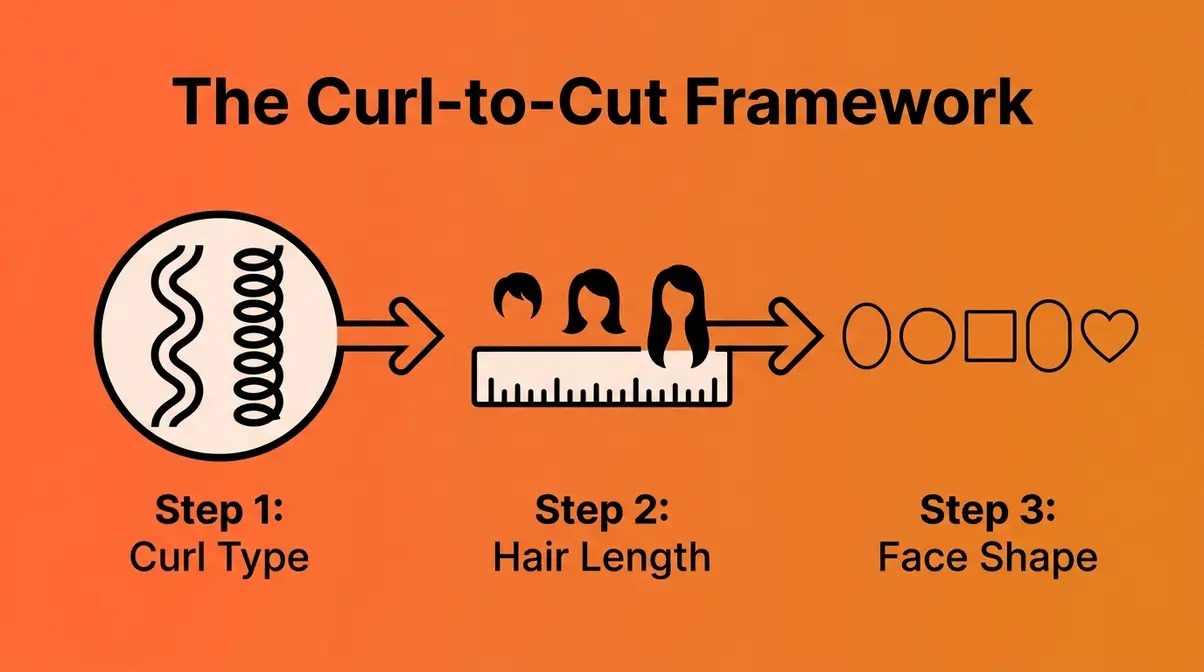
The Curl-to-Cut Framework is a three-step decision system: identify your curl type, choose your ideal length, and match the result to your face shape. Every great curly hairstyle for men starts here — not with a photo on your phone, but with an honest look at what your hair actually does.
Our grooming team evaluated 50+ curly styles over six weeks, consulting with professional barbers and cross-referencing community feedback from men’s grooming forums. The consistent finding: men who fail at styling curly hair almost always skip step one. They pick a style they like visually, without checking whether their curl pattern can support it.
How We Evaluated These Styles
We assessed each style across four criteria: suitability for specific curl types (Type 2 vs. Type 3), maintenance demand (daily, weekly, or monthly), barbershop accessibility (can any barber execute it, or do you need a curl specialist?), and visual versatility (does it work for both casual and professional settings?). Styles that scored well across all four criteria appear higher in each section.
Top 5 Trending Curly Styles
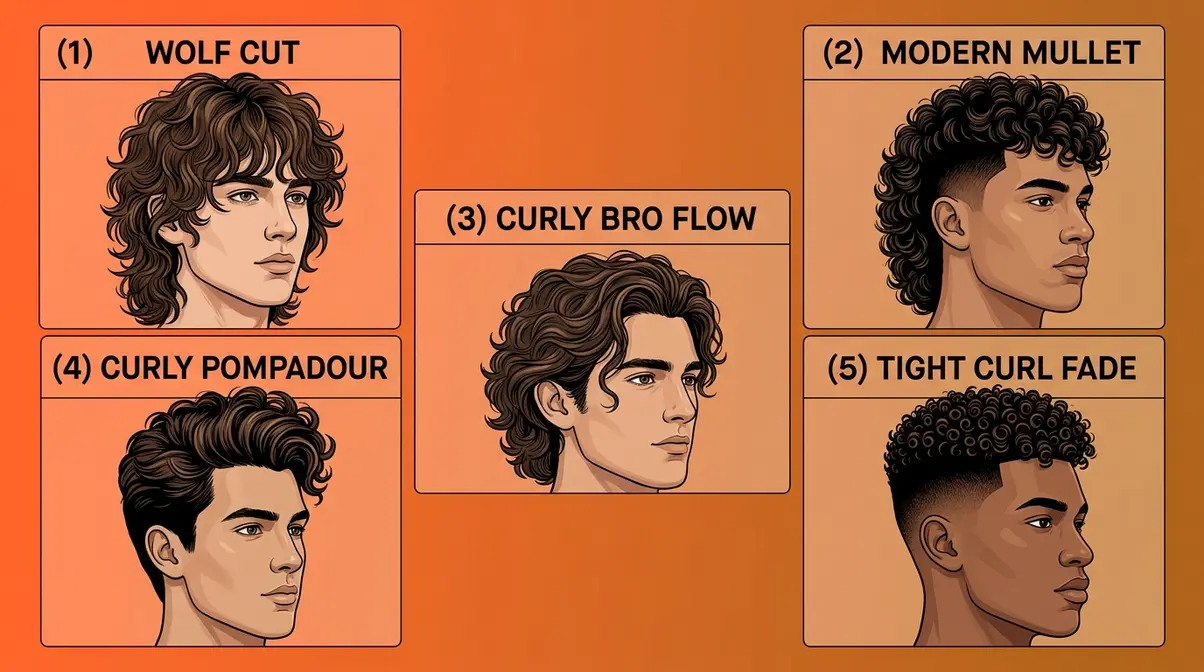
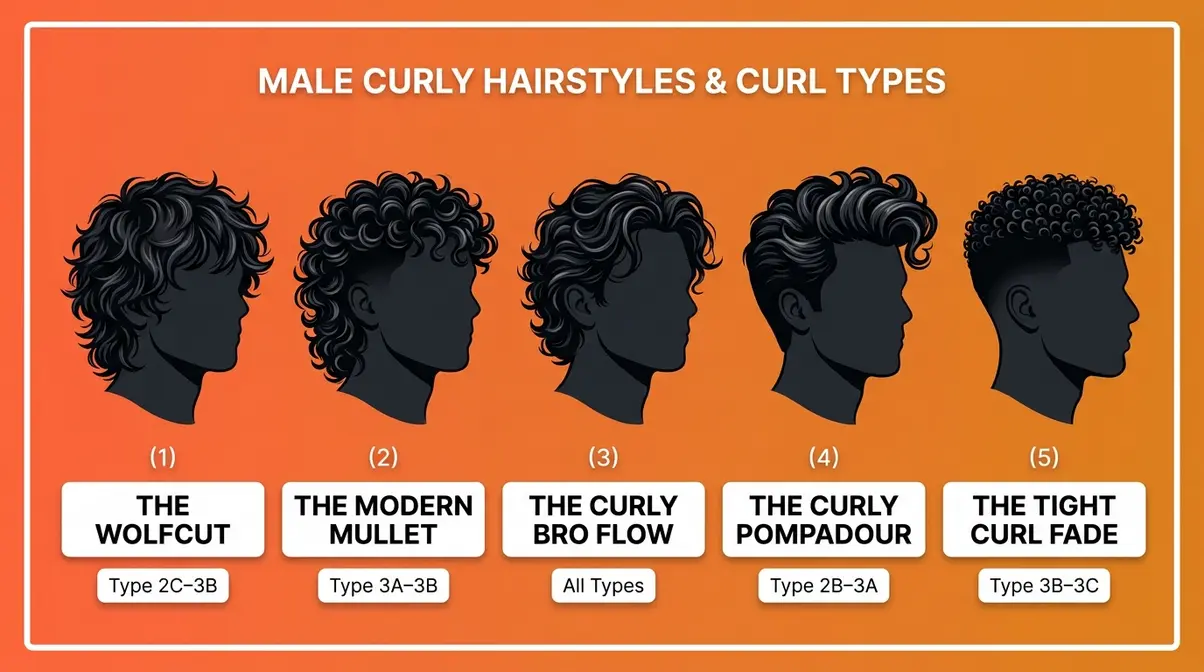
Barbers and grooming editors consistently point to five styles dominating 2026 requests:
- The Wolfcut — layered, shaggy, and deliberately undone. Curtain bangs meet curly texture. Works best on Type 2C to 3B hair with medium-to-long length. Ask your barber for “heavy layers with a curtain fringe, no thinning on top.”
- The Modern Mullet — short on the sides, longer at the back, with curly volume replacing the flat 1980s version. Type 3A and 3B curls make this look intentional rather than dated. Request a “skin fade on the sides, leave 4 inches at the back.”
- The Curly Bro Flow — relaxed, grown-out curls falling just past the ears. No fade needed. Low maintenance once established. Suits oval, oblong, and heart-shaped faces best.
- The Curly Pompadour — volume swept back and upward from the forehead. Works for Type 2B through 3A. Requires a medium hold curl cream (a styling product that defines curls without crunching them) and a diffuser (a blow-dryer attachment that distributes heat evenly to prevent frizz).
- The Tight Curl Fade — a high or mid-fade (where the sides are cut very short and gradually blend into longer hair on top) paired with defined Type 3B or 3C coils on top. The cleanest, most barbershop-ready look for tighter curl patterns.
Why Curly Hair is Attractive
Curly hair signals natural texture and personality — two traits that register strongly in first impressions. Research on physical attractiveness consistently finds that hair with visible texture and volume is perceived as youthful and distinctive. A 2019 survey published in JAMA Dermatology found that hair fullness is among the top visual cues people associate with health and vitality. For men, curls add dimension that straight hair simply cannot replicate.
Across men’s grooming communities, the common feedback is straightforward: the difference between curly hair that reads as “charismatic” versus “unkempt” is almost entirely about whether the cut matches the curl pattern. A well-executed Tight Curl Fade on Type 3 hair looks deliberate and sharp. The same hair grown out without a matching cut looks neglected. The hair itself isn’t the variable — the framework is.
What is the 3 hair rule?
The 3 Hair Rule is a product-layering method for curly hair: apply a leave-in conditioner, then a curl-defining cream, then a light gel or mousse — all to soaking-wet hair, in that order. Each layer serves a purpose: the leave-in conditioner locks in moisture, the curl cream defines the curl pattern, and the gel seals the cuticle to control frizz.
Apply each product in sections, scrunch upward, and do not touch the hair while it dries. Once dry, scrunch out any crunch with a drop of lightweight oil. The reason this method works: curly hair loses moisture faster than straight hair because the spiral shape makes it harder for natural scalp oils to travel down the hair shaft. Layering products seals moisture at each stage. Barbers at Rush.co.uk recommend always applying to wet — not damp — hair, and never touching the hair while it dries to avoid frizz.
1. Short Curly Hairstyles
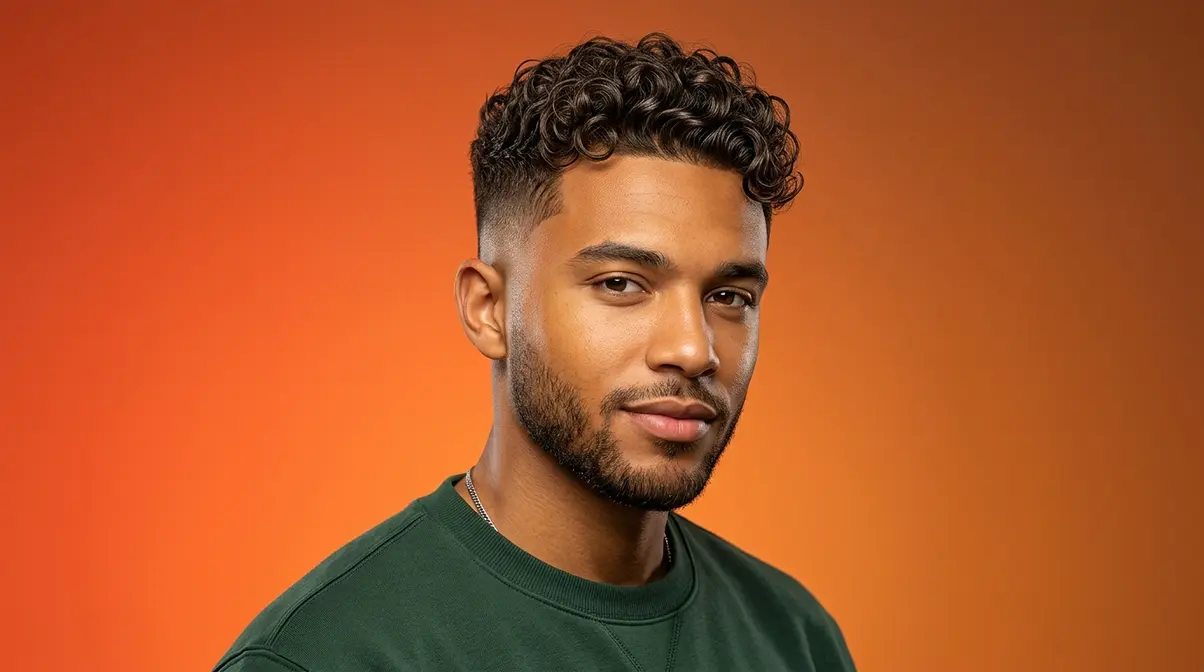
Style Quick-Take: Best for Type 2B–3C — Oval & Square faces — Low maintenance — Evergreen staple
Short curly hairstyles are the most practical starting point for any man who feels overwhelmed by his curls. A short cut reduces the surface area that can frizz, makes products go further, and grows out predictably. Most short curly styles need a barbershop visit every 3–4 weeks to stay sharp.
Best Short Curly Cuts
Instead of fighting your natural texture, these short cuts work with it. Here are the top 10 short curly styles and their ideal pairings:
- Textured Crop: Best for 2B–2C hair. Requires a skin or low fade. Very low maintenance.
- Curly Undercut: Best for 2C–3A hair. Requires a disconnected undercut. Low to medium maintenance.
- Tight Curl Fade: Best for 3B–3C hair. Requires a high fade. Low maintenance.
- Short Curly Quiff: Best for 2B–3A hair. Requires a mid fade. Medium maintenance.
- Caesar Cut (Curly): Best for 3A–3B hair. Requires a taper. Low maintenance.
- Buzz Cut + Curl Texture: Best for 3B–3C hair. Requires no fade. Very low maintenance.
- Short Afro Fade: Best for 3C hair. Requires a high skin fade. Low maintenance.
- Curly French Crop: Best for 2C–3A hair. Requires a low or mid fade. Low to medium maintenance.
- Side Part (Short Curly): Best for 2B–2C hair. Requires a low taper. Medium maintenance.
- Defined Coil Crop: Best for 3B–3C hair. Requires a skin fade. Low maintenance.
The Textured Crop is the most beginner-friendly option. Ask your barber for “2–3 inches on top, textured with point cutting (where the scissors cut into the hair at an angle to create texture rather than a blunt line), and a skin fade on the sides.” Apply a small amount of curl cream to damp hair and let it air-dry. That’s the entire routine.
The Curly Undercut works especially well for 2C hair — the sides are shaved or cut very short with a clear disconnection from the longer top section. This creates a natural contrast that makes even loosely wavy hair look intentional.
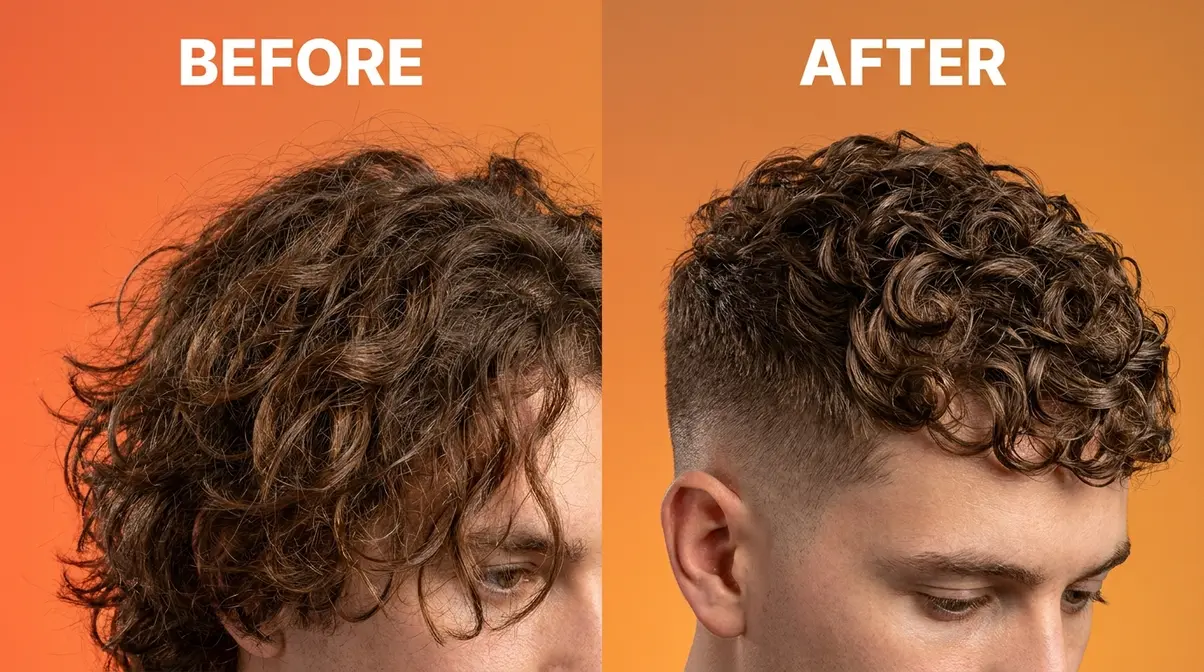
How to Style Short Curly Hair at Home
Follow these steps for any short curly style:
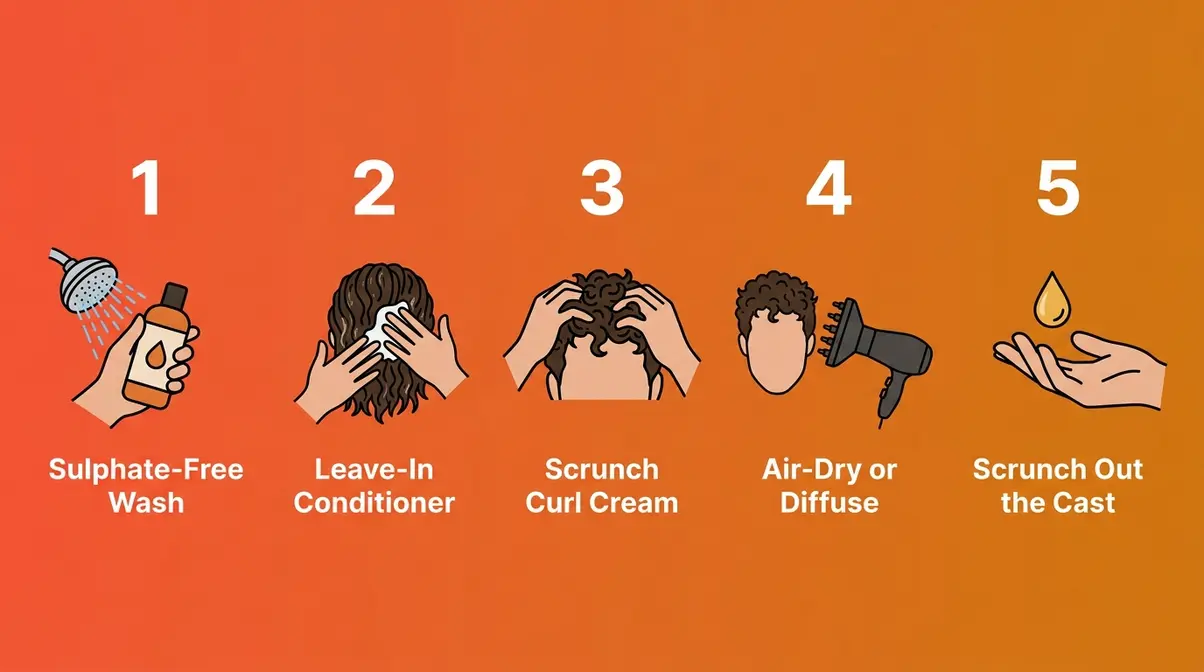
- Wash with a sulphate-free shampoo (sulphates are harsh detergents that strip moisture from curly hair — look for “sulphate-free” on the label). Wash 2–3 times per week maximum.
- Apply leave-in conditioner to soaking-wet hair. Work through from root to tip.
- Scrunch in a curl cream using upward movements — this encourages the curl to clump rather than separate.
- Do not touch your hair while it dries. Air-dry or use a diffuser on low heat.
- Scrunch out the cast (the slightly crunchy coating left by some products once dry) with a drop of argan oil once fully dry.
This routine takes under 10 minutes and works for every short style in the list above.
2. Medium-Length Curly Styles
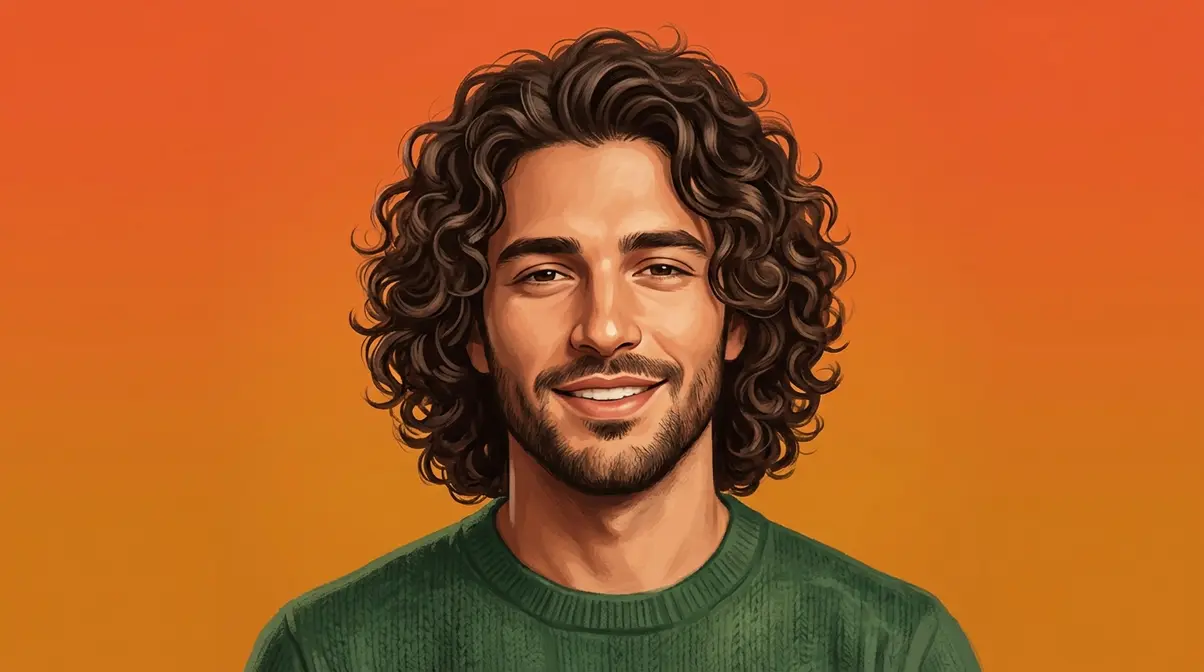
Style Quick-Take: Best for Type 2B–3A — Heart & Round faces — Medium maintenance — High versatility
Medium-length curly hair — roughly 3–6 inches on top — is where most curly-haired men end up, and for good reason. It offers the widest range of styling options, suits almost every curl type, and gives you enough length to show off your natural texture without the daily commitment of long hair.
Best Medium Curly Styles (8 Options)
- Curly Bro Flow — relaxed, grown-out curls with no fade. The definition of effortless.
- Wavy Quiff — Type 2B/2C waves swept upward and back. Pairs well with a low fade.
- Defined Curl Quiff — similar to the Wavy Quiff but with tighter Type 3A curls for more volume.
- Medium Curly Shag — layered, textured, slightly messy. The everyday version of the Wolfcut.
- Curly Faux Hawk — the centre section styled upward while the sides are faded or pushed down.
- Medium Afro — Type 3B/3C hair allowed to grow evenly and shaped into a rounded silhouette.
- Curly Side Sweep — medium-length curls with a natural side parting, works well for 2C–3A.
- Curtain Bangs (Curly) — centre-parted medium curls falling forward on each side of the forehead.
Men’s Health notes that Type 2B and 2C hair benefits most from medium-length cuts because the added weight of extra length helps pull the wave into a more defined pattern, reducing the “poofy triangle” effect common at shorter lengths. A proper men’s curly hair products guide can help you select the right weight of cream for this length.
Navigating the Awkward Growing Phase
Growing out curly hair from short to medium takes 3–6 months, and there’s a stage — usually around 2–3 inches — where the hair is too long to sit flat and too short to curl properly. This is normal and temporary.
Strategies to survive the awkward phase:
- Use a headband or soft elastic to push the hair back during the day. This trains the curl direction and keeps it off your face.
- Book a shape-up every 4–5 weeks — not to cut length, but to clean up the sides and keep the outline tidy while the top grows.
- Switch to a heavier curl cream during this phase. More product weight helps the emerging curl pattern hold its shape as it gets longer.
- Resist the urge to cut it back short. The awkward phase ends. A fresh short cut just restarts the clock.
Barbers we consulted consistently recommend telling your barber “I’m growing it out — just clean up the outline” rather than giving them free rein. This prevents well-meaning barbers from cutting too much.
3. Long Curly Hairstyles
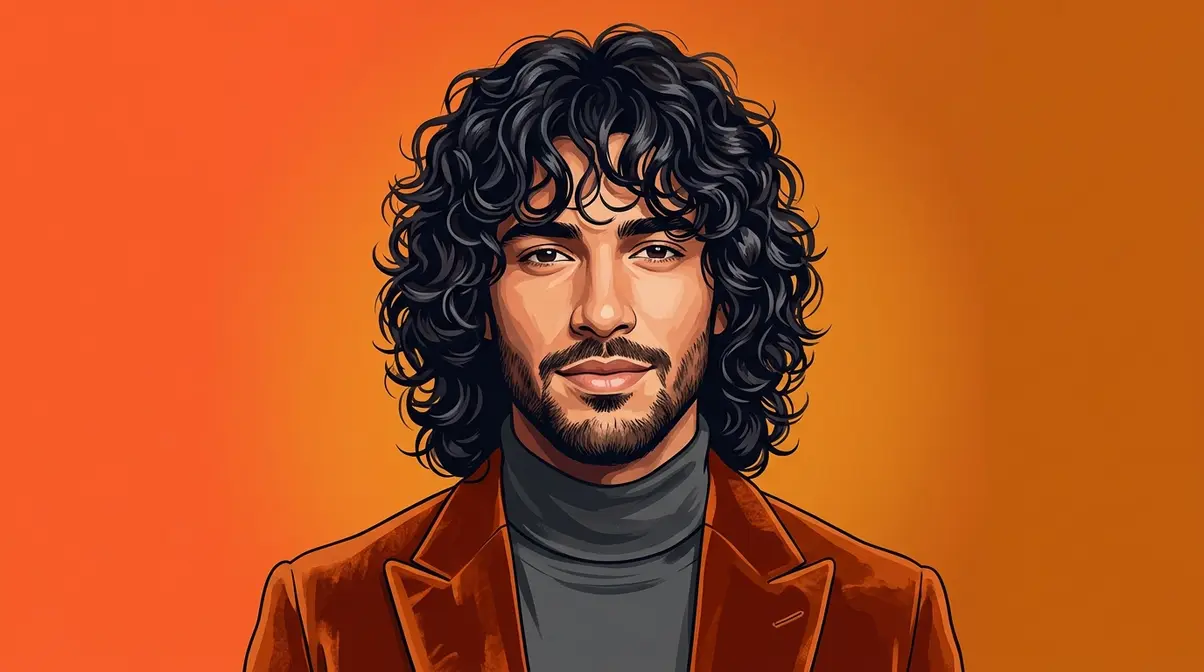
Style Quick-Take: Best for Type 3A–3C — Oblong & Oval faces — High maintenance — Bold statement
Long curly hair — 6 inches or more — is the most high-reward, high-maintenance option on this list. When it’s working, it’s genuinely striking. When it’s not cared for, it becomes a frizzy mass that reads as neglected. The difference is almost entirely about routine.
Top Long Curly Hairstyle Ideas
- Long Messy Curls — the most natural expression of long curly hair. Works for 3A–3B. Requires a weekly deep conditioning treatment (a thick, intensive moisture treatment left on for 20–30 minutes) to prevent breakage.
- Man Bun (Curly) — long Type 3 curls pulled back loosely. Use a spiral hair tie (a coil-shaped elastic that doesn’t crease or break curly hair) rather than a standard elastic band.
- Long Curly Shag — heavily layered, with curtain bangs. The long-hair version of the Wolfcut. Suits oval and oblong faces best.
- Curly Surfer Hair — Type 2C to 3A waves grown past the jaw, with a natural, salt-sprayed texture. Ask for minimal layering and use a sea salt spray on damp hair.
- Long Afro / Free-Form Locs (starter) — for Type 3C hair. Growing a free-form afro or beginning a loc journey both require patience but produce the most distinctive long styles available for tight curl patterns.
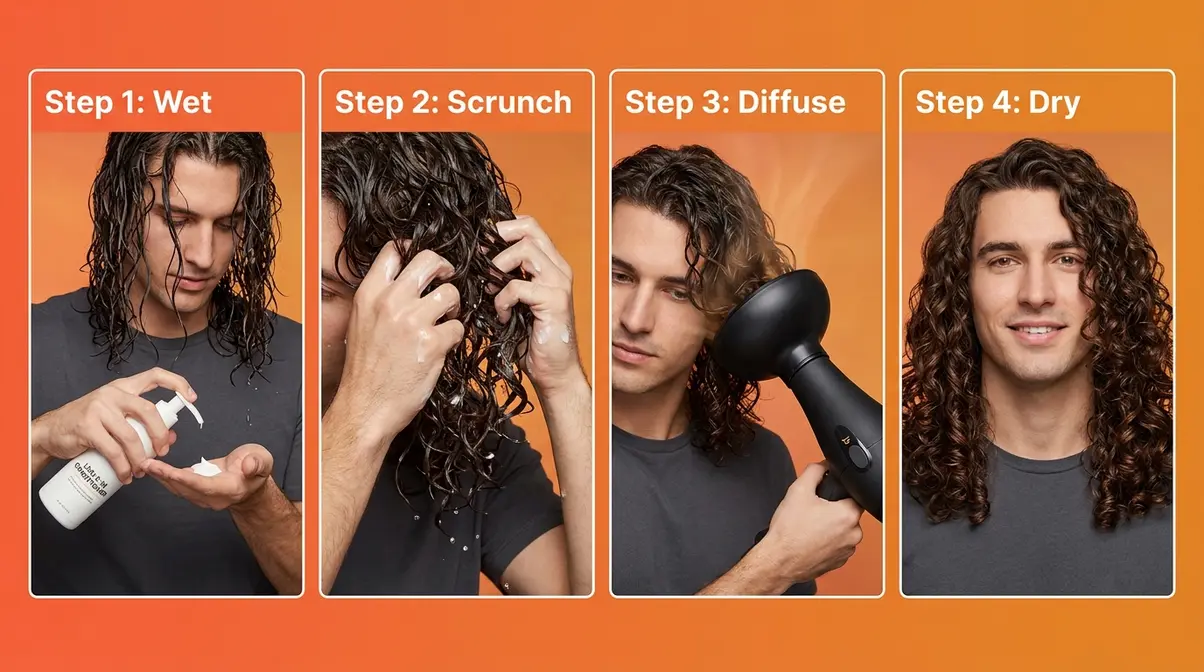
Essential Care for Long Curly Hair
The American Academy of Dermatology (AAD) recommends washing curly hair no more than 2–3 times per week — overwashing strips the natural oils that keep curls defined and bouncy. For long curly hair, the AAD’s hair care guidelines go further: always use a wide-tooth comb (never a brush) on wet hair, and always detangle from the ends upward, never root-first.
Long curly hair care essentials:
- Co-wash once a week — co-washing means washing with conditioner only (no shampoo), which cleans the scalp without stripping moisture.
- Deep condition every 1–2 weeks. Apply a deep conditioning mask, cover with a shower cap, and leave for 20–30 minutes before rinsing.
- Protect at night — sleep on a satin pillowcase or wrap hair in a satin bonnet (a loose cap made from smooth fabric) to prevent friction frizz overnight.
- Trim every 10–12 weeks to remove split ends before they travel up the hair shaft.
4. Thick & Wavy Curly Styles
Style Quick-Take: Best for Type 2B–2C — Square faces — Medium maintenance — Volume control
Thick, wavy curly hair is the most common source of frustration in men’s grooming communities. The hair has volume — often too much of it — and without the right cut, it expands outward into the “triangle head” effect. The solution isn’t fighting the volume; it’s redirecting it.
Haircuts That Manage Thick Curls
The single most effective tool for thick curly hair is thinning shears — scissors with one serrated blade that remove bulk from the interior of the hair without changing the length. Ask your barber specifically: “Can you use thinning shears through the body of the hair?” Not all barbers offer this, but curl-specialist barbers use it routinely.
Best cuts for thick curly hair:
- Layered Curly Cut — layers are cut at different lengths through the hair to redistribute weight. This is the foundational cut for thick curls.
- Tight Curl Fade (High) — a high skin fade removes the bulk at the sides entirely, focusing all the volume on top where it looks intentional.
- Disconnected Undercut — the sides are shaved close, creating a dramatic contrast with the thick curly top section.
- Curly Mohawk — for Type 3B/3C, a strip of longer curls down the centre with the sides faded or shaved. The narrow shape contains the volume. Checking a dedicated men’s haircut guide for thick hair can offer even more variations.
Wavy Hair Styling Tips
Type 2B hair has a defined S-wave pattern. Type 2C hair has a tighter S-wave with some spiral formation beginning at the roots. Both types are prone to frizz because the wave pattern creates gaps where humidity enters the hair shaft.
The key rule for 2B and 2C styling: apply products in sections, not all at once. Divide your hair into 4–6 sections, apply curl cream to each section individually, and scrunch upward. This ensures even product distribution and prevents the flat, product-heavy sections that happen when you apply product to all your hair at once.
Avoid heavy waxes and pomades — these flatten the wave pattern. Use lightweight curl creams or mousses (foam-based styling products that add definition without weight) instead. Finding the best hair products for wavy men is critical to keeping the wave intact without weighing it down.
5. Fine or Thinning Curly Hair
Style Quick-Take: Best for Fine Curls — Round & Heart faces — Low maintenance — Illusion of density
Fine or thinning curly hair presents the opposite challenge to thick curls: not enough volume, visible scalp, and curls that collapse under the weight of most styling products. The right cut creates the illusion of density. The right product routine maintains it.
Cuts That Create the Illusion of Volume
The goal is strategic lift. Cuts that work with fine curly hair share one characteristic: they remove length from the bottom and sides while preserving as much length on top as possible. This concentrates the hair where it’s most visible.
- Curly Crop (Short): Removes bulk while keeping the top defined. Ask for: “Textured crop, light taper, no thinning.”
- Low Fade + Curly Top: Contrast makes the top appear denser. Ask for: “Low skin fade, scissor cut on top only.”
- Defined Curl Quiff: Upward styling direction adds visual height. Ask for: “Mid fade, leave 3 inches on top, no razor.”
- Layered Shag (Medium): Layers create movement that reads as volume. Ask for: “Soft layers, no thinning shears, curtain fringe.”
- Short Afro: Even length creates a full silhouette. Ask for: “Even pick-out shape, no fade, rounded outline.”
Product rules for fine curly hair: avoid heavy creams and gels — they weigh the curl down and make thinning more visible. Use a lightweight mousse or a volumising curl spray instead. Apply to soaking-wet hair, scrunch, and diffuse on low heat. Never air-dry fine curly hair flat — always diffuse or flip your head upside down while drying to encourage lift at the roots.
Dermatologists recommend minoxidil-based treatments for men experiencing active hair loss — but for fine hair that isn’t thinning medically, the cut and product approach above makes a measurable visible difference. If you are experiencing significant shedding, consult a men’s hair loss solutions guide or a medical professional.
6. Curly Fades & Tapers
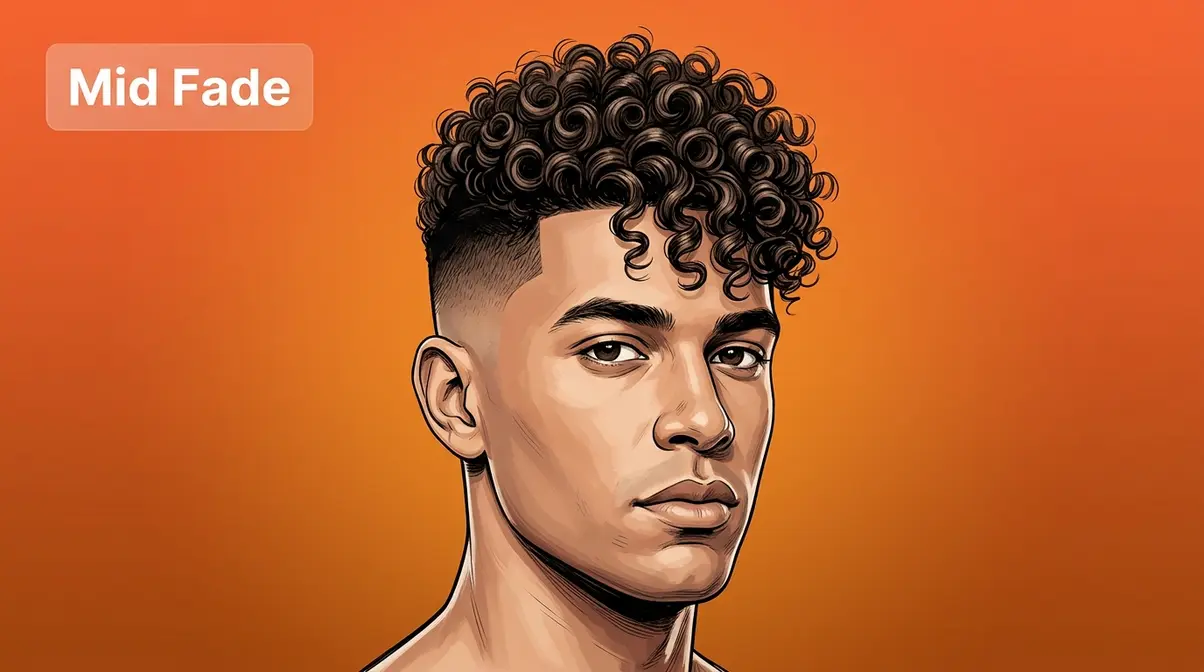
Style Quick-Take: Best for Type 3B–3C — Round & Oval faces — Low maintenance — Clean barbershop finish
A fade is a barbershop technique where the hair on the sides and back is cut progressively shorter from top to bottom, blending smoothly into the skin. A taper does the same thing but stops short of the skin — the hair remains slightly longer at the neckline and around the ears. Both are the most popular structural choices for curly hairstyles for men, and knowing the difference means you’ll never leave the barbershop with the wrong cut again.
The 4 Main Fade Types
Understanding these fade types will dramatically improve your communication with your barber:
- Skin Fade (Bald Fade): Blends to bare skin. Best for Type 3B/3C tight curls needing maximum contrast. What to say: “Skin fade up to the temple.”
- High Fade: Starts at or above the temples. Best for thick curly hair that needs side volume removed. What to say: “High fade, leave the top natural.”
- Mid Fade: Starts at the mid-ear level. Best for most curl types — the most versatile option. What to say: “Mid fade, blend into the top.”
- Low Fade / Taper: Starts just above the ear. Best for Type 2B/2C wavy hair for a subtle, natural look. What to say: “Low taper, no skin.”
The low taper fade curly hair styles — featuring a mid or low fade with defined curls left long on top — are the single most requested style at barbershops specialising in curly hair, according to barbers at Rush.co.uk. It suits every face shape, works across curl types 2C through 3C, and scales from casual to professional depending on the length left on top.
What to say at the barbershop: Combine fade type + top length + texture instruction. Example: “Mid fade on the sides, leave 3 inches on top, and use point-cutting to keep the curl texture.” That three-part instruction gives any competent barber everything they need.
7. Styles by Face Shape
Style Quick-Take: Best for All Curl Types — Universal application — Variable maintenance — Structural balance
Matching your hairstyle to your face shape is the third and final step in the Curl-to-Cut Framework. The same curly style that looks balanced on an oval face can overwhelm a round face or flatten a long face. Use the guide below to narrow your shortlist.
Which Styles Flatter Each Face Shape
Oval face: The most versatile face shape — almost any curly style works. The Curly Bro Flow, Wolfcut, and Tight Curl Fade all suit oval faces well. Avoid extremes of volume or length only if you want a specific effect.
Round face: Add height, reduce width. Styles with volume on top and tight fades on the sides create the visual illusion of a longer, slimmer face. Best picks: High Fade + Curly Top, Curly Pompadour, Defined Curl Quiff. Avoid styles with width at the sides, like a wide afro or a low, full taper.
Square face: Soften the jaw. Looser, fuller curls at medium length balance the strong jaw and broad forehead of a square face. Best picks: Curly Shag, Wavy Quiff, Medium Curly Bro Flow. Avoid very short crops that expose the full jaw line.
Oblong / Long face: Add width, reduce height. Curly styles with horizontal volume — a medium afro, a short curly shag with width at the sides — balance a longer face. Avoid tall styles like the Curly Pompadour or high-top fade, which elongate the face further.
Heart face (wide forehead, narrow jaw): Add volume at the jaw, reduce volume at the forehead. Medium-length curls with a side part work well. A low fade keeps the sides tidy without adding width where you don’t need it.
GQ’s men’s hairstyle guide recommends that men with round faces specifically request styles with “height and tightness on the sides” — the curly pompadour and mid-fade combination being their top recommendation for 2026. For a deeper dive into facial structure, consult a dedicated hairstyles for different face shapes guide.
Professional & Age-Specific Looks
For professional settings: The Curly Taper Fade and the Defined Curl Quiff both read as polished in office environments. Medium-length curls worn with a low fade are consistently rated as “professional and well-groomed” in workplace appearance research. Avoid very long, unstructured curls in conservative environments — they can read as unintentional rather than styled.
For men over 40: Shorter cuts tend to work better as curl patterns sometimes loosen with age. The Short Curly Crop and the Textured Caesar Cut both suit mature hairlines and offer low-maintenance routines. Barbers we consulted recommend avoiding very high fades for men with receding hairlines, as this draws attention to the recession.
For Black men with Type 3C hair: The Tight Curl Fade, Short Afro Fade, and Curly Taper are all barbershop staples that work with the tighter coil pattern. A curl specialist (a barber trained specifically in textured and coiled hair) will produce better results than a general barber for Type 3C styles. If you need more tailored advice, seek out a Black men’s haircut guide.
8. What’s Your Curl Type?
Style Quick-Take: Best for Baseline Knowledge — All face shapes — Foundational step — Crucial for product selection
Curl type is the foundation of the Curl-to-Cut Framework. Before you choose a style or book a barbershop appointment, you need to know whether your hair is Type 2 (wavy) or Type 3 (curly). These two categories have different moisture needs, different ideal products, and different optimal cuts. Using the wrong approach for your curl type is the single most common reason men fail at styling their natural hair.
What is 2B 2C hair for men?
Type 2B and 2C hair are wavy curl patterns — not tight coils, but defined S-waves that sit between straight hair and fully curly hair. Research on hair morphology published in the International Journal of Trichology classifies wave patterns by the degree of curvature — Type 2 hair has a moderate curvature that lies between straight (Type 1) and fully curly (Type 3).
- 2A: A loose, barely-there wave. Often looks straight when dry. Best styled with a light sea salt spray or texturising spray on damp hair.
- 2B: A more defined S-wave with some frizz. Responds well to lightweight curl creams. The Textured Crop and Wavy Quiff both suit 2B hair well.
- 2C: A tight S-wave with spiral formation beginning at the roots. The most frizz-prone Type 2. Benefits from the full 3 Hair Rule routine — leave-in conditioner, curl cream, and light gel.
How to identify your Type 2 subtype: Wash your hair, apply no products, and let it air-dry completely. The pattern your hair naturally forms is your baseline curl type.
What is Type 3 curly hair for men?
Type 3 curly hair forms a true spiral or corkscrew pattern, divided into three subtypes: 3A (large, loose spirals), 3B (medium, tighter spirals), and 3C (tight coils with significant density). These are the tight coils and defined ringlets that require more moisture, more product, and more gentle handling than Type 2 hair.
- 3A: Large, loose spirals roughly the circumference of a piece of sidewalk chalk. The most manageable Type 3. Suits the Curly Bro Flow and Curly Taper Fade well.
- 3B: Medium spirals, tighter and more voluminous than 3A. Benefits from heavier curl creams and regular deep conditioning. The Tight Curl Fade is the most popular cut for 3B hair.
- 3C: Tight coils with significant volume and density. Requires the most moisture of any Type 3 subtype. Best suited to the Tight Curl Fade, Short Afro Fade, and — for longer lengths — free-form styles.
Men’s grooming specialists at Man For Himself note that Type 3 hair in particular benefits from a curl-specialist barber — someone trained to cut curly hair dry (not wet), since curly hair changes shape dramatically when wet and a dry cut produces a more accurate result. Learning how to find a curl specialist barber is a vital step for Type 3 maintenance.
Common Curly Hair Mistakes
Even with the right cut, these mistakes will undermine your results. Our grooming team identified these as the most consistent errors across men’s curly hair communities:
Common Pitfalls
- Brushing dry curly hair. A brush breaks up the curl clumps that form naturally, turning defined curls into a frizzy halo. Use a wide-tooth comb on wet hair only — never a brush on dry curls.
- Using a regular towel to dry your hair. Standard towel fibres are rough and cause friction frizz. Use a microfibre towel (a smooth, fine-weave cloth that absorbs water without roughing up the hair cuticle) or a plain cotton T-shirt instead.
- Applying products to dry hair. Curl products only work when applied to soaking-wet hair. Applying to dry hair just creates build-up without definition.
- Getting a wet cut from a barber unfamiliar with curly hair. Curly hair shrinks significantly when dry — Type 3C hair can shrink by up to 75% of its wet length. A barber who cuts your hair wet without accounting for shrinkage will leave it much shorter than intended.
- Over-washing. Washing daily strips the natural oils that keep curls hydrated. Twice a week is the maximum for most curl types; once a week works for many Type 3 men.
When to Choose a Different Approach
- If your hair is chemically relaxed (straightened with a chemical process), the curl-type system above doesn’t apply — relaxed hair needs a completely different styling approach.
- If you’re experiencing significant hair loss or scalp issues, consult a dermatologist or trichologist (a specialist in hair and scalp health) before changing your routine. Styling products and new cuts won’t address underlying scalp conditions.
- If your barber doesn’t know what a taper fade is, find a specialist. A barber unfamiliar with curly hair terminology will struggle to execute any of the styles in this guide accurately.
Frequently Asked Questions
What hairstyle is best for curly hair men?
The best hairstyle for curly hair men depends on three variables: curl type, hair length, and face shape — the core of the Curl-to-Cut Framework. For most beginners, a Curly Taper Fade (a mid or low fade with defined curls on top) is the safest starting point. It suits curl types 2C through 3B, works for most face shapes, and is achievable at any barbershop. If you have Type 2B or 2C wavy hair, the Textured Crop is equally versatile and even lower maintenance.
What is the curly hair trend for men in 2026?
The dominant curly hair trends for men in 2026 are the Wolfcut, the Modern Mullet, and the Curly Taper Fade. The Wolfcut — layered, shaggy, with curtain bangs — is the most-requested style at men’s salons this year, particularly for Type 2C to 3B hair. The Modern Mullet has made a genuine comeback in curly form, with the curl texture replacing the flat, dated version. The Curly Taper Fade remains the most barbershop-accessible option for men wanting a clean, structured look.
Do girls prefer men with curly hair?
Preference varies by individual, but curly hair on men is consistently rated positively in appearance research. A recurring finding across attraction studies is that hair with visible texture and natural volume is associated with health and distinctiveness — qualities that register positively in first impressions. More practically: well-styled curly hair that suits the wearer’s face shape and features is almost universally more appealing than the same hair left unstyled. The style matters more than the texture itself.
Is straight or curly hair in style in 2026?
Both are in style, but curly and textured hair has significantly more cultural momentum in 2026. The dominant men’s hair trends this year — the Wolfcut, the Modern Mullet, the Curly Bro Flow — all rely on natural texture rather than straightened or heavily processed styles. Search data shows a consistent year-over-year increase in men searching for curly hair styling guidance, while interest in chemical straightening treatments for men has declined. If you have natural curls, 2026 is genuinely the best time to work with them rather than against them.
How often should men wash curly hair?
Men with curly hair should wash it 1 to 3 times per week, depending on their specific curl type. Over-washing strips the scalp of natural sebum, which curly hair desperately needs to prevent frizz. Type 2 wavy hair can typically handle being washed 2-3 times a week with a gentle, sulphate-free shampoo. Type 3 curly hair often thrives when washed just once a week, utilizing a co-wash (conditioner only) between deep cleanses to maintain moisture.
Can you get a fade with curly hair?
Yes, getting a fade with curly hair is one of the most effective ways to manage volume while maintaining texture. A high fade removes bulk from the sides entirely, making thick Type 3 curls much easier to control on top. A low taper fade offers a more subtle transition, which works excellently for looser Type 2 waves. Fades create a sharp, intentional contrast that prevents curly hair from looking unkempt as it grows out.
How do you stop curly hair from frizzing?
The most effective way to stop curly hair from frizzing is to apply styling products to soaking-wet hair and avoid touching it while it dries. Frizz occurs when the hair cuticle is raised and individual strands separate from their natural curl clumps. By layering a leave-in conditioner and a holding gel onto wet hair, you seal the cuticle and lock the moisture in. Drying with a microfibre towel instead of a standard cotton towel also drastically reduces friction-induced frizz.
Conclusion
For men with natural curls, the path from frustration to confidence isn’t about finding a miracle product or a lucky haircut — it’s about applying a system. The Curl-to-Cut Framework reduces every styling decision to three questions: What is my curl type? What length suits my lifestyle? What does my face shape need? Answer those three questions, and the list of curly hair hairstyles for men that will actually work for you goes from overwhelming to precise.
The evidence is consistent across barber consultations, grooming community feedback, and appearance research: curly hair that is cut to match its natural pattern — and maintained with the right products and routine — looks deliberate, distinctive, and confident. That’s not a style trend. It’s the fundamental principle behind every great curly hairstyle covered in this guide.
Your next step is concrete: identify your curl type using the Type 2 vs. Type 3 guide above, pick one style from the matching length category, and book a consultation with a curl-specialist barber. Bring the barbershop language from the Fades & Tapers section. Give yourself 30 days with the 3 Hair Rule routine before evaluating results. The hair you’ve been frustrated with is the same hair — the only thing changing is the framework you’re bringing to it. Once you’re ready, explore trending curly hairstyles for men to find your next signature look.

Dave King
Writes evidence-based hair-care guides for Care About Your Hair — for every hair type, jargon-free and independent.