 Dave King
You grab your brush after washing, and a small clump of hair wraps around the bristles — again. Or you wake up to a tangled knot that takes ten minutes to undo. If you’ve been told to “brush from the bottom up to prevent breakage,” you’ve heard the right advice. But nobody ever explains exactly how to do it, or why it works, or what else you need to do around it. That’s where most guides fail: they give you a list of tips, not a system.
Long hair is more prone to breakage, dryness, and split ends than short hair, and a scattered list of tips won’t fix that. In this guide, you’ll learn The Routine Stack — a clear, step-by-step approach that separates what you do daily from what you do weekly and monthly, so you stop losing length to preventable damage.
To take care of long hair, wash 2–3 times per week with shampoo on the scalp only, condition from mid-lengths to ends, towel-dry by wrapping (not rubbing), detangle from ends to roots with a wide-tooth comb, apply heat protectant before any heat styling, and protect hair at night with a silk scrunchie or bonnet. The full routine takes 20–30 minutes on wash days.
Knowing how to take care of long hair means layering a daily protection routine on top of a weekly reset — what we call The Routine Stack. Research shows conditioners reduce mechanical friction on the hair fiber, which is the #1 cause of breakage in long hair (dermatological research on conditioners, PubMed, 2014).
- Detangle bottom-up: Always work from ends to roots to prevent snapping the shaft
- Wash less often: 2–3 times per week preserves natural oils and reduces dryness
- Protect at night: A silk pillowcase or loose braid cuts friction-related breakage while you sleep
- Trim every 8–12 weeks: Prevents split ends from traveling up the shaft and shortening your length
What You Need Before You Start
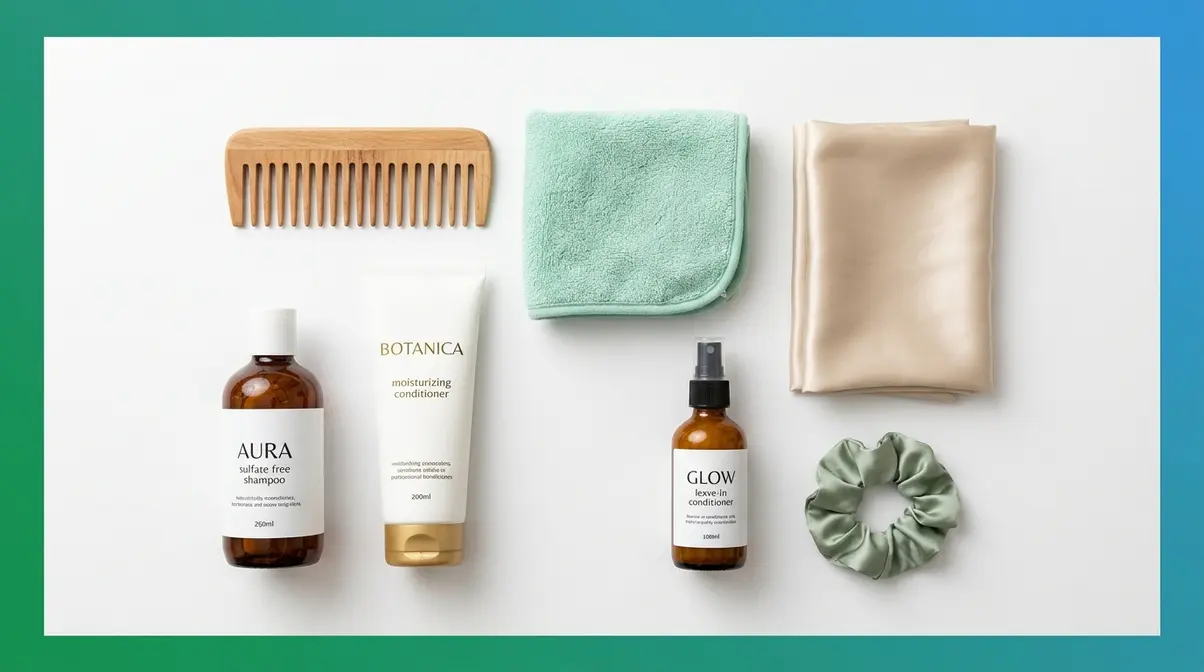
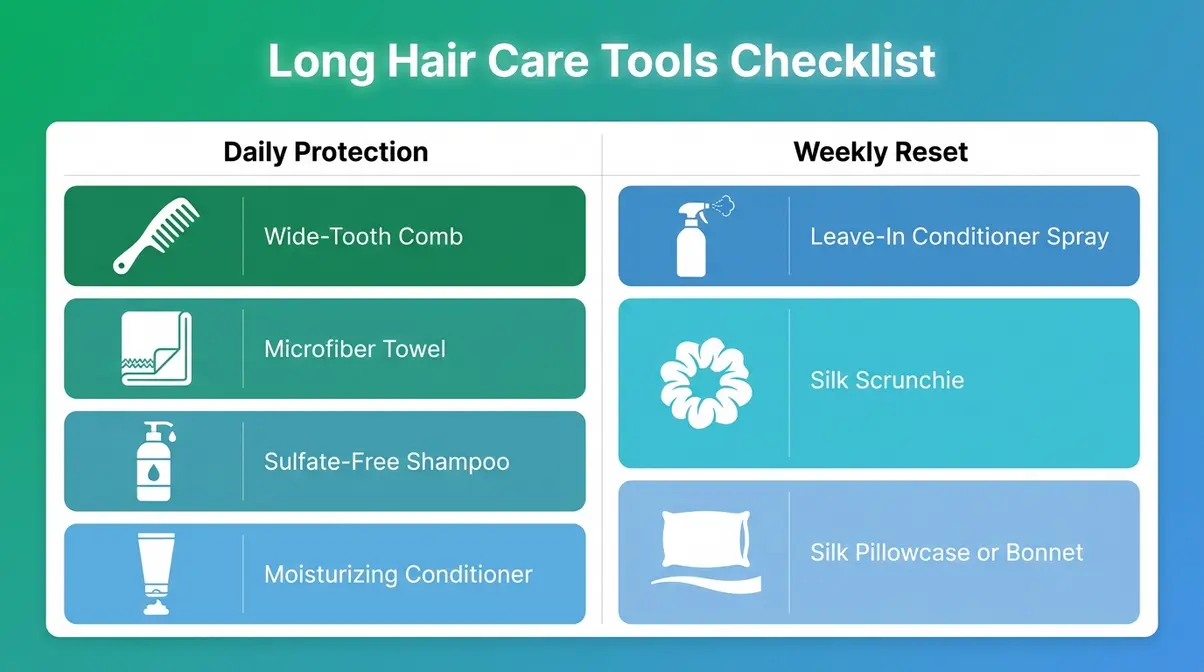
Before diving into the steps, gather these tools. Most long hair damage happens because of the wrong equipment, not the wrong intentions. These are the only items you need to build The Routine Stack — some serve the daily protection layer, and others serve the weekly reset layer.
Tools for Your First Routine
The tools you use matter as much as the techniques. Using a wide-tooth comb on wet hair reduces breakage by reducing mechanical friction on the cuticle (dermatological research on conditioners, PubMed, 2014). Here’s what to have on hand before your first routine:
- Wide-tooth comb: A styling tool with widely spaced teeth that glides through wet hair without snapping strands — unlike a paddle brush, which grabs and pulls
- Microfiber towel or old T-shirt: A soft absorbent cloth that dries hair without the rough friction of a regular cotton bath towel, which roughens the cuticle
- Sulfate-free or gentle shampoo: Cleans the scalp without stripping the natural oils that travel down long strands and keep the lengths moisturized
- Moisturizing conditioner: Neutralizes static and coats the cuticle to reduce friction — this is the single most evidence-backed step for preventing mechanical breakage
- Leave-in conditioner or detangling spray: Provides slip for detangling without rinsing; applied to damp hair before combing
- Silk scrunchies or spiral hair ties: Holds hair without the metal clasp that cuts into strands and creates a tension groove
- Silk pillowcase or silk/satin bonnet: The nightly friction shield that completes the protective layer of The Routine Stack (Step 5)
Now that you have the right tools, here’s exactly how to use them — starting with the foundation of every routine: washing.
Is Long Hair Harder to Maintain?
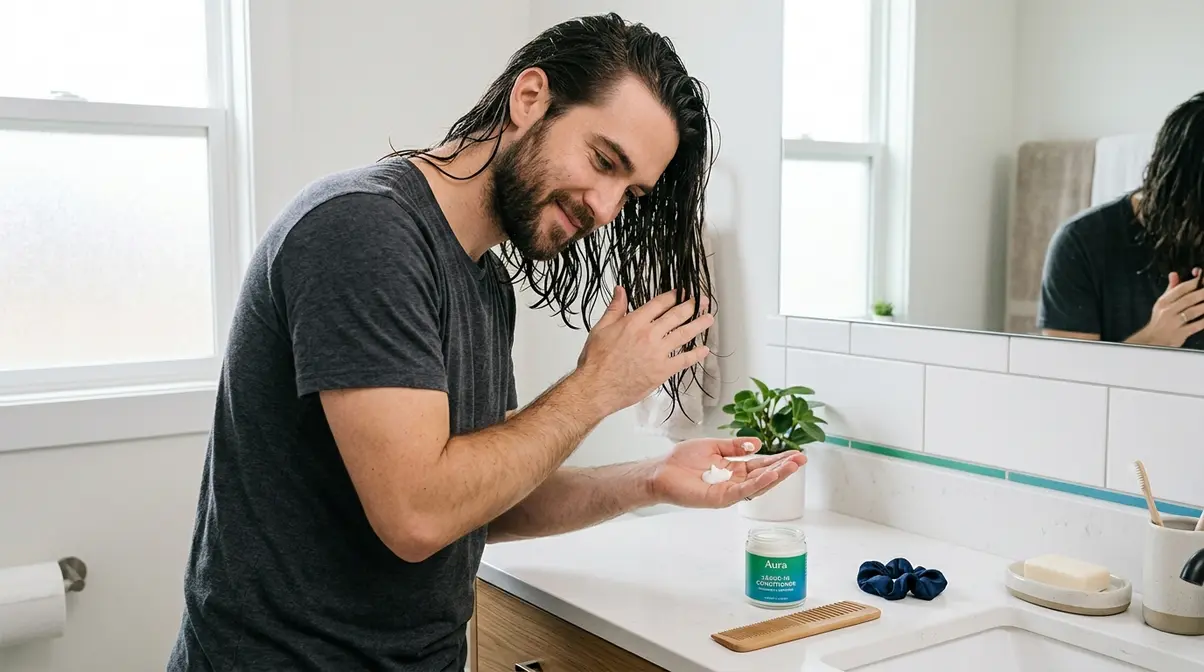
Time is a real concern, especially for beginners. Long hair requires more deliberate care than short hair, but it doesn’t have to be time-consuming. Here’s a realistic breakdown: on wash days, Steps 1–5 take approximately 20–30 minutes. On non-wash days, you only need Steps 3 and 5 — roughly 5 minutes. Once a week, add 20 minutes for a deep-conditioning reset. That’s it. The goal is a repeatable system, not perfection — and it gets faster as the habits become automatic.
Start with Step 1 — the most important thing you’ll do for your long hair.
Step 1: Wash Your Hair the Right Way
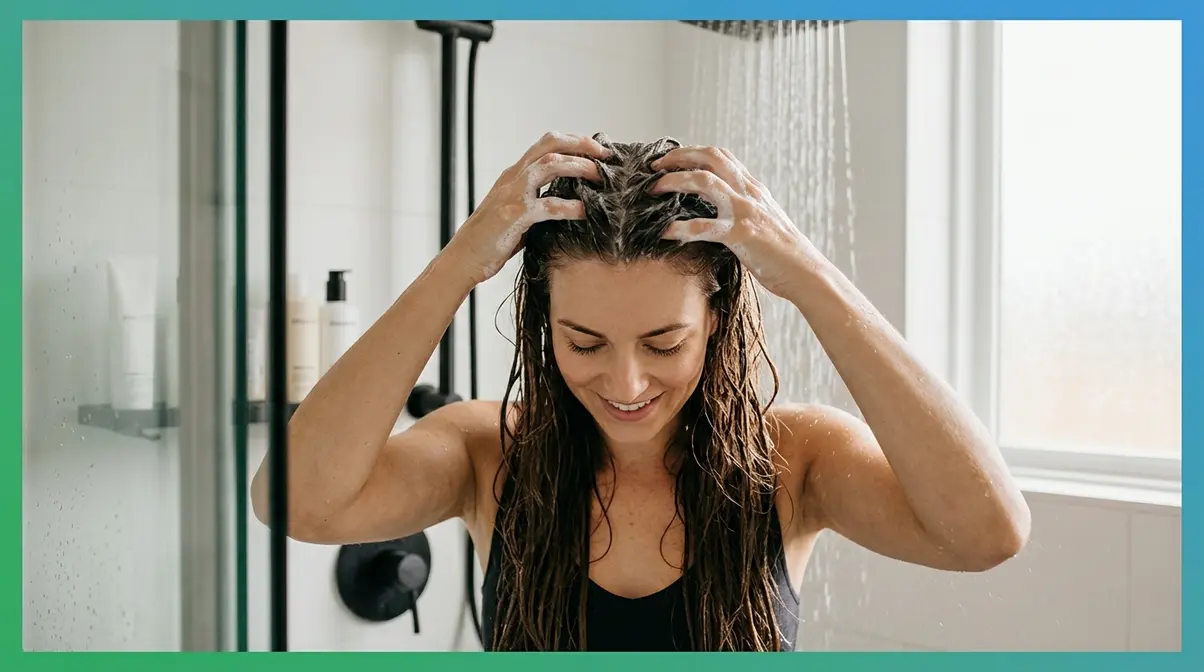
Washing long hair correctly means applying shampoo only to your scalp, not your lengths. This single change prevents the dryness and brittleness that most long-haired people experience. According to Cleveland Clinic guidelines on washing frequency, washing frequency should match your hair type — not a fixed daily schedule (Cleveland Clinic, 2026).
How Often Should You Wash Long Hair?
The general rule for most hair types is 2–3 times per week — not daily. Here’s the reason: your scalp produces natural oils (sebum) that travel down the hair shaft to moisturize the lengths. Washing every day strips those oils before they ever reach your ends, leaving the lengths dry and brittle.
Adjust based on your hair type:
- Fine or oily hair: Up to 3 times per week — oil builds up faster on finer strands
- Thick, curly, or dry hair: 1–2 times per week — these textures need every bit of natural oil they can get (Cleveland Clinic, 2026)
- Men with long hair: Men often have oilier scalps and may find 2–3 times per week is a comfortable starting point — more on this in the men’s section
After two weeks on this schedule, your scalp should feel less oily between washes — it adjusts its oil production to match how often you clean it.
How to Shampoo and Condition
This is where most people go wrong — shampooing root to tip, then skipping conditioner, or applying it to the scalp. The correct technique is specific, and it makes a measurable difference. Dermatological research on conditioners confirms that conditioners neutralize negative electrical charges on the hair fiber, reducing frizz and cuticle damage during combing (PubMed, 2014). For women and men caring for long hair, this step is non-negotiable.
Follow these steps:
- Wet hair thoroughly with lukewarm water — hot water opens the cuticle and increases friction, making hair more vulnerable
- Apply a small amount of sulfate-free shampoo (a gentler formula that cleans without stripping the scalp’s natural oils) to the scalp only — work into a lather with your fingertips, not your nails
- Let the lather rinse down the lengths as you rinse — this is enough to clean the mid-lengths without stripping them
- Apply conditioner from mid-lengths to ends — never on the scalp, where it causes buildup and weighs hair down
- Leave conditioner on for 2–3 minutes before rinsing, so it has time to coat and smooth the cuticle
After rinsing, your ends should feel smooth and slip through your fingers easily — not rough or squeaky.
Rinsing Without Leaving Residue
Residue left in the lengths causes buildup that makes hair feel heavy and greasy within a day. Rinse completely, then finish with a cool (not ice cold) rinse:
- Rinse thoroughly with lukewarm water first, working your fingers through the lengths to remove all conditioner
- Finish with a cool water rinse — this closes the cuticle, sealing in moisture and adding visible shine
- Apply leave-in conditioner to damp (not soaking wet) hair after towel blotting — do NOT rinse it out
For women with long hair, a final cool rinse is one of the most underused techniques for reducing frizz and keeping the cuticle smooth between washes. Your hair should feel clean at the roots and slippery-smooth at the ends after this step.
You’ve washed correctly. Now the most common mistake happens — drying. Here’s how to avoid it.
Step 2: Dry Your Hair Without Causing Damage

The moment you step out of the shower is when most long hair damage occurs. Wet hair is fragile — it stretches and snaps under friction. Knowing how to dry your hair correctly is one of the most important parts of how to take care of long hair, and it takes almost no extra time once you know the technique.
Why Rubbing with a Towel Breaks Hair
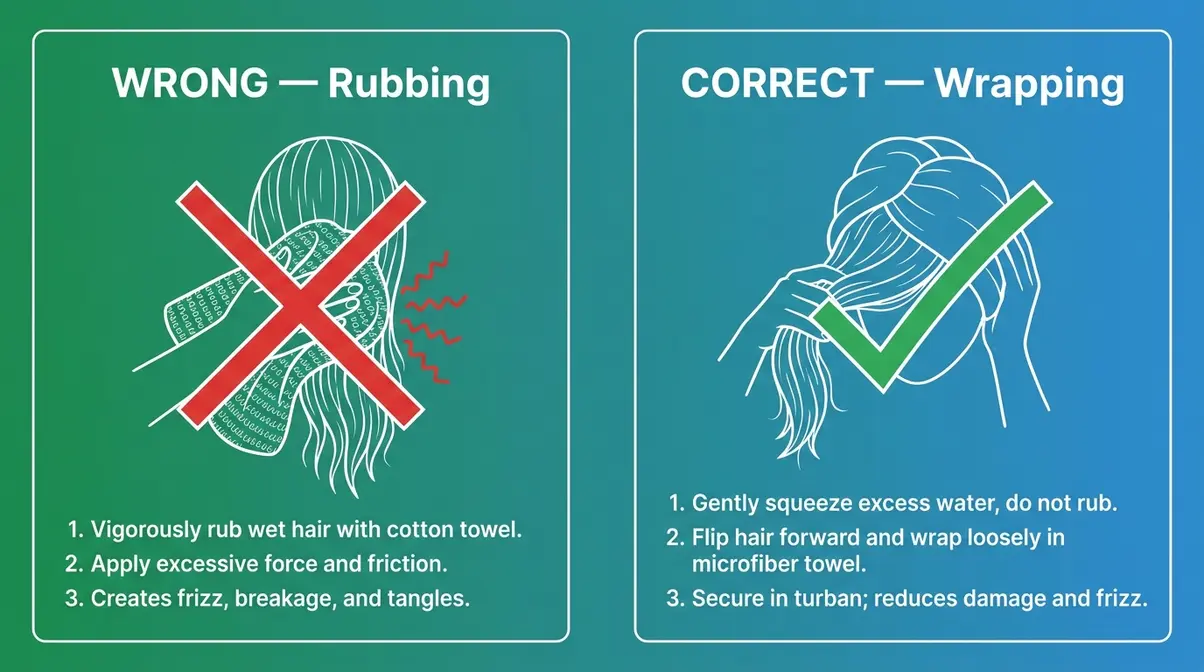
Wet hair is in a weakened state. The hydrogen bonds that give hair its strength are temporarily broken by water, making each strand far more elastic and prone to snapping under stress. Rubbing with a regular cotton towel creates friction that roughens the cuticle (the outer protective layer of each hair strand) and causes the shaft to tangle and snap. This is especially damaging for long hair — the lengths have been exposed to more weathering than the roots over months or years of growth, making them structurally thinner and more fragile, as noted in a scientific overview of hair weathering (PubMed, 2015).
After this section, you’ll understand exactly why your brush comes away with broken hairs after drying — and how to stop it.
How to Towel-Dry and Air-Dry
Dermatologist-recommended habits to prevent breakage from the American Academy of Dermatology (AAD) — the professional body representing U.S. dermatologists — confirm that wrapping hair in a towel rather than rubbing it prevents mechanical breakage and traction damage (AAD, 2026). Here’s the correct technique:
- Gently squeeze (do not wring) excess water from your hair with your hands first
- Lay your microfiber towel flat, flip your hair forward, and wrap the towel in a loose turban shape
- Leave for 10–15 minutes — the microfiber absorbs water without friction
- Remove and let air-dry, or use a diffuser attachment on low heat
Air-drying is the healthiest option — no heat exposure at all. Detangle with a wide-tooth comb while hair is damp, not soaking wet. If you need to use a blow dryer, always apply a heat protectant spray to damp hair first and keep the dryer moving — never hold it in one spot for more than two seconds.
After this step, your hair should feel damp but not dripping, with no rough or tangled sections.
Your hair is damp and ready. Now comes the step most people do wrong: detangling.
Step 3: Detangle Without Breakage
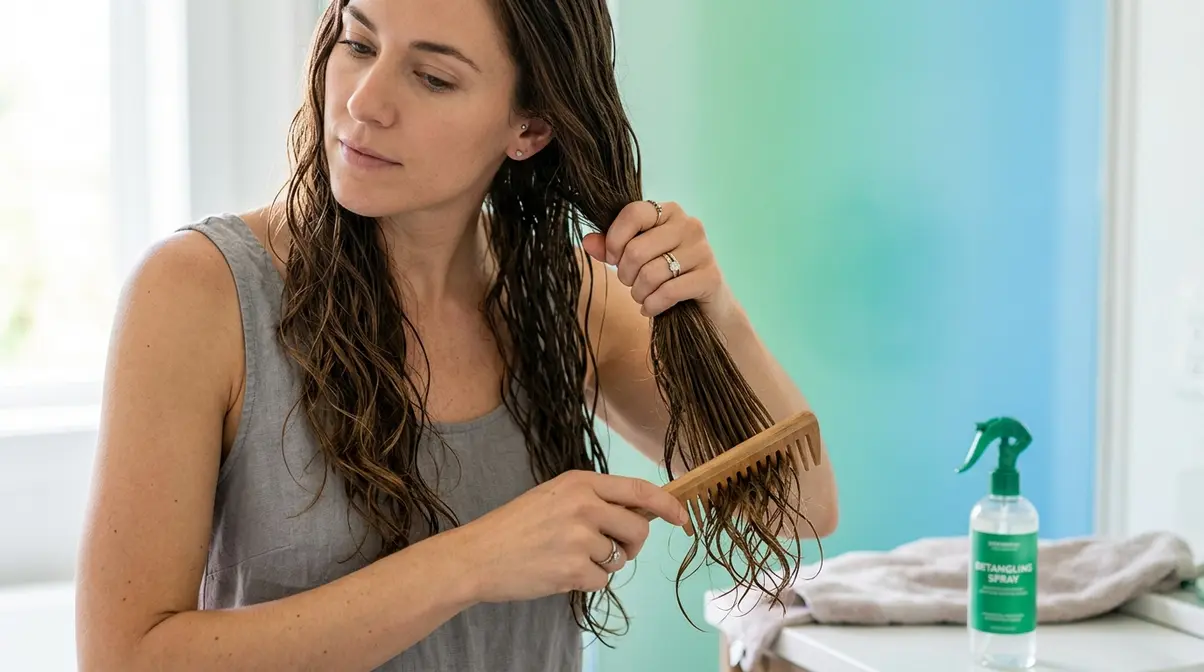
Detangling is where most long hair breakage happens — not because people are careless, but because they start at the roots. Starting at the roots forces knots down the full length of the hair, snapping strands with every stroke. The fix is simple: always start at the ends.
“Brush from the bottom up to prevent breakage.”
— The most consistent advice across the r/longhair community on Reddit
Choosing the Right Brush or Comb
The tool you choose depends entirely on whether your hair is wet or dry:
| Tool | Best For | Avoid When |
|---|---|---|
| Wide-tooth comb | Wet or damp hair — glides without catching | Hair is bone dry (use boar bristle instead) |
| Detangling brush | Damp hair, thick or curly textures — flexible bristles bend around knots | Soaking wet hair (too much friction) |
| Paddle or boar-bristle brush | Dry hair only — distributes natural oils down the shaft | Any time hair is wet or damp |
| Fine-tooth comb | Styling dry hair near the scalp | Wet or tangled hair (will snap strands) |
“
How to Detangle from the Bottom Up
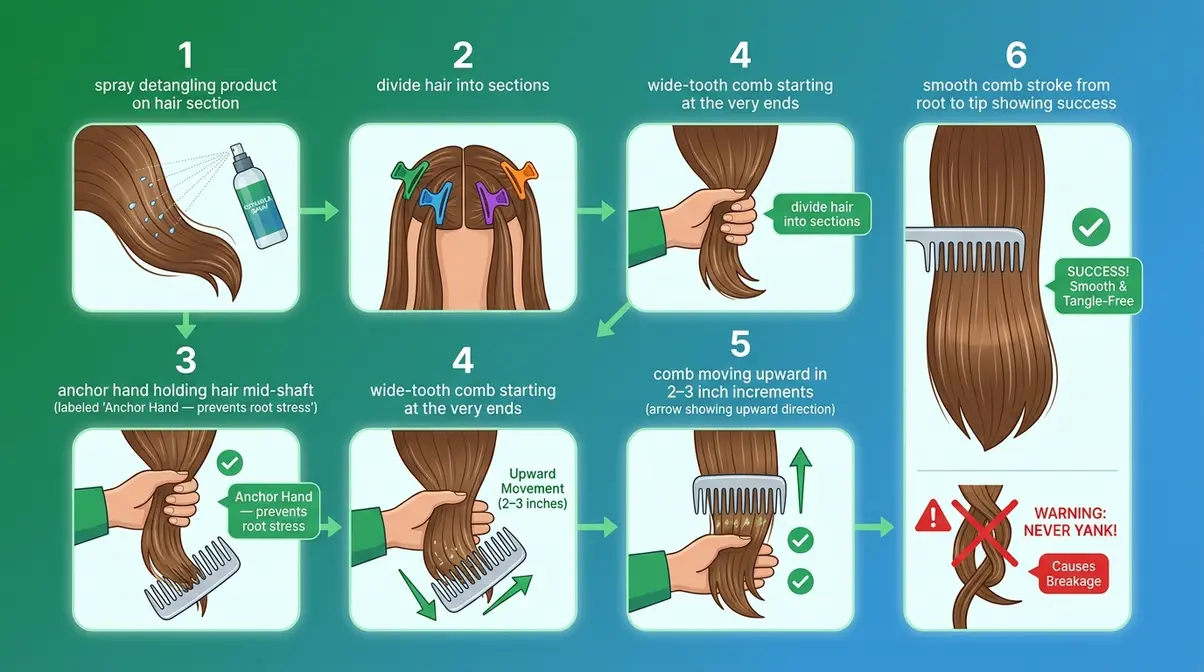
Johns Hopkins advice on hair structural integrity recommends using a wide-tooth comb on wet hair and minimizing heat styling tools that strip moisture (Johns Hopkins Medicine, 2026). The bottom-up technique is the practical application of that principle. Follow these steps exactly:
- Apply a small amount of detangling spray or leave-in conditioner to damp hair — this adds “slip” so the comb glides instead of catches.
- Divide hair into 2–4 sections using your fingers — smaller sections mean less pulling and more control.
- Hold a section near the middle with one hand — this is your “anchor hand,” and it’s the detail most guides skip. Holding above the knot prevents the tugging force from reaching the scalp and causing follicle stress.
- Start your wide-tooth comb at the very ends — work through any knots at the tips first, using short, gentle strokes.
- Move the comb up 2–3 inches at a time, working toward the roots incrementally.
- Never yank through a knot — stop, hold the hair above the knot with your anchor hand, and work through it gently before moving higher.
After detangling, you should be able to run a wide-tooth comb from root to tip in one smooth motion with no snagging.
When and How to Use a Detangling Spray
A detangling spray adds “slip” — it temporarily coats the hair shaft so the comb glides rather than catches. Apply to damp (not soaking wet) hair in sections before combing, using 1–2 sprays per section from mid-length to ends. A budget alternative that works well: diluted conditioner in a clean spray bottle. Avoid heavy oils or serums as a substitute — they weigh down fine hair and cause buildup over time. Once your hair is detangled and damp, it’s time to protect it from the heat.
Step 4: Protect Your Hair from Heat Damage
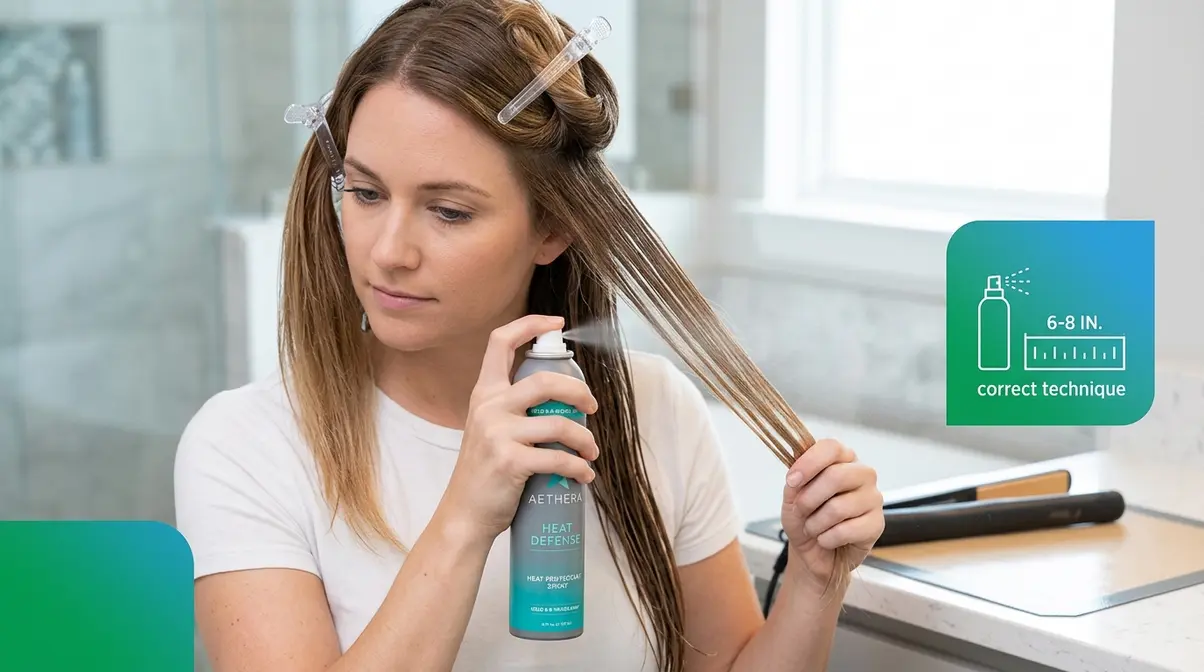
Heat styling is one of the most common ways long hair gets damaged. The lengths of your hair are the oldest part — they’ve been through more washing, brushing, and sun exposure than the roots. They need protection before any heat touches them. A heat protectant spray — a product that coats the hair shaft with a film that disperses heat before it can penetrate the cuticle — is not optional if you use any heat tools.
How to Apply Heat Protectant Correctly
Applying heat protectant to damp hair before any heat styling is the single most effective way to prevent long-term heat damage to long hair (American Academy of Dermatology, 2026). Most people spray it on unevenly and assume it’s working. Here’s the correct technique:
- Towel-dry hair first — heat protectant works best on damp (not soaking wet) hair, where it bonds to the surface evenly
- Section hair into 4–6 parts for thorough coverage
- Spray 6–8 inches from the hair, working section by section from mid-lengths to ends
- Comb through each section with a wide-tooth comb to distribute the product evenly
- Do NOT apply to the scalp — heat protectant on the scalp causes buildup and can clog follicles
Temperature guidance: Keep flat irons and curling wands below 230°C (450°F). For fine or already-damaged hair, stay below 180°C (356°F) — heat above those thresholds permanently alters the hair’s protein structure and cannot be repaired by any product.
After applying, the hair should feel slightly coated but not greasy. If it feels wet, you’ve used too much.
Limiting Heat Without Losing Style
A practical target for most people: use heat tools no more than three times per week. On non-heat days, heatless styles do the heavy lifting:
- Overnight braids: Braid damp hair before bed for natural waves in the morning — no heat needed
- Twist buns: Twist damp sections and secure with a silk scrunchie for loose, defined curls by morning
- Air-dry with microfiber: Let the microfiber towel do the work and embrace your hair’s natural texture
For men with long hair, skipping heat tools entirely is actually an advantage. Daily heat is the fastest route to split ends, and most men’s long-hair styles look better with natural texture anyway. Once you’ve protected your hair from heat, the next step is protecting it while you sleep — this is where most people lose length without realizing it.
Step 5: Protect Your Hair at Night

Cotton pillowcases create friction every time your head moves during sleep. Over a full night, that friction roughens the cuticle and causes the kind of slow, cumulative breakage that’s hard to trace back to a single cause. Caring for long hair at night is one of the highest-ROI habits you can build — it takes five minutes and protects hours of daytime effort.
Pineapple Method and Sleep Braids
Two protective styles work for most hair types:
The pineapple method — a protective style where you gather all your hair into a very loose, high ponytail on top of your head before sleeping — works best for wavy, curly, or thick hair because it preserves curl pattern overnight:
- Flip all your hair to the top of your head
- Gather loosely with a silk scrunchie — the key word is loosely (no tension on the roots)
- The hair sits in a loose “fountain” shape on top — not a tight bun
Loose braid alternative — better for straight or fine hair, which doesn’t need the volume at the crown:
- Gather hair into one or two loose braids
- Secure with a silk scrunchie — never a metal elastic, which creates a tension groove in the shaft
What NOT to do: Tight ponytails with regular elastics cause traction damage — repeated tension at the tie point leads to breakage exactly where the elastic sits. After trying a protective style for one week, you should notice fewer tangles in the morning and less hair on your brush.
Silk Pillowcases vs. Silk Bonnets
Sleeping on a silk or satin pillowcase significantly reduces friction-related breakage and frizz compared to cotton pillowcases, which roughen the hair cuticle during movement (Turbie Twist, 2026). Here’s how the two main options compare:
| Option | Best For | Drawback |
|---|---|---|
| Silk pillowcase | All hair types; beginner-friendly (no effort) | Hair can slide off; doesn’t fully contain very long or thick hair |
| Silk bonnet | Curly, thick, or very long hair (past shoulder blades) | Some find it uncomfortable; must be the right size |
| Satin bonnet or pillowcase | Budget-conscious beginners | Slightly less smooth than real silk, but still far better than cotton |
You now have a complete daily routine. The next layer of The Routine Stack is what you do weekly and monthly to reset and maintain your hair’s health.
Your Weekly and Monthly Long Hair Routine
Your daily routine — washing, drying, detangling, and protecting — keeps your hair from getting worse. But once a week, you need to actively repair and restore it. This is the second layer of The Routine Stack: the weekly reset that reverses the small amounts of damage that accumulate every day.
The Weekly Deep-Conditioning Reset
Regular conditioner coats the surface of the hair shaft. A deep conditioning mask — a thick, intensive treatment left on the hair for 10–30 minutes — goes further, penetrating the cortex (the inner structural layer) to restore moisture from the inside out. For long hair, which has been exposed to more cumulative damage than short hair, this weekly step is what separates hair that grows and holds length from hair that stays perpetually dry and brittle.
Here’s how to do it:
- Shampoo your scalp as usual, then rinse
- Squeeze out excess water from the lengths — the mask absorbs better into damp, not soaking wet, hair
- Apply a deep conditioning mask generously from mid-lengths to ends
- Comb through with a wide-tooth comb to distribute evenly
- Cover with a shower cap and leave for 20–30 minutes — wrapping a warm towel over the cap speeds absorption by opening the cuticle slightly
- Rinse thoroughly with cool water to seal everything in
After your first weekly mask, the difference in how your ends feel — softer, smoother, less prone to tangling — is usually noticeable immediately.
Trimming for Healthy Growth
Getting a micro-trim every 8 to 12 weeks prevents split ends from traveling up the hair shaft — the main cause of length loss in long hair (Theradome, 2026). This surprises many beginners who avoid trims because they want to grow length. The logic is counterintuitive but sound: a split end doesn’t stop splitting. It travels upward, and by the time you can see it clearly, it’s already traveled several centimeters. A small trim every 8–12 weeks removes less total length than waiting 6 months for a larger cut.
A good ultimate long hair care guide will reinforce this point — consistent micro-trims are the single most reliable way to retain length over the long term.
Monthly Scalp Care and Protein Treatment
Once a month, shift attention from the lengths to the scalp — the foundation of healthy hair growth. A healthy scalp means healthy follicles, which means stronger hair from the root.
Monthly scalp massage: Use your fingertips (not nails) to massage the scalp in small circular motions for 3–5 minutes. This increases blood circulation to the follicles. Some people add a few drops of a lightweight oil (jojoba or rosehip) to their fingertips during the massage. In summer months, this is also a good time to check for product buildup from dry shampoos or styling products.
Monthly protein treatment: A protein treatment — a product that temporarily fills in damaged areas of the hair shaft to restore strength — is especially useful if your hair feels limp, stretchy when wet, or unusually prone to breakage. Use it once a month, not weekly — over-proteining can make hair feel stiff and brittle. Apply like a deep conditioner, leave for 15–20 minutes, and rinse well.
Long Hair Care for Men
Men growing out their hair face a specific challenge that most guides ignore entirely: the process looks and feels different at every stage, and the styling rules that apply to women’s long hair don’t always translate. The basics of The Routine Stack — gentle washing, bottom-up detangling, heat protection, night protection — apply equally. What differs is the context.
The Awkward Growth Stage: What to Expect
The most common question from men growing long hair is: “How do I get through the stage where it looks terrible?” That stage — roughly from ear-length to shoulder-length — typically lasts 6–12 months, and it’s the point where most men give up. Common pain points reported by the r/longhair community include the hair sticking out at awkward angles, feeling limp at the sides, and not being long enough to tie back.
Here’s what actually helps during this stage:
- Use a light leave-in conditioner to weigh the hair down slightly and reduce the “poofing” at the sides
- Get a shape-up trim every 10–12 weeks — not to cut length, but to remove bulk and keep the shape intentional rather than shapeless
- Start the scalp massage habit now — men often have oilier scalps, and regular scalp care during the growth phase supports follicle health
- Embrace half-up styles as soon as the hair is long enough — even a small half-bun reduces the awkward-middle-length appearance significantly
The awkward stage ends. The men who make it through are the ones who treat it as a temporary phase with a known endpoint, not a permanent problem.
Simple Styling Tips for Men
Once past shoulder length, men have more options than most realize. Across professional styling communities, the consistent advice is to keep it simple — complex styling on long men’s hair often looks effortful rather than intentional.
Practical everyday styles:
- Man bun: Gather hair at the crown or nape and secure with a silk scrunchie. Keep it loose — a tight bun creates traction damage at the hairline over time
- Half-up, half-down: Pull the top layer back and secure, leaving the rest down. Works at every length past ear-level
- Low ponytail: The lowest-effort style and the easiest on the hair. Use a spiral hair tie to avoid creasing
- Loose braid: A single loose braid works for the gym, outdoor activities, or sleep protection — and it requires no skill to learn
For men with long hair who use zero heat tools (which is most men), a lightweight leave-in conditioner applied after washing is usually all the styling product needed. Visit Hudson Hawk’s long hair tips for men for additional technique guidance specific to men’s hair textures and growth patterns.
Adjusting Your Routine for Your Hair Type
The Routine Stack works for all hair types, but the emphasis shifts depending on your texture. Here’s how to tune each step for your specific hair.
Curly and Wavy Long Hair
Curly and wavy hair is the most prone to dryness and frizz because the natural oils from the scalp have a harder time traveling down a curved shaft. Wash 1–2 times per week maximum. Apply conditioner generously and consider the “squish to condish” method — gently squishing water and conditioner into the hair while still in the shower to encourage curl clumping. Deep condition weekly without fail. The pineapple method at night is especially valuable here, as it preserves curl definition overnight.
Thick Long Hair
Thick hair holds moisture well but takes much longer to dry, making it vulnerable to breakage if detangled too soon after washing. Divide into more sections (4–6) during detangling. Use a deep conditioning mask every 5–7 days rather than weekly. When air-drying, a second microfiber towel wrap after the first 15 minutes speeds the process without heat. Managing frizz and volume in thick hair is also about layering — a leave-in conditioner followed by a lightweight oil on the ends seals moisture without weighing the hair down.
Thin or Fine Long Hair
Fine hair breaks more easily and shows damage faster than other textures. Use a lightweight conditioner rather than a heavy mask — rich formulas weigh fine hair down and make it look flat. Wash 2–3 times per week to prevent oil buildup, which flattens fine hair further. Avoid heavy oils entirely. For night protection, the loose braid works better than the pineapple method, which can add unwanted volume at the crown. Building volume in fine long hair comes from technique, not product — focus on root lifting while blow-drying on low heat with a diffuser.
Straight Long Hair
Straight hair shows grease and product buildup quickly, which is why many people with straight long hair over-wash. Resist the urge — 2–3 times per week is still the right target. Straight hair benefits most from the cool-water rinse after conditioning, which adds visible shine and smoothness. Because straight hair lies flat, damage like split ends and breakage is more visible than on curly textures. Regular micro-trims every 8–10 weeks keep the ends looking clean and intentional.
What the Community Says: Top Tips from Reddit
Most Upvoted r/longhair Advice
Brand-driven guides have an obvious bias. Community consensus from people who actually live with long hair every day is a different kind of signal. Common pain points and solutions reported by the r/longhair community reflect years of collective trial and error — and they align closely with what professional stylists and dermatologists recommend.
The most consistently upvoted advice across the community includes:
- Switch to a silk or satin pillowcase immediately — this is described as the single highest-impact change most people make, with noticeable results in morning tangling within days
- Stop using regular hair elastics — the metal clasp or tight band creates a breakage point exactly where it sits. Spiral ties and silk scrunchies are the universal replacement
- Detangle before washing, not after — gently working through dry hair before stepping into the shower prevents the wet hair from tangling further under the water pressure
- Less shampoo, more conditioner — the community consensus is that most people are over-shampooing and under-conditioning, especially at the ends
- Protective styles for the gym — a loose braid or bun during workouts prevents the mechanical damage from hair rubbing against clothing and equipment
- Patience with growth — the most common advice for beginners: set a 6-month horizon before evaluating results. Hair grows approximately 6 inches per year on average, and visible progress takes time
These aren’t revolutionary insights — they’re the basics done consistently. That consistency is the point.
Common Long Hair Care Mistakes to Avoid
Mistakes That Cause Breakage
Understanding what not to do is just as important as knowing the correct technique. The following mistakes are responsible for most preventable long hair damage:
- Brushing wet hair with a paddle brush: Wet hair stretches up to 30% before snapping. A paddle brush on wet hair pulls through knots rather than releasing them. Use a wide-tooth comb only until hair is at least 80% dry
- Skipping heat protectant “just this once”: Heat damage is cumulative and permanent. Each unprotected heat session adds to the total damage load on the lengths
- Tight hairstyles every day: Daily tight ponytails or buns cause traction alopecia — gradual hair loss along the hairline from repeated tension. Vary your styles and always keep the tension loose
- Washing with hot water: Hot water lifts the cuticle and increases friction during washing. Lukewarm for the wash, cool for the final rinse
- Sleeping on wet hair: Wet hair is fragile, and movement during sleep on a cotton pillowcase while wet is a reliable recipe for breakage and matting
When to Consider a Different Approach
The Routine Stack works for the vast majority of long hair types, but there are situations where a different approach makes more sense. If you’re experiencing significant hair loss (more than 100–150 strands per day), a thinning part, or bald patches, the issue may be medical — not mechanical. Conditions like telogen effluvium, androgenetic alopecia, or scalp conditions like seborrheic dermatitis require evaluation by a dermatologist or trichologist, not a new routine.
Similarly, if your hair has been chemically processed (bleached, permed, or relaxed), the damage threshold is lower and the standard routine may need adjusting. Chemically processed hair often needs protein treatments more frequently (every 2–3 weeks rather than monthly) and benefits from a lower maximum heat temperature (below 180°C / 356°F). If in doubt, consult a licensed stylist who specializes in chemically processed hair — a single consultation can prevent months of compounding damage. For a comprehensive overview of all the above, the Ogle School’s guide to keeping long hair healthy covers professional-level context that goes beyond routine basics.
Frequently Asked Questions
Does long hair cause hair loss?
Having long hair does not inherently cause hair loss, but improper care can lead to breakage that looks like thinning. Tight hairstyles, heavy extensions, and aggressive brushing create traction and mechanical damage. When you follow a gentle routine, your hair remains securely anchored in the follicle. If you notice excessive shedding at the root, consult a dermatologist.
How do girls maintain long hair?
The most effective approach is washing 2–3 times per week, conditioning from mid-lengths to ends, detangling bottom-up with a wide-tooth comb, and protecting hair at night. For women with long hair, the weekly deep-conditioning mask is the single highest-impact addition to a basic routine.
What is the healthiest way to wear long hair?
Loose, low-tension styles are the healthiest way to wear long hair day-to-day. Tight buns, high ponytails, and styles with metal elastics create repeated tension at the same points on the shaft. This leads to traction damage and breakage over time. The healthiest everyday options are a loose low ponytail with a spiral tie, a loose braid, or wearing it fully down. For sleeping, the pineapple method or a loose braid with a silk scrunchie eliminates overnight friction.
How often should I trim long hair to keep it healthy?
Trim every 8–12 weeks to keep long hair healthy and growing. A micro-trim — removing just 0.5–1 cm — is enough to remove split ends before they travel up the shaft, according to Theradome (2026). Many people avoid trims because they want to grow length, but this is counterproductive. A split end that isn’t removed keeps splitting upward, eventually requiring a larger cut.
Conclusion
For anyone frustrated with dry, tangled, or breaking long hair, the answer isn’t more products — it’s a more deliberate system. If you are wondering exactly how to take care of long hair without getting overwhelmed, The Routine Stack makes that system concrete: daily habits (washing correctly, drying gently, detangling bottom-up, protecting from heat) layered on top of a weekly reset (deep conditioning, scalp care) and monthly maintenance (protein treatments, micro-trims).
Research confirms that conditioners reduce mechanical friction on the hair fiber (PubMed, 2014), that wrapping rather than rubbing prevents cuticle damage (AAD, 2026), and that consistent micro-trims every 8–12 weeks are the most reliable way to retain length over time (Theradome, 2026). The techniques in this guide reflect community consensus from r/longhair, professional stylist advice, and dermatologist-backed recommendations — not a single brand’s marketing.
The Routine Stack works because it removes the guesswork. You don’t need to remember a list of 20 tips — you need two layers: what you do every day and what you do once a week. Every technique in this guide fits one of those two layers.
Start tonight with Step 5: swap your cotton pillowcase for a silk or satin one, or gather your hair into a loose braid with a silk scrunchie before bed. That one change — five seconds of effort — will show you measurable results within a week. Then add one step at a time until the full routine is second nature. For a deeper dive into every aspect of long hair care, the ultimate long hair care guide covers advanced topics including color-treated hair, growth supplements, and scalp conditions.

Dave King
Writes evidence-based hair-care guides for Care About Your Hair — for every hair type, jargon-free and independent.