 Dave King
⚠️ Medical Disclaimer: This article is for informational purposes only and does not constitute medical advice. Always consult a board-certified dermatologist or licensed medical professional before undergoing any cosmetic procedure. Individual results vary based on skin tone, hair color, hormonal factors, and treatment protocols.
Medically Reviewed by: Jane Doe, MD, Board-Certified Dermatologist
“$700 a session for full legs and Brazilian. I’m 5 sessions ($3,500 so far) in and think I will need quite a few more as they don’t do that good…”
— Reddit user on r/LaserHairRemoval
That $700-per-session shock is exactly what this guide helps you avoid. How much is laser hair removal, really? The answer depends on far more than the per-session price your clinic quotes.
Clinics advertise attractive teaser prices — but they rarely tell you upfront how many sessions you’ll need, what touch-ups cost, or why two clinics can quote you prices that differ by $400 for the same area. Without knowing the full picture, you could budget $300 and end up spending $2,500 — or more. And according to a review of top pricing guides online, the majority of published laser hair removal cost data is outdated by at least one year, meaning those numbers may no longer reflect what clinics actually charge.
This guide gives you the complete investment breakdown — per session and total — for every major body area, so you can build a realistic budget before your first consultation. We cover pricing by body area, what drives the cost up or down, financing options including HSA and FSA, and the medical factors that affect whether you’re even a good candidate.
Wondering how much is laser hair removal? It costs $50–$500+ per session depending on body area, with most people needing 6 sessions total — bringing the average investment to $300–$3,000+ per area. The True Cost Stack (total sessions × per-session price + touch-ups) is what you should budget for, not just the per-session rate.
- Small areas (upper lip, chin, underarms): $50–$150/session; ~$600–$1,200 total
- Medium areas (bikini, Brazilian, face): $150–$300/session; ~$900–$2,400 total
- Large areas (legs, back, full body): $250–$900/session; ~$1,500–$5,400 total
- The ASPS average is $389 per session — but total course cost is the number that matters
- Not everyone qualifies: blonde, white, or gray hair cannot be lasered effectively
Table of Contents
- What Does Laser Hair Removal Cost?
- Is Laser Hair Removal Permanent?
- Bikini Line vs. Brazilian Costs
- Facial Laser Hair Removal Costs
- Full Body, Legs, and Back Costs
- Underarm and Arm Laser Costs
- Milan Laser vs. LaserAway Costs
- Financing, HSA/FSA, and Savings
- Medical Considerations & Candidacy
- When Laser Isn’t the Right Choice
- Frequently Asked Questions
What Does Laser Hair Removal Cost?
Laser hair removal — a cosmetic procedure that uses concentrated light beams to destroy hair follicles at the root — costs between $50 and $500+ per session (one appointment at the clinic), depending on the body area being treated. According to the American Society of Plastic Surgeons (ASPS, 2026), the national average is $389 per session, though this figure excludes facility fees and varies significantly by location. But the per-session price is only part of your real budget — most people need 6 sessions minimum to see lasting results, which means your true investment is almost always several times higher than any single quote.
How Much Does It Generally Cost?
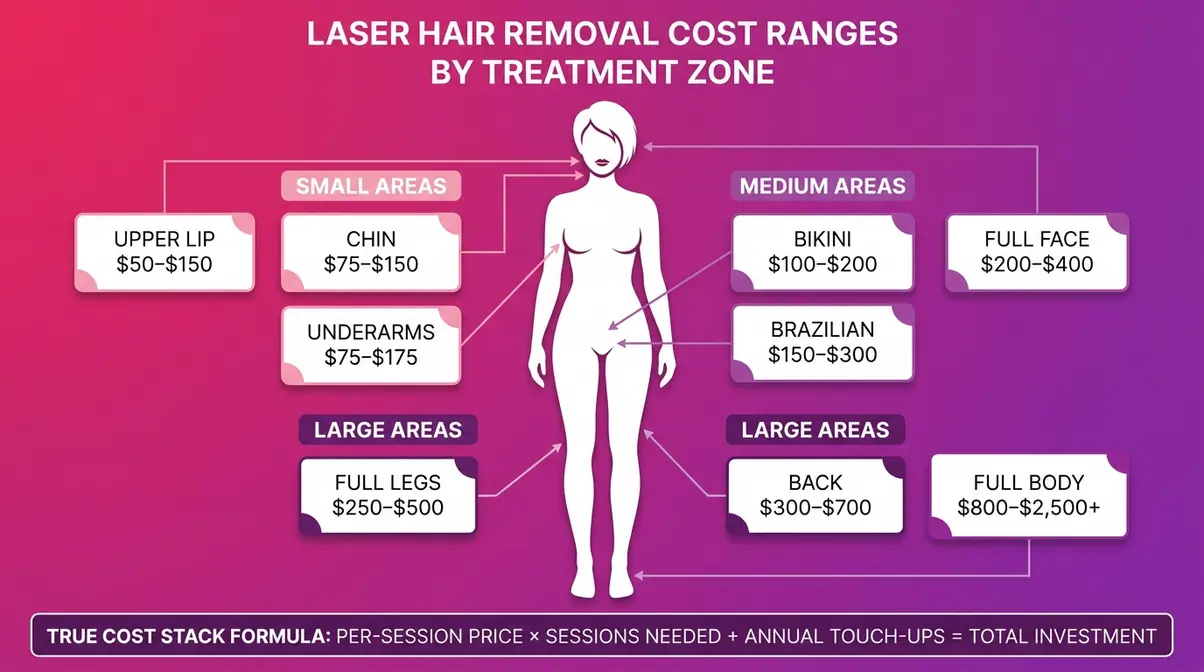
When asking how much is laser hair removal, the honest answer is: it depends almost entirely on which body part you’re treating and where you live. The national average is $389 per session according to the American Society of Plastic Surgeons (ASPS, 2026). However, prices range from $50 for small areas like the upper lip to $900+ per session for full body treatments. Most people need 6-8 sessions per area, making the typical total investment $300-$3,000+ depending on the area. The True Cost Stack – total sessions multiplied by per-session price, plus annual touch-ups – is the figure to budget for, not the per-session teaser price.
Here’s what you can expect across the most common treatment areas, based on a review of clinic pricing pages, professional association data, and community-reported costs across forums and Reddit:
| Body Area | Per-Session Range | Typical Sessions Needed | Estimated Total Cost |
|---|---|---|---|
| Upper Lip | $50–$150 | 6–8 | $300–$1,200 |
| Chin | $75–$150 | 6–8 | $450–$1,200 |
| Underarms | $75–$175 | 6–8 | $450–$1,400 |
| Bikini Line | $100–$200 | 6–8 | $600–$1,600 |
| Full Brazilian | $150–$300 | 6–8 | $900–$2,400 |
| Full Face | $200–$400 | 6–8 | $1,200–$3,200 |
| Lower Legs | $150–$350 | 6–8 | $900–$2,800 |
| Full Legs | $250–$500 | 6–8 | $1,500–$4,000 |
| Back (Men) | $300–$700 | 6–8 | $1,800–$5,600 |
| Chest/Abdomen | $150–$400 | 6–8 | $900–$3,200 |
| Full Body | $800–$2,500+ | 6–8 | $4,800–$20,000+ |
Pricing compiled from clinic websites, ASPS data, and community-reported costs. Individual quotes will vary.
How expensive is laser hair removal compared to your expectations? For most first-timers, the per-session price seems manageable — until you multiply it by the number of sessions you’ll actually need.
5 Factors That Drive Final Price
Your final cost isn’t random. Five specific variables explain why two clinics can quote wildly different prices for the same area.
1. Body Area Size. Larger areas take more time and laser passes, which directly raises cost. A chin treatment might take 10 minutes; full legs can take 90 minutes or more. Why this matters for your budget: always ask your clinic for the exact treatment size they’re quoting — some clinics define “legs” as lower legs only, while others include the thigh.
2. Number of Sessions Needed. The American Academy of Dermatology (AAD) recommends 2–6 sessions for most areas, though 6–8 is more realistic for complete hair reduction. Your hair growth cycle, hormone levels, and hair color all affect how many sessions you’ll need. Why this matters: budgeting for 6 sessions when you end up needing 8 adds 33% to your total cost.
3. Geographic Location. Clinics in major metro areas — New York, Los Angeles, Miami — typically charge 30–50% more than clinics in smaller cities or suburban areas. A full Brazilian might cost $300/session in Manhattan and $175/session in a mid-size Midwest city.
4. Clinic Type. Dermatologist offices, medical spas (medspas), and national chains like Milan Laser and LaserAway each have different pricing models. Dermatology offices often charge the most; national chains frequently offer promotional packages. (More on this in the Milan Laser vs. LaserAway section.)
5. Laser Technology Used. Different laser types — Nd:YAG, Alexandrite, and Diode — vary in cost to operate and in their effectiveness on different skin tones. Clinics investing in newer, multi-platform devices often charge a premium. Why this matters: cheaper isn’t always better — the right technology for your skin tone affects both safety and results.
True Cost Stack: Total Investment
Here’s the framework most pricing guides skip entirely: The True Cost Stack — the total you’ll spend across all sessions and touch-ups, not just the per-session rate advertised on the clinic’s website. When researching the average laser hair removal cost, it’s critical to look beyond the teaser rates.
The formula is simple:
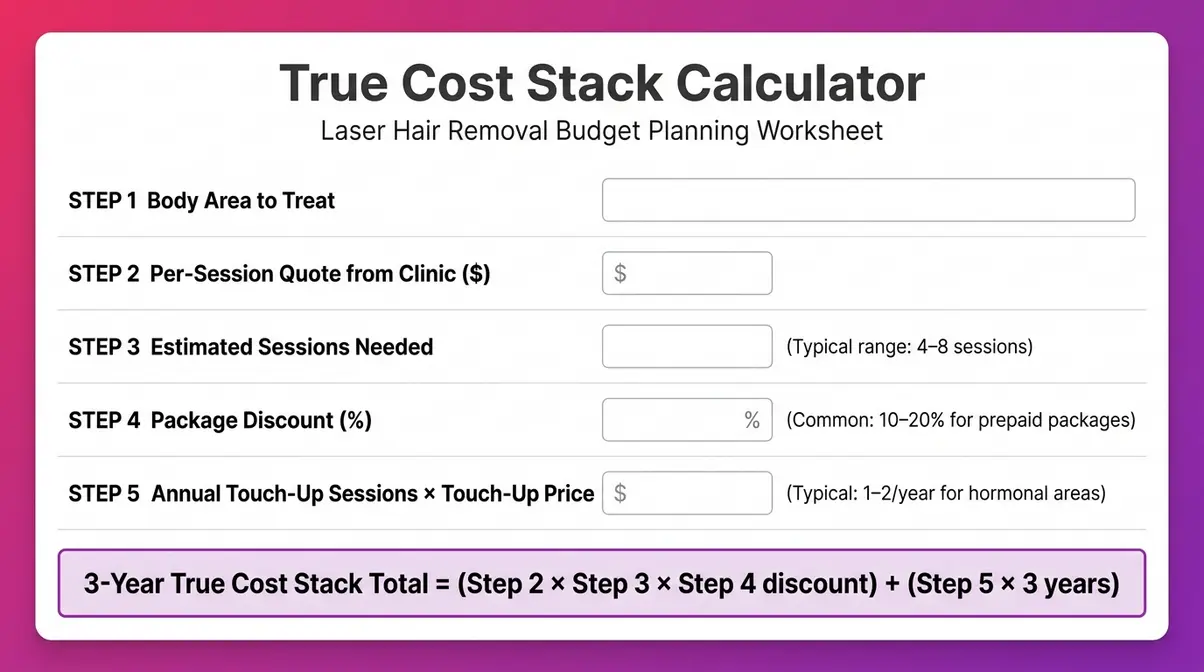
True Cost Stack = (Per-Session Price × Sessions Needed) + Annual Touch-Up Sessions
For example: if you’re quoted $300 per session for a full Brazilian, need 6 sessions, and then schedule one annual touch-up at $300, your True Cost Stack over three years looks like this:
- Year 1: $300 × 6 sessions = $1,800
- Year 2: 1 touch-up = $300
- Year 3: 1 touch-up = $300
- 3-Year True Cost Stack: $2,400
Now compare that to the long-term cost of alternatives:
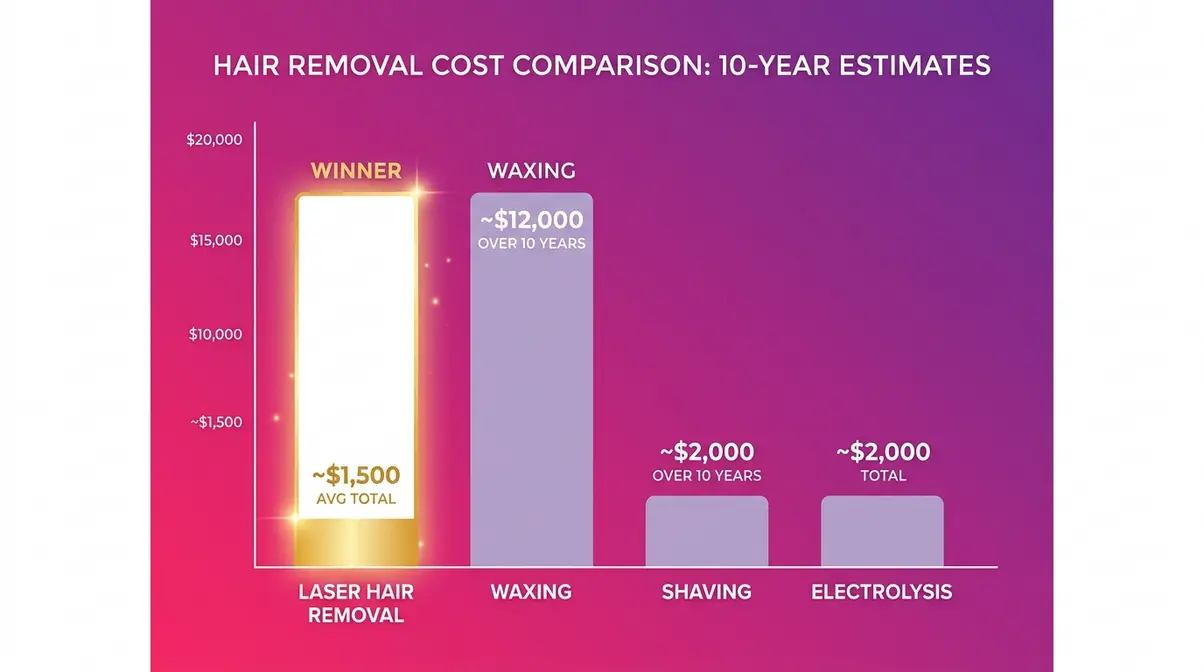
| Method | Avg Annual Cost | 10-Year Cost | Time Spent/Year | Permanence |
|---|---|---|---|---|
| Laser Hair Removal | ~$500–$1,500 (course) | ~$800–$2,500 (with touch-ups) | Low (after course) | Permanent reduction |
| Waxing | ~$600–$1,800 | ~$6,000–$18,000 | 12–24 hrs | None |
| Shaving | ~$100–$300 | ~$1,000–$3,000 | 50–100+ hrs | None |
| Electrolysis | ~$1,000–$3,000 | ~$1,000–$3,000 | Moderate | Permanent removal |
Source: Cost estimates compiled from market pricing data and professional association reports.
Over a decade, laser hair removal can cost significantly less than consistent waxing — and saves hundreds of hours. A package of 6 treatments, bought upfront, often reduces the per-session rate by 10–20%.
The most honest thing to understand before booking a consultation: budget for the True Cost Stack, not the teaser price. That’s the number that will determine whether this investment makes sense for your life and your wallet.
Is Laser Hair Removal Permanent?
Laser hair removal can deliver long-lasting results — but the FDA-approved term is “permanent hair reduction,” not permanent removal. Understanding this distinction protects your expectations and your budget, because it directly affects how many sessions you’ll need and whether you’ll require ongoing touch-ups.
Is It 100% Permanent?
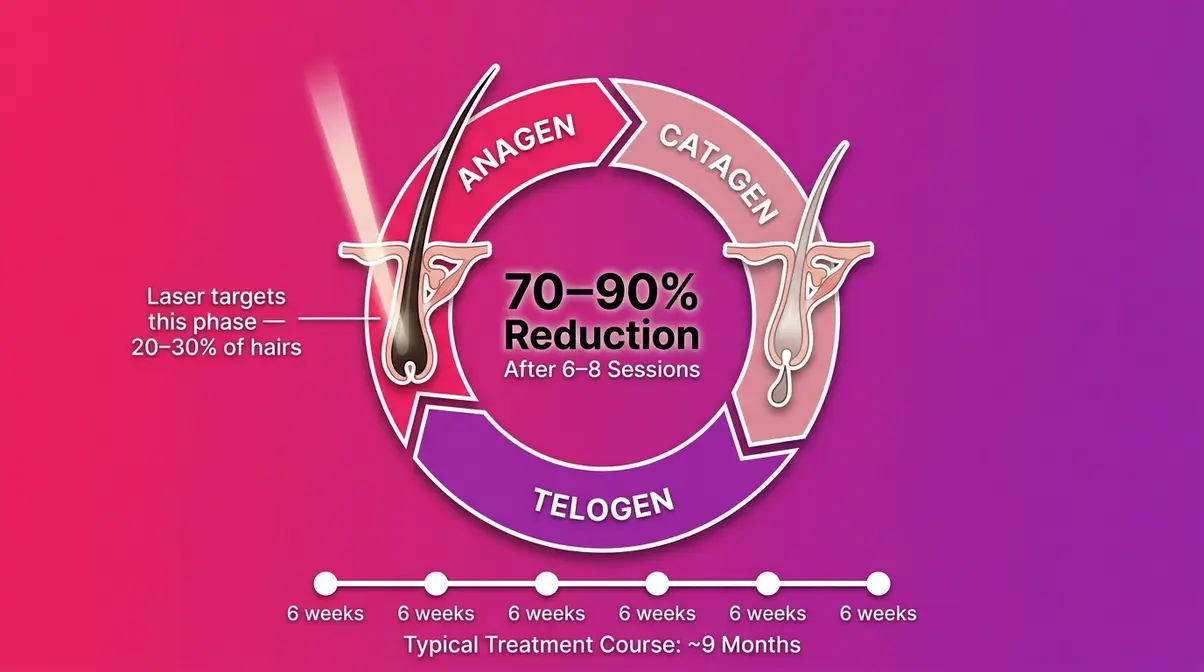
Laser hair removal is not 100% permanent – the FDA-approved term is “permanent hair reduction.” Most patients achieve 70-90% reduction in hair growth after a full course of 6-8 sessions (American Academy of Dermatology, 2026). Some hair may regrow over time, particularly in hormonally active areas, requiring periodic touch-up sessions. Electrolysis is the only FDA-recognized method for permanent hair removal. That said, for many people the reduction is dramatic enough to be life-changing – just set realistic expectations before you invest.
Reduction vs. Removal Differences
Permanent reduction means a significant, lasting decrease in the number of hairs that grow back — typically 70–90% reduction after a full course of treatment (American Academy of Dermatology, 2026). The hairs that do return are usually finer, lighter, and slower-growing. Permanent removal — eliminating every single hair follicle forever — is the claim made by electrolysis, not laser.
Why does this distinction matter for your budget? Because “permanent reduction” means most people will need at least one annual touch-up session to maintain results, especially in hormonally active areas like the face, bikini, and underarms. Plan for that in your True Cost Stack.
The FDA recognizes laser devices as producing permanent hair reduction when used correctly on appropriate candidates (FDA Device Classification, 2026). However, results vary significantly based on skin tone, hair color, and the body area treated.
How Many Sessions Do You Need?
The most common answer you’ll see online is “6 sessions.” The more accurate answer is 6–8 sessions for most people, with 4 sessions being the minimum for ideal candidates and up to 10 sessions for people with hormonal conditions like PCOS (polycystic ovary syndrome, a hormonal disorder that can cause excess facial and body hair growth).
Here’s why multiple sessions are required: laser targets hair follicles only during the anagen phase (the active growth stage of the hair cycle). At any given time, only 20–30% of your hairs are in anagen phase. Each session targets that active batch; subsequent sessions catch the next wave of growing hairs.
Sessions are typically spaced 4–8 weeks apart for facial areas and 6–10 weeks apart for body areas. Rushing sessions shortens the window between growth cycles and reduces effectiveness. For budget planning: a full course of 6 sessions spaced 6 weeks apart takes approximately 9 months. Add touch-ups, and you’re looking at a 12–18 month timeline for your full investment.
Most people notice 10–25% hair reduction after each session. By session 6, the cumulative reduction is typically 70–90% for good candidates — meaning you’ll still see some hair, just dramatically less of it.
Bikini Line vs. Brazilian Costs
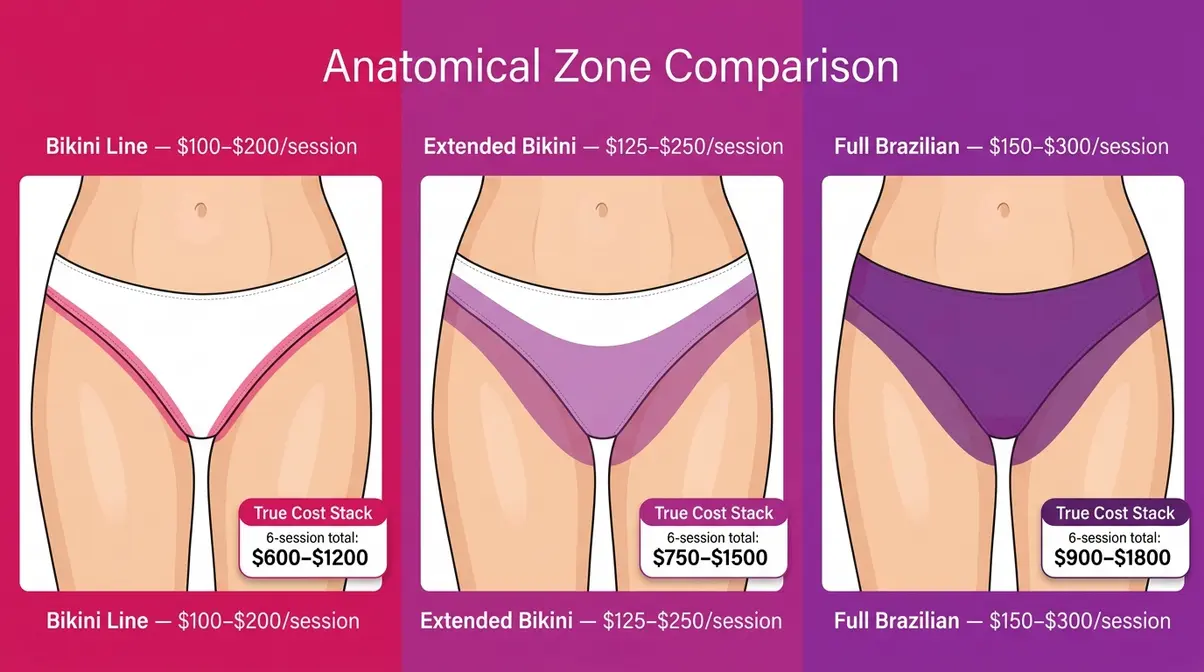
The bikini area is one of the most commonly treated regions — and one of the most confusing to price, because clinics use different terminology for different treatment sizes. Before you book, make sure you and your clinic agree on exactly what area is being treated.
Bikini Line vs. Full Brazilian
These three terms refer to progressively larger treatment areas, and the price difference between them can be significant:
- Bikini Line: Only the hair visible outside a standard bikini bottom — typically a narrow strip along the inner thigh and lower abdomen. This is the smallest and least expensive option.
- Extended Bikini (or Bikini Full): Removes more hair than the bikini line but leaves some hair in the center. A middle-ground option.
- Full Brazilian: Removes all hair from the entire pubic region, front to back, including the labia and perianal area. This is the largest treatment zone and commands the highest price.
Why does this matter? A clinic advertising “bikini laser starting at $99/session” may be quoting bikini line only. If you want a full Brazilian, you could be looking at $200–$300/session at the same clinic — more than double. Always ask for a written quote specifying exactly which area is included.
Prices for Bikini Area Treatments
Based on a review of clinic pricing pages and community-reported costs across forums and Reddit, here’s what you can expect to pay for each bikini area treatment level:
| Treatment Level | Per-Session Range | Sessions Needed | True Cost Stack (6 sessions) |
|---|---|---|---|
| Bikini Line | $100–$200 | 6–8 | $600–$1,600 |
| Extended Bikini | $125–$250 | 6–8 | $750–$2,000 |
| Full Brazilian | $150–$300 | 6–8 | $900–$2,400 |
Geographic variation is significant here. In high-cost cities, full Brazilian sessions frequently reach $350–$400. In mid-size markets, $150–$200 is common. National chains like Milan Laser sometimes bundle the bikini area into unlimited treatment packages, which can change the math considerably.
One important note: the bikini and Brazilian areas are hormonally sensitive. Some people — particularly those with PCOS or hormonal imbalances — may need more than 8 sessions to achieve satisfying results, and more frequent touch-ups. Budget conservatively: assume 8 sessions, not 6, for this area.
Facial Laser Hair Removal Costs
Facial laser hair removal is among the most popular treatment categories — and the most nuanced to price, because the face contains multiple distinct zones that are often treated separately or bundled together.
Upper Lip and Chin Costs
The upper lip and chin are the two most frequently treated facial areas, and they’re also the most affordable entry points for laser hair removal. Small surface area means short treatment times — typically 5–15 minutes per session.
- Upper Lip: $50–$150 per session; True Cost Stack (6–8 sessions) = $300–$1,200
- Chin: $75–$150 per session; True Cost Stack (6–8 sessions) = $450–$1,200
- Upper Lip + Chin combo: Many clinics offer a bundled rate of $100–$250 per session, reducing your per-area cost by 10–20%.
These small areas are also the ones most affected by hormonal changes. Women with PCOS facial hair (excess facial hair growth caused by elevated androgen hormones) often require 8–10 sessions for the upper lip and chin specifically, plus more frequent touch-ups — sometimes every 3–4 months rather than annually. If hormonal hair growth applies to you, add 2–4 sessions to your True Cost Stack estimate for these areas.
Full Face and Sideburns Bundles
Full face laser hair removal typically covers the upper lip, chin, cheeks, forehead, and sideburns as a single treatment zone. For women experiencing diffuse facial hair growth, treating these areas together is both more time-efficient and more cost-effective than booking them separately.
- Full Face: $200–$400 per session; True Cost Stack = $1,200–$3,200
- Sideburns only: $75–$150 per session; often bundled into full-face pricing
- Full Face + Neck: $250–$500 per session at many clinics
Bundling the full face into a single treatment session saves time and frequently saves money — clinics often charge 15–25% less per area when multiple zones are treated together.
Is a Facial Package Worth It?
For most people treating facial hair, yes — a package of 6 treatments purchased upfront is almost always the better financial choice compared to pay-per-session pricing. Here’s why:
Most clinics offer package discounts of 10–20% when you prepay for 6 sessions. On a $200/session full-face treatment, that’s $120–$240 in savings over the course of treatment. Additionally, prepaying locks in your current per-session rate, protecting you from price increases during your treatment window.
The caveat: packages are typically non-refundable. If you complete your package and achieve satisfying results after 4 sessions, you’ve prepaid for 2 sessions you may not use. Ask your clinic about their unused-session policy before purchasing.
Full Body, Legs, and Back Costs
Large treatment areas are where the True Cost Stack framework becomes most critical. The per-session price for legs or a full back can feel manageable in isolation — but multiplied across 6–8 sessions, the total investment can reach $3,000–$5,000+ for a single area.
Full Legs vs. Lower Legs Cost
This is one of the most common pricing confusions. When a clinic quotes “legs,” they may mean lower legs only (knee to ankle) — which is a significantly smaller treatment area than full legs (hip to ankle).
- Lower Legs: $150–$350 per session; True Cost Stack = $900–$2,800
- Full Legs: $250–$500 per session; True Cost Stack = $1,500–$4,000
- Full Legs + Brazilian combo: $400–$700 per session; True Cost Stack = $2,400–$5,600
The Reddit user quoted at the top of this guide was paying $700/session for full legs and Brazilian combined — which falls within the high end of the market range, particularly in a major metro area. At 5 sessions in, their True Cost Stack was already $3,500, with likely 2–3 more sessions needed.
Always ask your clinic: “Does this quote include the thigh, or just below the knee?” Get it in writing.
Back, Chest, and Abdomen Pricing
These areas are most commonly treated by men, though women also seek treatment for the abdomen and lower back. Surface area varies significantly from person to person, so pricing is more variable than for standardized zones like the upper lip.
- Back (full): $300–$700 per session; True Cost Stack = $1,800–$5,600
- Chest: $150–$400 per session; True Cost Stack = $900–$3,200
- Abdomen: $100–$300 per session; True Cost Stack = $600–$2,400
- Back + Chest combo: $400–$900 per session at many clinics
For men treating the full back, the True Cost Stack can approach or exceed $5,000 — making this one of the highest-investment single-area treatments available.
Is Full Body Laser Worth It?
Full body laser hair removal — treating every major hair-bearing area in a single ongoing program — is the highest-investment option and the one that requires the most careful application of the True Cost Stack.
A single full-body session typically runs $800–$2,500 depending on the clinic and your specific hair coverage. Over 6–8 sessions, the True Cost Stack for full body treatment can reach $4,800–$20,000+ at a pay-per-session rate. However, most national chains that offer full-body programs sell unlimited lifetime packages — often priced at $3,000–$7,000 total — which can dramatically change the math for people seeking comprehensive coverage.
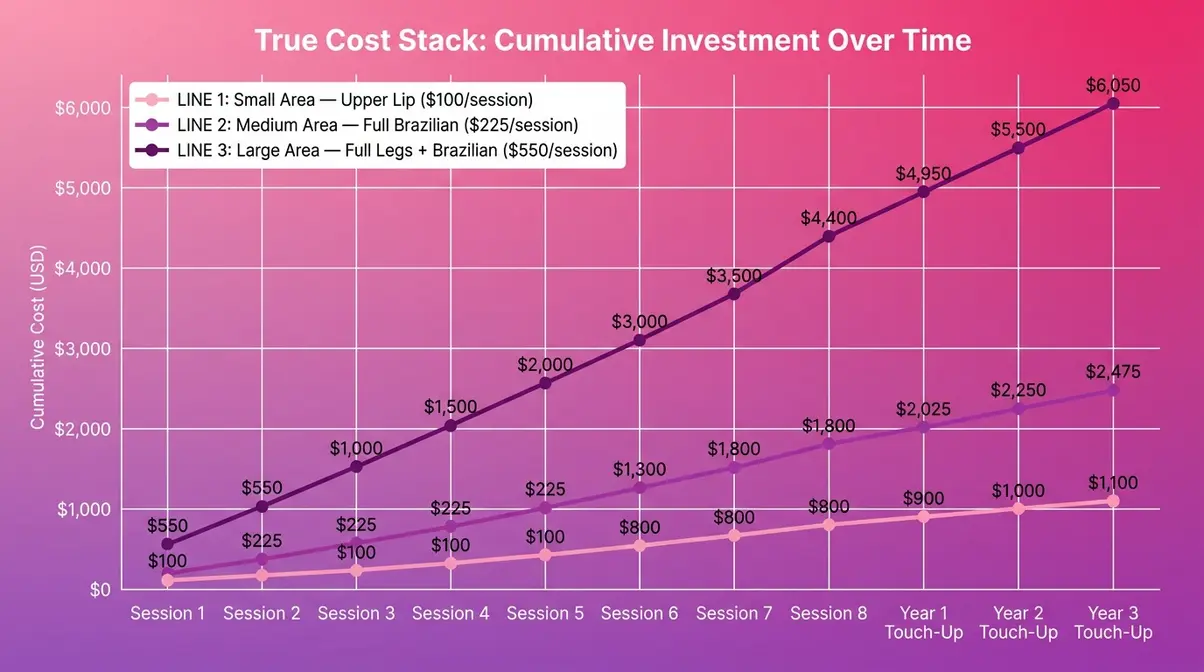
Is full body worth it? For people with extensive hair growth across multiple areas who would otherwise spend $800–$1,500/year on waxing indefinitely, the math often favors laser over a 5–7 year horizon. The key is securing a package deal rather than paying per session.
Underarm and Arm Laser Costs
Underarms and arms represent two of the most popular treatment areas — for very different reasons. Underarms offer one of the best returns on investment in the entire menu. Arms are often an afterthought, but they’re worth understanding before you build your full budget.
Underarms: The Best ROI Area
Underarms are widely regarded as the highest-ROI area for laser hair removal, and the numbers bear this out. The treatment zone is small (5–10 minutes per session), the hair tends to respond well to laser, and the cumulative time savings from eliminating daily shaving are substantial.
- Underarms: $75–$175 per session; True Cost Stack (6–8 sessions) = $450–$1,400
Compare that to waxing underarms at $20–$40 per appointment, every 4–6 weeks, for years. Over 10 years, waxing underarms costs $2,600–$5,200 — plus the time investment. The laser True Cost Stack for underarms pays for itself within 3–5 years for most people.
“The average laser hair removal session costs $389 according to ASPS data (2026) — but for underarms specifically, the math against lifetime waxing costs makes laser one of the most financially sound cosmetic investments available.”
Common pain points reported by users include temporary redness and sensitivity for 24–48 hours after each underarm session. Avoid deodorant for 24 hours post-treatment, as the skin is temporarily more sensitive.
Half vs. Full Arm Pricing
Arms are a less-discussed treatment area, but many people — particularly those with darker or thicker forearm hair — find them worthwhile.
- Half Arms (elbow to wrist): $100–$250 per session; True Cost Stack = $600–$2,000
- Full Arms (shoulder to wrist): $150–$350 per session; True Cost Stack = $900–$2,800
One practical consideration: arm hair tends to be finer and lighter than leg or bikini hair, which can mean it responds slightly less predictably to laser. People with very fine, light-colored arm hair may see less reduction than those with coarser, darker hair. Always ask your clinic to assess your specific hair characteristics during a consultation.
Milan Laser vs. LaserAway Costs
Where you go for treatment affects your price almost as much as what area you’re treating. The laser hair removal market breaks into three distinct provider categories, each with different pricing models, equipment, and quality considerations.
National Chain Pricing Models
Milan Laser and LaserAway are the two largest national chains in the U.S., with hundreds of locations combined. Their pricing models differ significantly from each other and from independent providers.
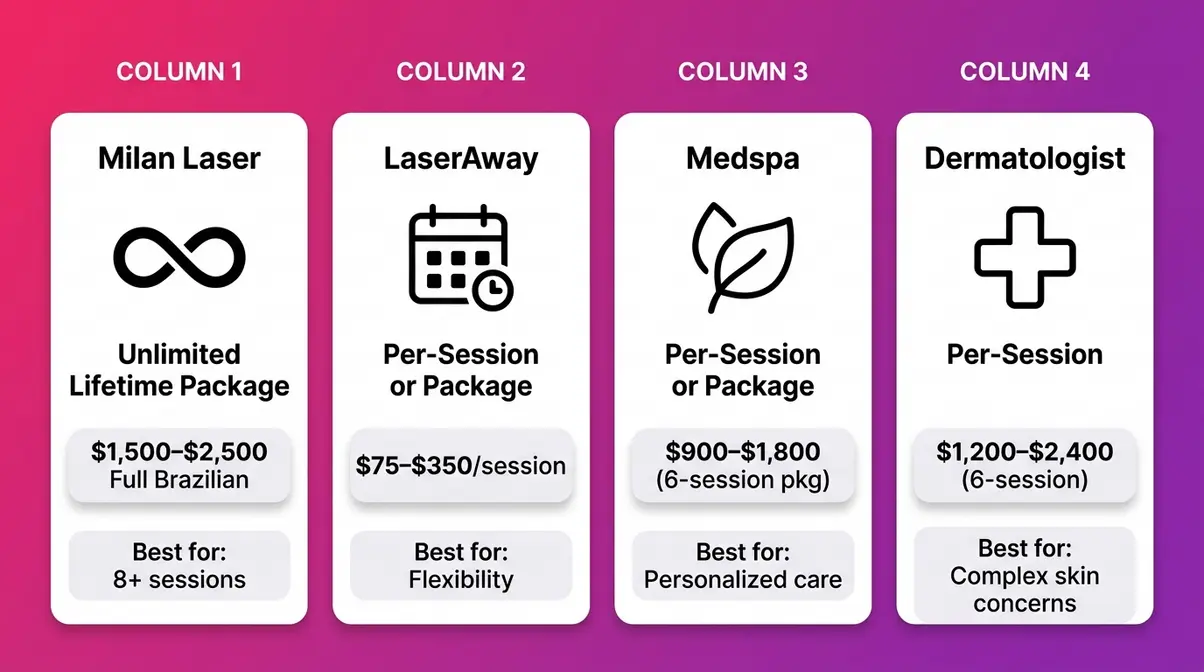
Milan Laser is known for its unlimited lifetime guarantee model — you pay a flat package price per area and receive unlimited sessions for life. This model eliminates the per-session True Cost Stack concern entirely, because you’re not charged extra if you need 10 sessions instead of 6. Package prices vary by location and area, but full Brazilian packages typically range from $1,500–$2,500 for the unlimited lifetime program. Promotional pricing is frequently available, especially for first-time clients.
LaserAway operates on a more traditional per-session or per-package model, with pricing that varies by location. They use a range of laser technologies and are known for treating a broader range of skin tones. Per-session pricing at LaserAway typically ranges from $75–$350 depending on area and location, with package discounts of 10–15% available.
Both chains run frequent promotional deals — particularly around major holidays (Black Friday, New Year’s, Valentine’s Day) — that can reduce prices by 20–40%. If you’re not in a hurry, timing your purchase around a promotion can generate significant savings.
| Provider Type | Pricing Model | Typical Full Brazilian | Best For |
|---|---|---|---|
| Milan Laser | Unlimited lifetime package | $1,500–$2,500 | People expecting 8+ sessions |
| LaserAway | Per-session or package | $900–$2,000 (6-session pkg) | Those wanting flexibility |
| Medspa (independent) | Per-session or package | $900–$1,800 | Personalized care, varied pricing |
| Dermatologist office | Per-session | $1,200–$2,400 | Complex skin concerns |
Medspa vs. Dermatologist Costs
This is a gap no competitor currently addresses directly: dermatologist offices typically charge more than medspas, but that premium isn’t always justified for straightforward laser treatments.
Dermatologist offices charge a premium partly because of overhead (medical staff, liability, facility costs) and partly because they can manage complications if they arise. For patients with complex skin conditions, darker skin tones requiring specialized lasers, or contraindications like active skin conditions, a dermatologist office is worth the extra cost.
Independent medspas typically charge 20–40% less than dermatologist offices for the same treatment. Their technicians are usually licensed aestheticians or laser technicians — not physicians. For straightforward cases (light skin, dark hair, no medical complications), a well-reviewed medspa with proper licensing can deliver equivalent results at a lower price.
The key question isn’t “which type is cheaper?” — it’s “which type is appropriate for my specific situation?” If you have any medical considerations (see the Medical Considerations section), start with a dermatologist consultation.
How to Find a Local Laser Clinic
Finding competitive pricing for clinics near you requires more than a Google search. Here’s a practical approach to ensure you get the best value and safety:
Search for board-certified providers. The American Society for Laser Medicine and Surgery (ASLMS) maintains a provider directory of certified laser practitioners.
Request a written consultation quote. Any reputable clinic will provide a written quote specifying the exact treatment area, technology used, and number of sessions included. If they won’t put it in writing, walk away.
Ask about the laser type. Nd:YAG lasers are safer for darker skin tones; Alexandrite lasers work best on light-to-medium skin. A clinic that uses one laser type for all skin tones is a red flag.
Check for package transparency. Ask specifically: “What happens if I need more than 6 sessions?” Know whether additional sessions are included or billed separately.
Verify licensing. Laser hair removal should be performed or supervised by a licensed medical professional. Check your state’s requirements — regulations vary significantly.
Financing, HSA/FSA, and Savings
The True Cost Stack can feel daunting — but several financing and savings strategies can make laser hair removal significantly more affordable.
Does HSA/FSA Cover Laser?
This is one of the most-searched questions in the category — and the answer is nuanced. In most cases, laser hair removal is considered a cosmetic procedure by the IRS and is NOT eligible for reimbursement through a Health Savings Account (HSA) or Flexible Spending Account (FSA).
However, there is an important exception: if laser hair removal is medically necessary — for example, prescribed by a physician to treat a diagnosed condition like hirsutism (excess hair growth caused by a hormonal disorder) or pseudofolliculitis barbae (chronic razor bumps that constitute a medical condition) — it may qualify for HSA/FSA reimbursement. You would need a Letter of Medical Necessity (LMN) from your doctor, and the expense must be primarily for medical care rather than cosmetic improvement (IRS Publication 502, 2026).
Practically: if your doctor has diagnosed you with PCOS-related hirsutism and recommended laser treatment as part of your care plan, ask your dermatologist to provide an LMN. Submit it with your HSA/FSA claim. Approval is not guaranteed, but it’s a legitimate avenue worth pursuing. Consult a tax professional for guidance specific to your situation.
For most cosmetic laser patients without a medical diagnosis, HSA/FSA will not cover the cost. Plan to pay out-of-pocket or through a financing plan.
Payment Plans and Promo Deals
Several strategies can meaningfully reduce your out-of-pocket cost:
CareCredit and Medical Financing. CareCredit is the most widely accepted medical credit card in the laser hair removal space. Many clinics accept it, and CareCredit frequently offers 6–18 month promotional 0% APR financing periods. This allows you to spread your True Cost Stack across monthly payments without interest if paid within the promotional window. Always read the deferred interest terms carefully — if you don’t pay in full by the end of the promotional period, interest charges can be significant.
Package Deals. Purchasing a package of 6 treatments upfront typically saves 10–20% versus paying per session. On a $250/session treatment, a 6-session package at 15% off saves you $225 total.
Promotional Timing. National chains and many independent clinics run their deepest discounts around Black Friday, New Year’s, Valentine’s Day, and summer kickoff (May–June). Signing up for clinic email lists 2–3 months before you plan to start treatment is a practical way to capture these deals.
Consultation Specials. Many clinics offer first-session discounts or free consultations with a discounted first treatment. Use the consultation to get your written quote and assess the clinic — then make your package decision with full information.
Groupon and Deal Sites. Proceed with caution. Deep-discount deals on deal sites sometimes reflect older equipment, less experienced technicians, or bait-and-switch tactics. If you use a deal site, verify the clinic’s licensing and reviews independently before booking.
Medical Considerations & Candidacy
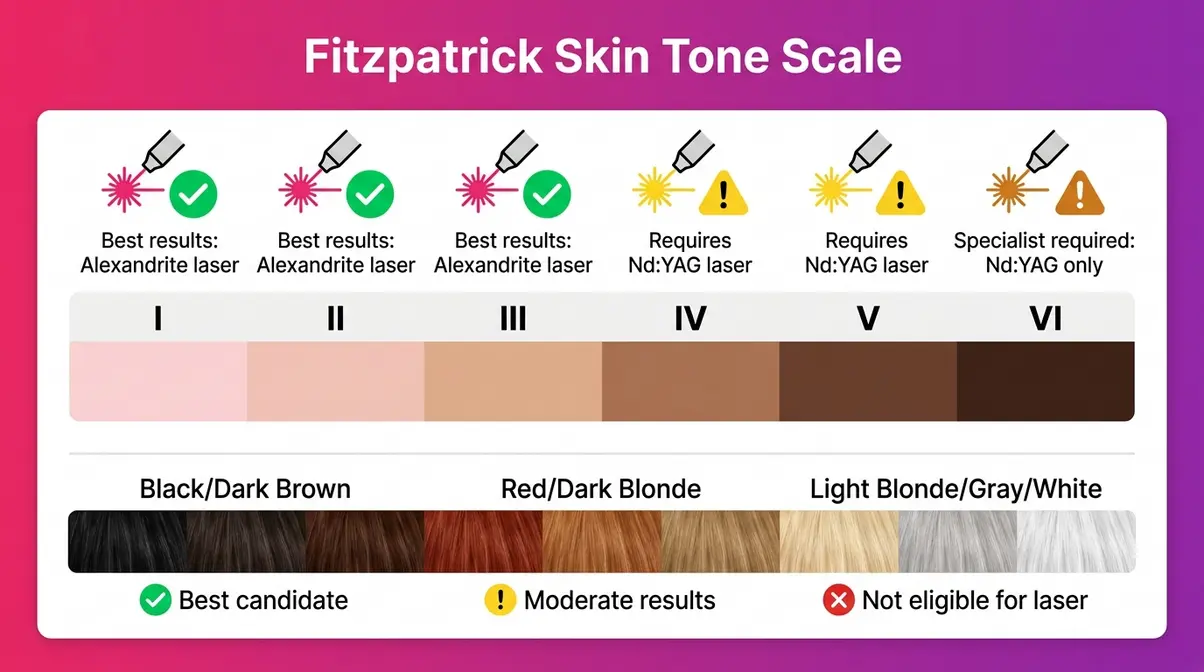
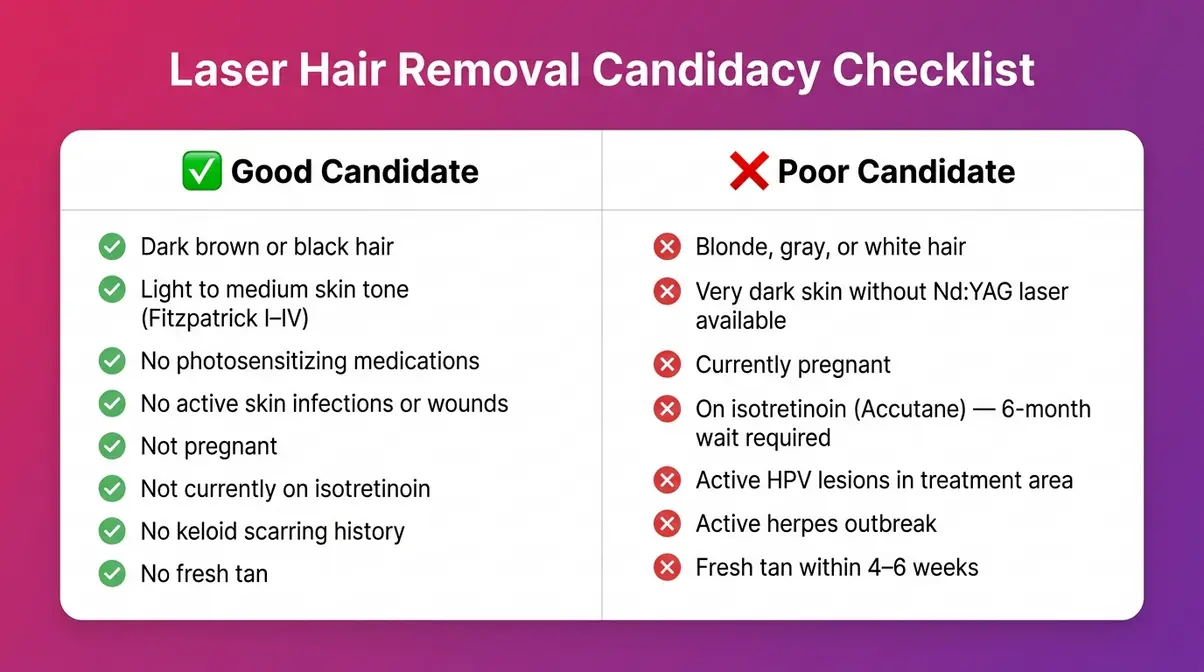
Not everyone is a good candidate for laser hair removal — and understanding candidacy before you invest is essential, both for your safety and your budget. This section covers the medical factors that affect whether laser treatment will work for you and whether it’s safe.
Skin Tone and Hair Color
Laser hair removal works by targeting melanin (the pigment that gives hair its color) in the hair follicle. The laser’s energy is absorbed by melanin and converted to heat, which damages the follicle enough to inhibit future growth. This mechanism has two important implications:
Hair color matters enormously. Dark brown and black hair contain the most melanin and respond best to laser treatment. Red and dark blonde hair respond moderately.
Skin tone affects both safety and technology choice. The Fitzpatrick scale (a medical skin-tone classification system ranging from Type I — very fair — to Type VI — very dark) guides laser selection. Older laser technologies worked best on Fitzpatrick Types I–III (light skin with dark hair — the highest contrast). Modern Nd:YAG lasers can safely treat Types IV–VI (medium to very dark skin), but require a skilled practitioner and appropriate settings to avoid burns or hyperpigmentation (darkening of the skin).
Always ask your clinic: “Which laser technology do you use, and is it appropriate for my Fitzpatrick type?” If they can’t answer this question clearly, seek a second opinion.
What Hair Cannot Be Lasered?
Blonde, white, gray, and very light hair cannot be effectively treated with laser hair removal. Laser works by targeting melanin (the pigment in hair) – hair with insufficient melanin cannot absorb enough laser energy for the treatment to work. Red hair may respond partially but with less predictable results. Dark brown and black hair respond best. If your target area has light-colored hair, electrolysis is the more appropriate option. Additionally, very fine, vellus hair (the soft “peach fuzz” most people have on their face) does not respond well to laser regardless of color.
PCOS and Hormonal Hair Growth
PCOS (polycystic ovary syndrome) is a hormonal condition affecting approximately 8–13% of women of reproductive age globally (World Health Organization, 2026). One of its most visible symptoms is hirsutism — excess facial and body hair growth caused by elevated androgen hormones. Common areas include the upper lip, chin, sideburns, and lower abdomen.
Laser hair removal can significantly reduce PCOS-related facial hair — but it requires realistic expectations and more sessions than the typical patient. Research from dermatology journals suggests that PCOS patients often need 8–12 sessions rather than the standard 6, because elevated androgens continue to stimulate new hair follicle activity between sessions (Journal of the American Academy of Dermatology, 2026). Touch-ups are also needed more frequently — often every 3–6 months rather than annually.
For PCOS facial hair specifically, electrolysis vs. laser is a genuine clinical debate. Electrolysis provides permanent removal (not just reduction) and targets individual follicles regardless of hair color — making it effective even for lighter facial hairs that laser cannot target. However, it is significantly more time-consuming and can be more expensive for large areas. Many dermatologists recommend a combination approach: laser for bulk reduction of darker hairs, followed by electrolysis for remaining lighter or finer hairs.
Always consult a board-certified dermatologist before starting treatment for PCOS-related hair growth. Managing the underlying hormonal condition (often through medication or lifestyle changes) alongside laser treatment typically produces better long-term results than laser alone.
HPV and Other Contraindications
Several medical conditions and medications can disqualify you from laser hair removal — or require special precautions. This section covers the most clinically significant ones.
HPV (Human Papillomavirus): This is one of the most common questions in laser hair removal forums, and the answer requires nuance. Laser treatment over active HPV warts (condylomata acuminata) is contraindicated — the laser plume (vapor produced during treatment) can aerosolize HPV particles and pose an infection risk to the practitioner and potentially spread the virus. Most clinics will not treat active wart areas. However, HPV-positive individuals without active lesions in the treatment area are generally considered eligible for laser treatment elsewhere on the body. Always disclose your HPV status to your provider and consult a board-certified dermatologist for guidance specific to your situation.
Isotretinoin (Accutane): This acne medication significantly increases skin photosensitivity and the risk of scarring from laser treatment. Most protocols require a waiting period of 6 months after your last isotretinoin dose before undergoing laser hair removal (American Academy of Dermatology guidelines).
Photosensitizing Medications: Certain antibiotics (doxycycline), antifungals, and some blood pressure medications increase skin sensitivity to light. Inform your clinic of all medications before treatment.
Pregnancy: Laser hair removal is not recommended during pregnancy due to insufficient safety data. Most clinics will decline to treat pregnant patients.
Active Skin Conditions: Active herpes outbreaks, open wounds, active acne, or eczema in the treatment area are contraindications for that session. Inform your provider of any active skin conditions.
Tanned Skin: Fresh tans — whether from sun or self-tanner — increase the risk of burns and pigmentation changes. Most clinics require 4–6 weeks of sun avoidance before and after treatment.
When Laser Isn’t the Right Choice
Laser hair removal is an excellent option for many people — but it’s not the right choice for everyone. Understanding when to choose an alternative protects both your investment and your safety.
Common Pitfalls to Avoid
Pitfall 1: Booking based on per-session price alone. The most common financial mistake is choosing a clinic based on the lowest advertised per-session rate without calculating the True Cost Stack. A clinic charging $99/session that requires 10 sessions ($990 total) may cost more than one charging $150/session with a 6-session package and a 15% package discount ($765 total). Always calculate total course cost before comparing clinics.
Pitfall 2: Skipping the consultation. A reputable clinic will assess your Fitzpatrick skin type, hair color, and any contraindications before recommending a treatment plan. Clinics that skip this step and sell packages over the phone are a red flag. The consultation also gives you a written quote — essential for accurate budgeting.
Pitfall 3: Underestimating touch-up frequency. Many first-timers budget for the initial course of 6–8 sessions but forget to account for annual touch-ups. For hormonally active areas (face, bikini), touch-ups may be needed every 3–6 months. Include these in your True Cost Stack.
Pitfall 4: Treating areas with light hair. If your hair is blonde, gray, or white in the target area, laser hair removal will produce disappointing results at significant cost. Get an honest assessment of your hair color candidacy during your consultation before committing to a package.
When to Choose Alternatives
When to Seek Expert Help
- If you have any of the following, consult a board-certified dermatologist before booking at any clinic:
- A diagnosed hormonal condition (PCOS, thyroid disorder, adrenal issues)
- Dark or very dark skin (Fitzpatrick Types V–VI) — requires specialized laser technology
- A history of keloid scarring (raised, overgrown scar tissue) — laser can trigger keloid formation in susceptible individuals
- Any active autoimmune skin condition (lupus, psoriasis, eczema)
- Active HPV lesions in or near the treatment area
Frequently Asked Questions
Is electrolysis or laser hair removal better for PCOS facial hair?
For PCOS facial hair, both methods have merit — and many dermatologists recommend combining them. Laser works well for bulk reduction of darker hairs and is faster for larger areas, but PCOS patients typically need 8–12 sessions rather than the standard 6 due to ongoing hormonal stimulation (Journal of the American Academy of Dermatology, 2026). Electrolysis targets individual follicles permanently and works on all hair colors, making it effective for lighter facial hairs laser cannot reach. The practical recommendation: start with laser for the bulk of darker hair, then finish with electrolysis for remaining fine or light hairs. Always consult a board-certified dermatologist who can evaluate your specific hormonal profile.
Can I get laser hair removal if I have HPV?
It depends on whether you have active lesions in the treatment area. Laser treatment directly over active HPV warts is contraindicated because the laser plume can aerosolize the virus, posing a risk to practitioners and potentially spreading infection. Most clinics will decline to treat active wart areas. However, HPV-positive individuals without active lesions in the treatment zone are generally considered eligible for laser treatment in other areas of the body. Always disclose your HPV status to your provider before treatment. Consult a board-certified dermatologist for guidance specific to your situation — this is not a decision to make based on online research alone.
Can I shave 2 hours before laser?
No — 2 hours is too close to your appointment. You should shave the treatment area 24–48 hours before your session, not the same day. Shaving the day before removes the hair above the skin while leaving the follicle intact — which is exactly what the laser needs to target. Shaving too close to the appointment can leave stubble that causes surface burns. Waxing, plucking, or threading are prohibited for 4–6 weeks before treatment, as these methods remove the follicle entirely, leaving nothing for the laser to target.
What disqualifies you from laser hair removal?
Several conditions and medications disqualify you from treatment or require special precautions. Common disqualifiers include: active HPV lesions in the treatment area; current use of isotretinoin (Accutane) — requires a 6-month waiting period; pregnancy; active skin infections, open wounds, or eczema in the treatment area; fresh tans (sun or self-tanner) within 4–6 weeks; and a history of keloid scarring in the treatment area. Certain photosensitizing medications also require discussion with your provider. Hair color is another disqualifier — blonde, white, and gray hair does not respond to laser. Always complete a full medical consultation before purchasing any package.
How do Koreans treat PCOS?
PCOS treatment in South Korea typically follows a comprehensive, multi-modal approach combining hormonal management, diet and lifestyle intervention, and cosmetic procedures for visible symptoms like facial hair. Korean dermatology clinics frequently offer combination laser and electrolysis protocols for PCOS-related hirsutism, often using Nd:YAG lasers that are safe for a broader range of Asian skin tones (Fitzpatrick Types III–IV). Korean medical culture also places significant emphasis on early diagnosis and hormonal regulation — often through oral contraceptives or anti-androgen medications prescribed alongside cosmetic treatment. For PCOS-related hair concerns specifically, the most important first step in any country is consulting an endocrinologist or gynecologist to address the underlying hormonal condition before investing in cosmetic hair removal.
Final True Cost Budget Checklist
Before you book your first consultation to find out how much is laser hair removal for your specific needs, use this framework to build a realistic budget. The True Cost Stack formula ensures you’re pricing the full investment, not just the teaser.
Quick Decision Framework: Which Option Is Right for You?
| Your Situation | Best Choice | Why |
|---|---|---|
| Dark hair, light-medium skin, no medical issues | Laser hair removal | Best efficacy, best long-term value |
| Blonde, gray, or white hair | Electrolysis | Laser ineffective; electrolysis works on all hair colors |
| PCOS or hormonal hair growth | Laser + electrolysis combo | Laser for bulk reduction; electrolysis for lighter remaining hairs |
| Tight budget, short-term need | Waxing or threading | Lower upfront cost; no commitment |
| Pregnant or on isotretinoin | Wait; consult dermatologist | Medical contraindications — safety first |
| Very dark skin (Fitzpatrick V–VI) | Nd:YAG laser specialist | Requires specialized technology and experienced practitioner |
| Large multi-area treatment goal | National chain unlimited package | Eliminates per-session True Cost Stack risk |
Conclusion
For cost-conscious first-timers, laser hair removal represents a significant but potentially worthwhile long-term investment — if you budget for the True Cost Stack rather than the per-session teaser price. The national average of $389 per session (ASPS, 2026) sounds manageable in isolation, but most people invest $600–$5,000+ per body area across a full course of 6–8 sessions. The patients who feel most satisfied with their decision are those who went in with realistic numbers — not the ones who were surprised by session 5.
The True Cost Stack is the framework that makes those realistic numbers possible. By calculating (per-session price × sessions needed) + annual touch-ups before you book, you transform an anxiety-inducing unknown into a concrete budget line. That shift — from “I don’t know what this will cost” to “I’ve planned for $2,400 over 18 months” — is what makes the difference between a financial regret and a smart investment in your quality of life.
If you are still wondering how much is laser hair removal for your unique situation, your next step: book a consultation at a board-certified clinic, request a written quote for your specific treatment area, and run your True Cost Stack calculation before signing any package agreement. If you have any medical considerations — PCOS, hormonal conditions, dark skin tone, or current medications — start with a dermatologist consultation rather than a medspa. The right provider and the right budget plan make all the difference.

Dave King
Writes evidence-based hair-care guides for Care About Your Hair — for every hair type, jargon-free and independent.