 Dave King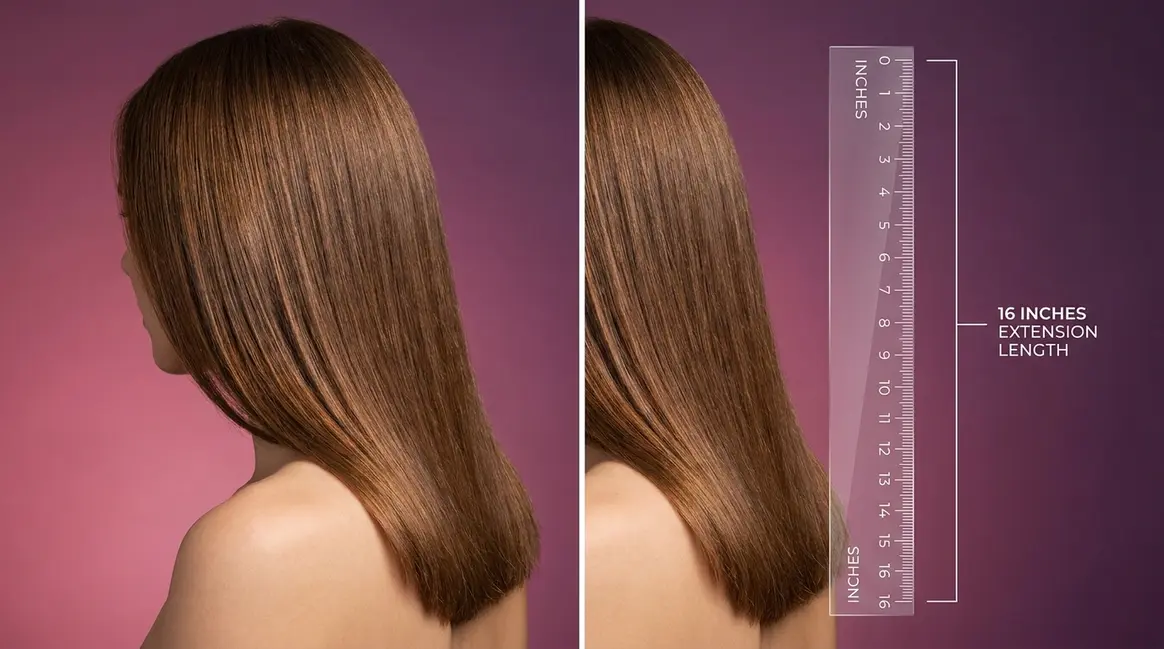
You’ve seen the before-and-after photos, but you still can’t picture what 16 inch hair extensions would actually look like on you — at your height, with your specific hair type. That’s a completely normal feeling, and it stops a lot of people from buying.
Most extension pages show you a product grid and nothing else. They don’t tell you that 16 inches falls near the collarbone on a 5’5″ woman — or that it looks completely different on someone who is 5’2″. They don’t explain which type works best when you’re trying to conceal thinning hair without anyone seeing the tracks. And they definitely don’t talk about price honestly.
This guide fills every one of those gaps. By the end, you’ll know exactly how 16-inch extensions look on your frame, which type works best for fine or thinning hair, and which brands are worth your money — so you can buy with confidence instead of anxiety.
16 inch hair extensions typically fall at the collarbone to just below the shoulders — but the exact look depends on your height, which is why length choice is personal, not universal. This is The Height-Adjusted Length Rule.
- On 5’2″ frames: 16 inches falls near the mid-chest — a dramatic, noticeable transformation
- On 5’8″ frames: 16 inches sits just past the collarbone — a natural, subtle upgrade
- Best for fine hair: Halo and clip-in extensions cause the least tension and are gentlest on fragile strands
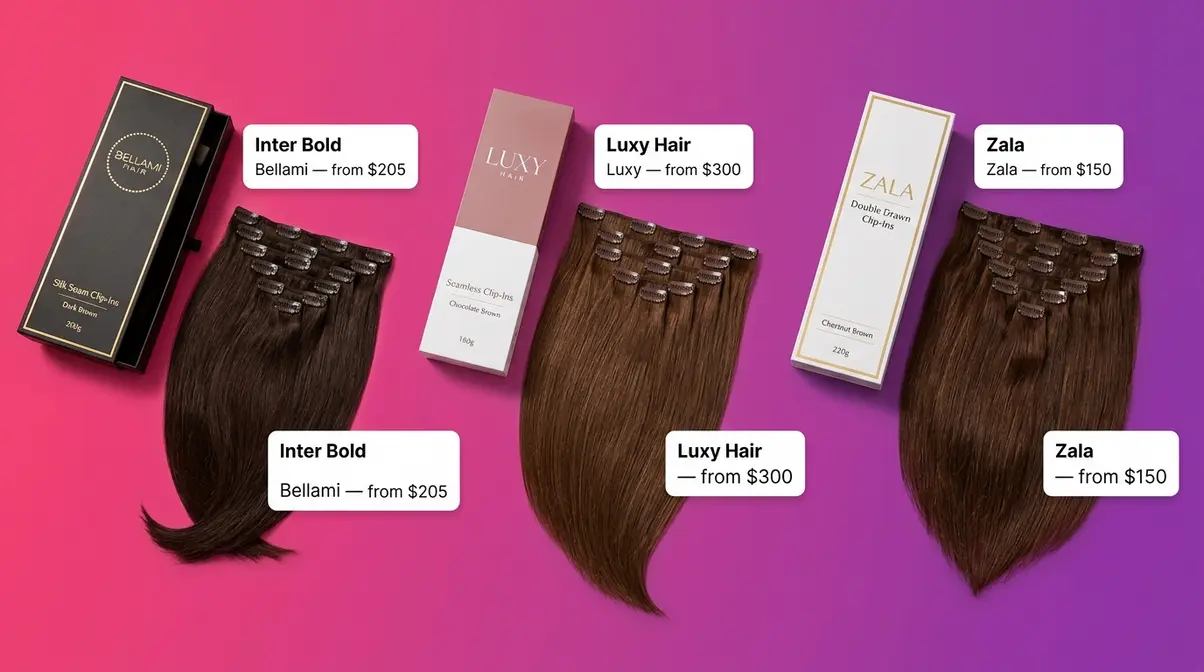
- Price range: Expect $150–$345 for quality human hair sets (as of June 2026 — Bellami from ~$205, Luxy Hair from ~$300, Zala from ~$150)
- Top brands: Bellami, Luxy Hair, and Zala are the most trusted names at this length
What Are 16 Inch Hair Extensions?
16 inch hair extensions are temporary or semi-permanent strands of real or synthetic hair — measuring exactly 16 inches (40.64 centimeters) from root to tip — that are attached to your natural hair to add length, volume, or both. They typically fall anywhere from the collarbone to just below the shoulders, depending on your height and existing hair length.
Beyond the basic definition, the critical thing to understand is The Height-Adjusted Length Rule: 16 inches is a measurement of the extension strand itself, not a fixed look on your body. The same set of extensions will land at a dramatically different point on a 5’2″ woman versus a 5’8″ woman. Your torso length, your natural hair’s starting length, and even the extension’s texture all change the final result. This guide uses that rule as its foundation — because understanding it is the difference between buying the right length and being disappointed when your order arrives.
Before you can decide if 16 inches is right for you, you need to see it. So let’s start with the visual evidence.
How Long Are 16 Inch Hair Extensions?
16 inch hair extensions measure exactly 40.64 centimeters and, on a person of average height (around 5’5″), they typically fall at the collarbone. However, your individual height changes where the hair actually lands on your body. This is why two women can order the exact same set and walk away with completely different results.
This is The Height-Adjusted Length Rule in action. Because torso proportions vary, a fixed strand length produces a variable visual outcome. The table below shows exactly where 16 inches falls across three common heights.
| Your Height | Where 16″ Falls | Look It Creates |
|---|---|---|
| 5’2″ (157 cm) | Mid-chest / upper bust | Dramatic length transformation |
| 5’5″ (165 cm) | Collarbone | Natural, versatile everyday length |
| 5’8″ (173 cm) | Just past the shoulders | Subtle, polished enhancement |
Torso length adds another layer of variation. Someone with a longer neck and higher shoulders may find the hair sits slightly higher than the table suggests — closer to the top of the collarbone rather than the base. If you know your torso runs long, consider sizing up to 18 inches.
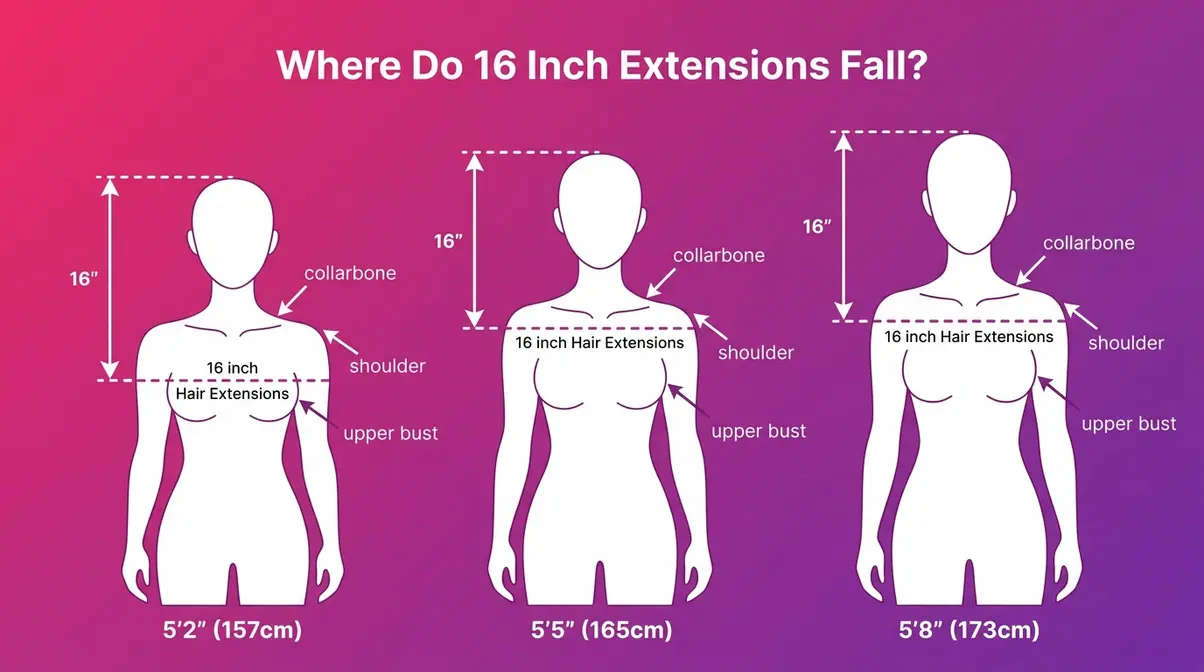
You can also visualize 16-inch hair extensions with additional length reference guides.
Where 16 Inches Falls on Your Body
At 40.64 centimeters, 16-inch extensions land at what stylists call “collarbone length” on most women — roughly where a necklace clasp sits at the back of your neck, or just above the top button of a shirt. On shorter frames, that same measurement reaches the upper bust area, which reads as genuinely long hair.
Your natural hair’s starting length matters just as much as your height. If your hair is already shoulder-length, 16-inch extensions add a more subtle boost — perhaps 4–6 inches of visible extra length. If you’re starting from a chin-length bob, the transformation is much more dramatic, typically adding 6–8 inches of visible length that lands just past the collarbone.
One more factor: wavy and curly extensions appear shorter than straight ones at the same labeled length. Curl shrinkage can reduce the visible length by 1–2 inches. So if you’re buying wavy extensions and you’re 5’5″, the hair may appear to fall slightly above the collarbone rather than directly on it. Straight extensions show the full 16 inches with no shrinkage.
16 Inch Hair Extensions Before and After
Picture this: you sit down with a chin-length bob and clip in a set of 16-inch extensions. Within ten minutes, you’re looking at collarbone-length hair with noticeably more volume. That’s the typical before-and-after story for someone starting from shorter hair — and it’s what drives most of the “short hair 16 inch hair extensions before and after” searches you see online.
The texture of the extensions changes the appearance significantly. Straight extensions show the full 16 inches and create a sleek, polished finish. Wavy extensions appear 1–2 inches shorter due to the wave pattern, but they tend to blend more naturally with most hair types. Color matching is the single most important factor in whether the transformation looks seamless or obviously fake — extensions that are even slightly off-shade stand out immediately, especially in natural light.
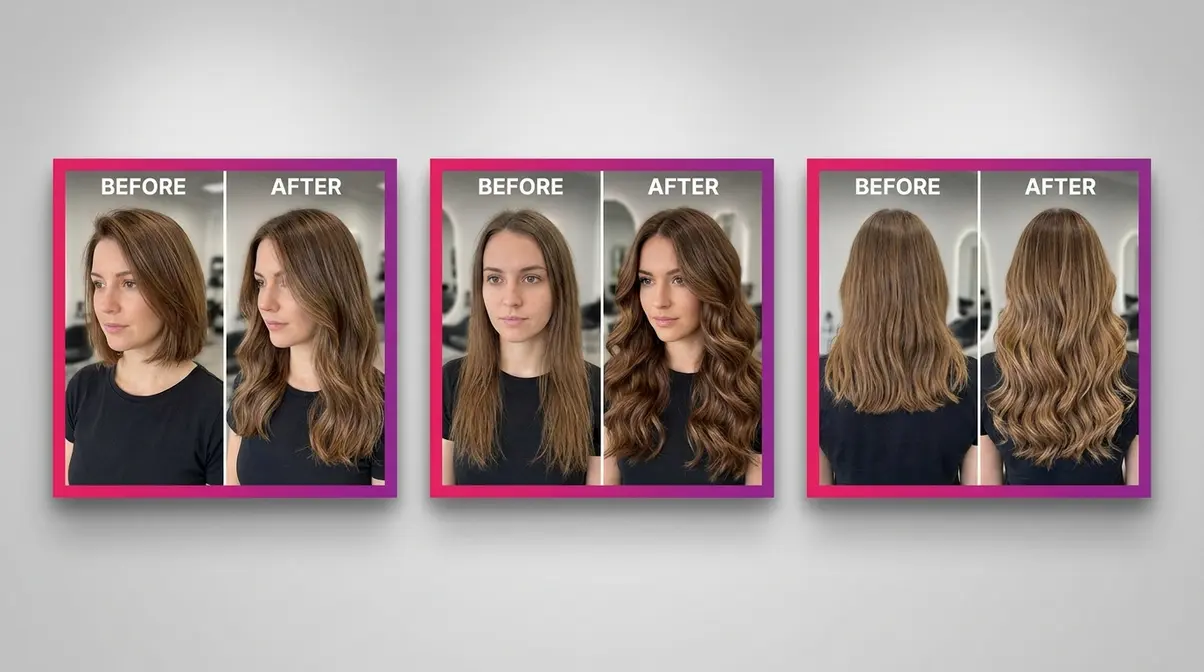
Seeing the length is one thing — but choosing the right length for your goals is another. Next, let’s compare 16 inches to the other popular sizes.
16 Inch vs. 14, 18, and 20 Inch Extensions
When comparing extension lengths, 16 inches sits in a versatile middle ground — longer than a subtle volume boost, shorter than a dramatic transformation. Knowing exactly how each length compares helps you avoid the most common buyer regret: ordering the wrong size and wishing you’d gone longer or shorter.
Are 16 inch hair extensions long enough?
For most women, 16 inch hair extensions are long enough to create a noticeable, flattering transformation. On a 5’5″ frame, 16 inches reaches the collarbone — which reads as medium-to-long hair in everyday life. If you’re 5’6″ or taller and want hair that falls visibly past the chest, 18 or 20 inches may serve you better. For women under 5’4″, 16 inches often delivers dramatic results that feel genuinely long. The right answer depends on your height and the look you’re going for.
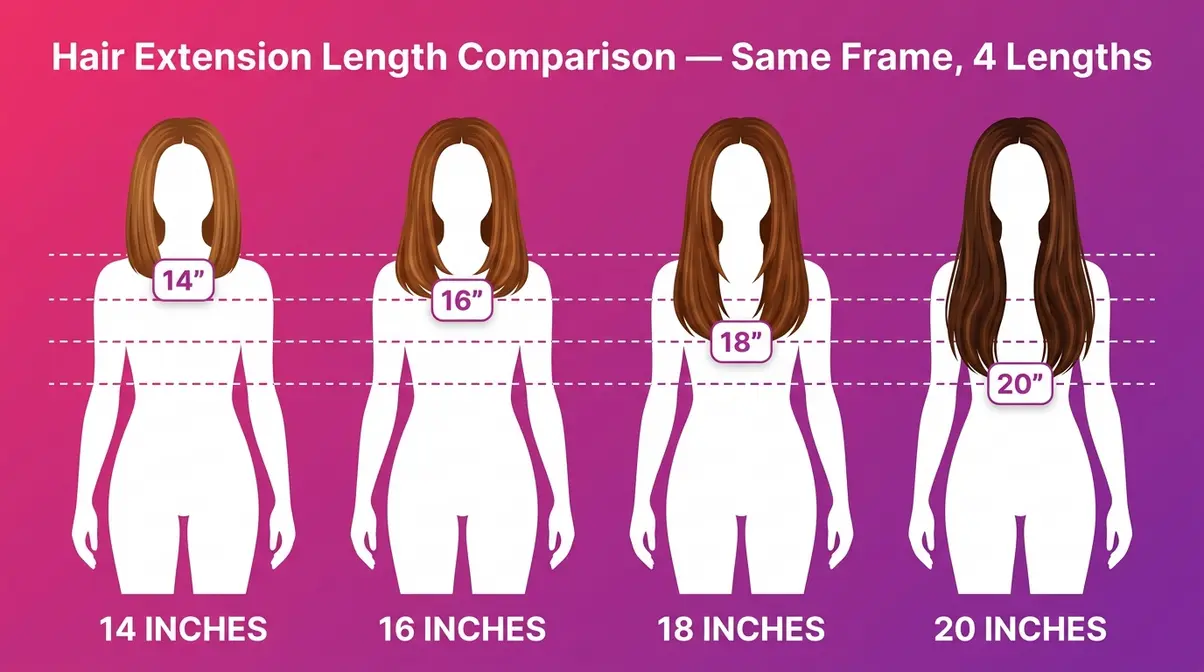
16 vs. 14 Inch: The Subtle Upgrade
14-inch extensions fall at or just above the collarbone on most frames — about two inches shorter than 16-inch options. That two-inch difference sounds small, but it’s the difference between hair that skims the top of your collarbone and hair that comfortably clears it. For women with very short natural hair (above the ears or at the jaw), 14 inches can feel like a natural progression, while 16 inches delivers more noticeable length.
Choose 14 inches if you want volume without dramatic length — or if your natural hair is already mid-neck and you simply want to fill it out. Choose 16 inches if you want a visible length upgrade that reads as “grown-out, healthy hair” rather than just added thickness.
16 vs. 18 Inch: The Most Common Dilemma
This is the comparison most buyers agonize over, and for good reason. 18-inch extensions typically fall mid-chest on a 5’5″ frame — roughly 2 inches below where 16-inch extensions land. On a 5’2″ frame, 18 inches can reach the upper stomach, creating a more dramatic look. On a 5’8″ frame, 18 inches sits at the collarbone — which is where 16 inches falls on a 5’5″ woman.
The practical rule: if you’re under 5’4″, 16 inches already gives you significant length. If you’re 5’6″ or taller and want hair that visually reads as “long,” consider 18-inch hair extension options. The weight difference is also real — 18-inch sets are heavier and may feel more noticeable on fine or thinning hair.
16 vs. 20 Inch: When More Is More
20-inch extensions fall well below the chest on most frames — what most people picture when they imagine “long hair.” The jump from 16 to 20 inches is significant in both look and weight. A 20-inch set is heavier, requires more blending work, and costs more. For fine or thinning hair, the extra weight of a 20-inch set can cause more strain on the scalp.
16 inches is the smarter starting point if you’ve never worn extensions before. You can always go longer once you know how extensions feel on your hair and scalp.
16 Inch Extensions on Short and Fine Hair
16-inch extensions can absolutely work on short and fine hair — but the application method and attachment type make all the difference between a natural result and visible tracks. This section is specifically for anyone dealing with fine strands, thinning patches, or hair that feels too fragile for traditional extension methods.
16 Inch Extensions on Short Hair?
The short answer is yes — with the right technique. Extensions need at least 3–4 inches of natural hair to attach securely and blend convincingly. If your hair is shorter than that (for example, a pixie cut), the tracks will likely show. A chin-length bob or longer, however, gives you enough hair to work with.
Clip-in extensions are the most beginner-friendly option for short hair because you can position each clip precisely to cover the shortest layers. Halo extensions (a single piece on an invisible wire) are also excellent for short hair because there are no individual clips to hide — the wire sits beneath your natural hair and the extensions fan out over the top.
The key challenge with short hair is blending the ends. Your natural hair ends at one point, and the extensions continue below it. A good tip: ask your stylist to lightly trim the extension ends to match your natural hair’s shape, which removes the blunt line that makes extensions look obvious.
Blending Tips for Fine and Thinning Hair
“Looking for hair pads 16 inches long to conceal thinning hair as topper look hideous on me.”
That quote captures exactly what so many buyers feel — toppers can look obvious, and the search for something that genuinely blends is real. Here are five techniques that work specifically when using extensions for thinning hair:
- Choose lighter-weight sets. Look for extensions labeled 100–120g rather than 160g+ sets. Less weight means less tension on fragile strands.
- Use halo or clip-in methods. These attach without heat, glue, or bonds — the three things most likely to worsen thinning. The American Academy of Dermatology specifically warns that tight, weighted hairstyles can lead to traction alopecia (hair loss caused by repeated pulling on the follicle).
- Avoid wearing extensions daily. Give your scalp rest days. Research published in PMC/NIH found that weft hair extensions can cause a distinctive horseshoe pattern of traction alopecia when worn continuously under tension.
- Match texture, not just color. Fine hair blends best with extensions that have a fine, silky texture — not thick, coarse wefts that sit visibly on top of your natural hair.
- Tease the roots lightly before clipping. A small amount of backcombing at the attachment point gives the clip something to grip, reducing slippage and the need to clip tighter.
A note on minoxidil compatibility: Many women using topical minoxidil (a common hair-regrowth treatment) wonder if they can still wear extensions. The answer is generally yes — as long as your scalp remains accessible for application. The Belgravia Centre advises that the extra weight of extensions can strain follicles, so lighter clip-in or halo methods are the safest pairing with minoxidil treatment. Be aware that minoxidil’s initial shedding phase may cause weft slippage as more natural hairs fall from the attachment point — this is temporary.
Types of 16 Inch Hair Extensions Explained
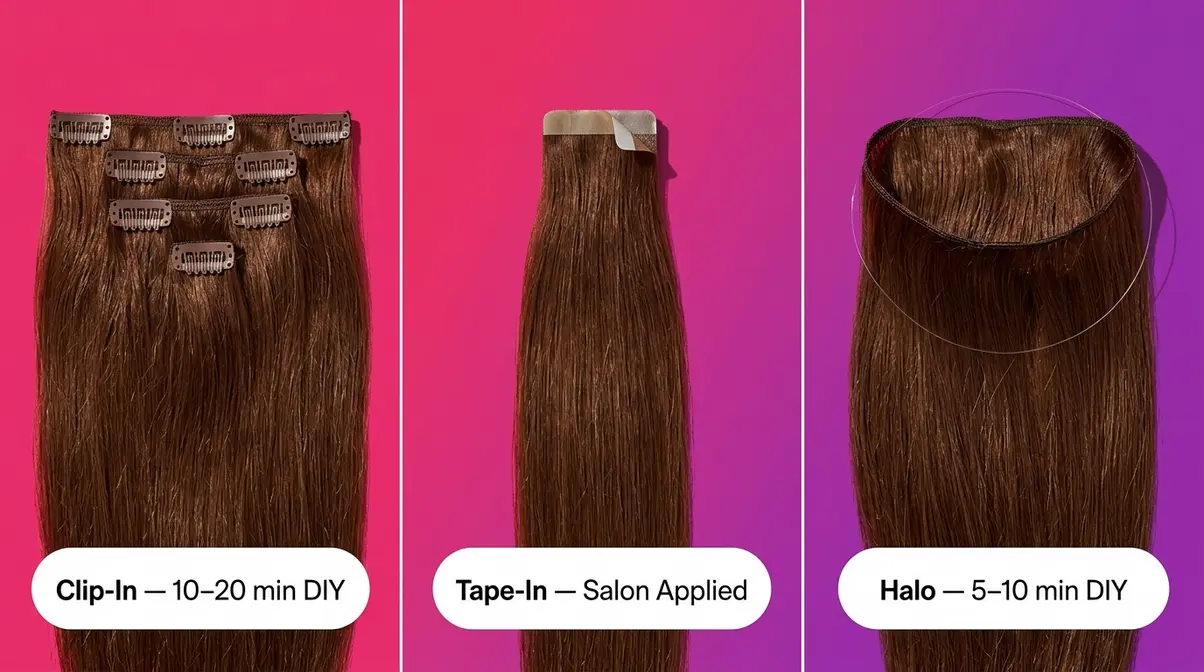
Our team evaluated the three most popular extension types for 16-inch lengths across application ease, blending ability, and suitability for fine hair — clip-ins, tape-ins, and halo extensions. If you’re exploring other semi-permanent methods, you might also learn about I-tip hair extensions as an alternative. Each has a distinct profile. The right choice depends on your lifestyle, budget, and how much time you want to spend on application.
| Type | Application Time | Cost (16″) | Best For | Maintenance |
|---|---|---|---|---|
| Clip-In | 10–20 min (DIY) | $100–$345 | Beginners, occasional wear | Remove nightly, wash weekly |
| Tape-In | 45–90 min (salon) | $200–$600 installed | Daily wear, semi-permanent | Reapply every 6–8 weeks |
| Halo | 5–10 min (DIY) | $150–$345 | Fine/thinning hair, low commitment | Remove nightly, wire adjustment |
Clip-In Extensions: Best for Beginners
Clip-in extensions are exactly what they sound like — individual wefts (strips of hair) with small pressure clips attached. You section your hair, snap the clips in, and you’re done. No salon visit required. For a 16-inch set, application takes 10–20 minutes once you’ve practiced a couple of times.
The biggest advantage for first-time buyers is reversibility. If you don’t love the look, you remove them and try again tomorrow. Clip-ins are also the easiest to match and blend because you can position each weft exactly where you need it. The main drawback is that they need to be removed every night — sleeping in clip-ins pulls on your scalp and can cause breakage over time.
Tape-In Extensions: Semi-Permanent
Tape-in extensions use medical-grade adhesive (think a flat, ultra-thin tape strip) to bond the extension to a thin section of your natural hair. A stylist applies them in a salon, and they stay in for 6–8 weeks before needing to be repositioned. They lie flat against the scalp, which makes them nearly invisible under most hairstyles.
The trade-off is commitment. You need a salon appointment for application and removal, and the adhesive can weaken if you use heavy oil-based products near the roots. For fine hair, tape-ins work well when applied carefully — but the tension from the bond can be problematic if your hair is already fragile. Ask your stylist to use half-strips rather than full strips to reduce the weight per attachment point.
Halo Extensions: Gentlest on Thin Hair
A halo extension is a single weft of hair attached to an invisible wire (monofilament thread) that sits on your head like a headband — just beneath your natural hair, which falls over it to hide the wire. There are no clips, bonds, glue, or heat involved. Application takes under ten minutes.
For anyone with thinning hair, a halo is often the safest choice. Because nothing attaches directly to your hair strands, there’s zero tension on your follicles. The limitation is that halos work best when you have enough natural hair to cover the wire — very short hair (above the jaw) may not hide it completely. Brands like Bellami and Luxy Hair both offer 16-inch halo options, and the wire is typically adjustable for a custom fit.
Human Hair vs. Synthetic — What Quality Means
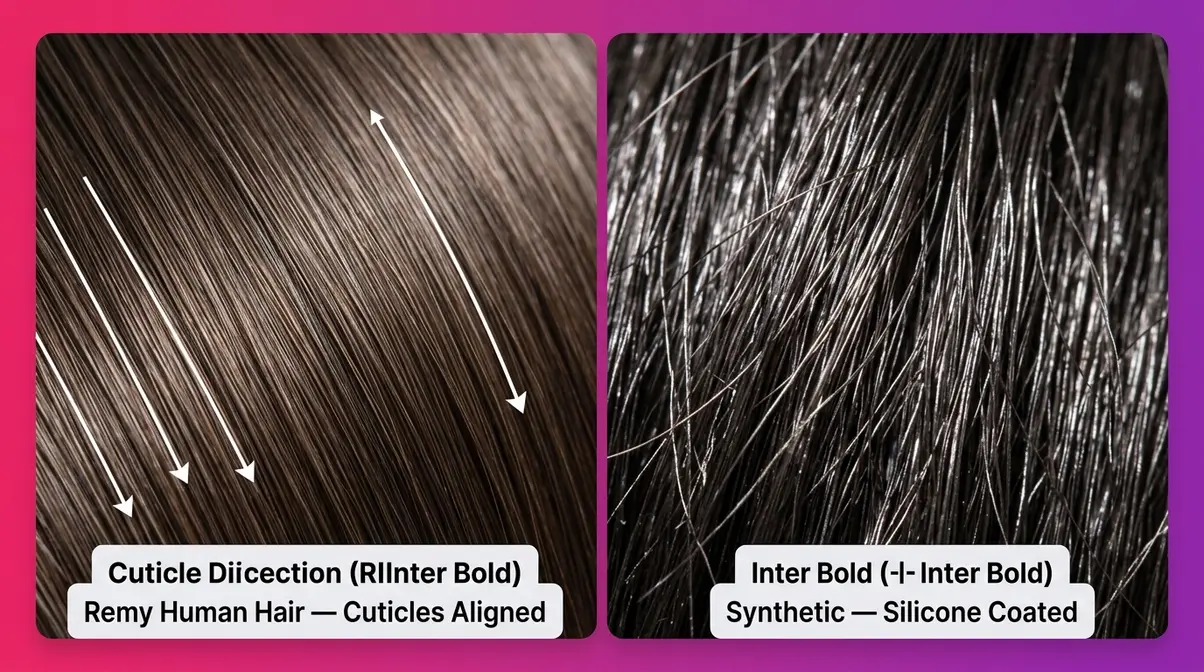
The single biggest quality decision you’ll make is choosing between human hair and synthetic fiber — and for 16-inch extensions you plan to style with heat, human hair is the only realistic option. Synthetic extensions cannot withstand curling irons or straighteners without melting or frizzing permanently.
Why Remy Human Hair Is the Gold Standard
Remy hair is human hair collected with all the cuticles (the outer protective layer of each strand) facing the same direction. This matters because when cuticles align, the hair stays smooth and tangle-free — it behaves almost identically to your own hair. Non-Remy human hair has cuticles going in mixed directions, which causes tangling, matting, and a shorter lifespan.
When a brand says “100% Remy human hair,” that’s the quality benchmark to look for. Remy extensions can be washed, blow-dried, curled, and straightened just like natural hair. With proper care, a quality set can last 6–12 months or longer.
How to Spot Low-Quality Extensions
Budget-friendly options can be tempting, but low-quality extensions reveal themselves quickly. Here are the warning signs to watch for before you buy:
- Excessive shine straight out of the package. Real Remy hair has a natural, muted sheen. Plasticky, mirror-like shine usually indicates silicone coating on low-grade hair — a coating that washes out within a few uses, leaving dry, tangled strands underneath.
- No mention of “Remy” or “cuticle-intact.” Reputable brands are transparent about this. If the product description just says “human hair” without specifying Remy, treat it with skepticism.
- Very low weight for the price. A quality 16-inch set typically weighs 100–160g. Sets advertised as full-head coverage at under $50 rarely deliver that weight in actual Remy hair.
- No return or exchange policy. Trustworthy brands stand behind their product with a return window. No return policy is a significant red flag.
Community consensus across professional extension communities consistently points to one rule: buy the best quality you can afford once, rather than replacing cheap sets every few months.
Top Brands for 16 Inch Hair Extensions
After evaluating the most-purchased brands at this length, three names consistently lead in quality, color range, and customer satisfaction: Bellami, Luxy Hair, and Zala. Each serves a slightly different buyer — here’s how to choose between them.
Bellami: Best for Luxury Buyers
Bellami is widely regarded as the professional-grade standard for clip-in and halo extensions. Their Silk Seam Clip-In line starts at approximately $205 for 16 inches (as of June 2026, verified via bellamihair.com), with some shade variants at around $225. The hair is 100% Remy human and comes in an extensive shade range, including highlighted and balayage options.
Bellami also offers a Halo PRO system available in 16 inches — a professional-grade halo with an adjustable 0.4mm wire and removable clips for a custom fit. If you want the closest thing to salon-quality results at home, Bellami is the benchmark.
Luxy Hair: Best for Natural Blends
Luxy Hair is particularly well-loved by buyers with fine, straight, or naturally smooth hair because their extensions tend to have a softer, more natural texture that blends seamlessly without looking too thick or voluminous. Their 16-inch Classic Clip-Ins are priced at $300 for 160g and their 16-inch Halo extensions at $345 for 140g (as of June 2026, verified via luxyhair.com).
The color range is excellent, with carefully developed shades designed to match natural hair tones. Luxy also offers a shade-matching tool on their website, which is genuinely useful for first-time buyers anxious about getting the color wrong.
Zala & Beauty Works: Budget Picks
For buyers who are budget-conscious, Zala offers a strong mid-range option. Their 16-inch 9-piece clip-in sets typically run $150–$250 depending on the shade and weight (as of June 2026, verified via zalahair.com). The hair is 100% Remy human, the color selection is wide, and the brand frequently runs promotions with buy-now-pay-later options and free shipping thresholds — making a quality set accessible without a large upfront cost.
Beauty Works, a UK-based brand available internationally via beautyworksonline.com, is another trusted option at a comparable price point. They’re particularly strong in blonde shades and offer a range of 16-inch clip-in and tape-in options. Both Zala and Beauty Works are excellent starting points if you’re trying extensions for the first time and aren’t ready to commit to a $300+ investment.
How Much Do 16 Inch Hair Extensions Cost?
Quality 16-inch human hair extensions range from approximately $100 for entry-level sets to $345 for premium brands — and the price difference reflects real differences in hair quality, longevity, and how natural the result looks.
Prices verified as of June 2026.
Price Range by Extension Type
| Extension Type | Budget Range | Mid-Range | Premium |
|---|---|---|---|
| Clip-In (16″) | $100–$150 | $150–$250 | $300–$345 |
| Tape-In (16″, installed) | $200–$300 | $300–$450 | $450–$600+ |
| Halo (16″) | $120–$180 | $200–$280 | $300–$345 |
Budget clip-in sets around $100 (commonly found on Amazon or marketplace sites) do exist in human hair, but the quality difference compared to a brand like Luxy or Bellami is noticeable — primarily in texture, longevity, and how well the color holds after washing.
Is Spending More Worth It?
For most first-time buyers, a mid-range set ($150–$250) from a reputable brand like Zala or Beauty Works is the smartest entry point. You get genuine Remy quality without the premium price, and you learn what weight, texture, and application method work for your hair before committing to a $300+ investment.
If you plan to wear extensions regularly — several times a week or daily — the math shifts. A $300 Luxy or Bellami set that lasts 12+ months with proper care costs less per wear than a $100 set you replace every 3–4 months. The longer you plan to wear them, the more the premium pays for itself.
Common Mistakes to Avoid
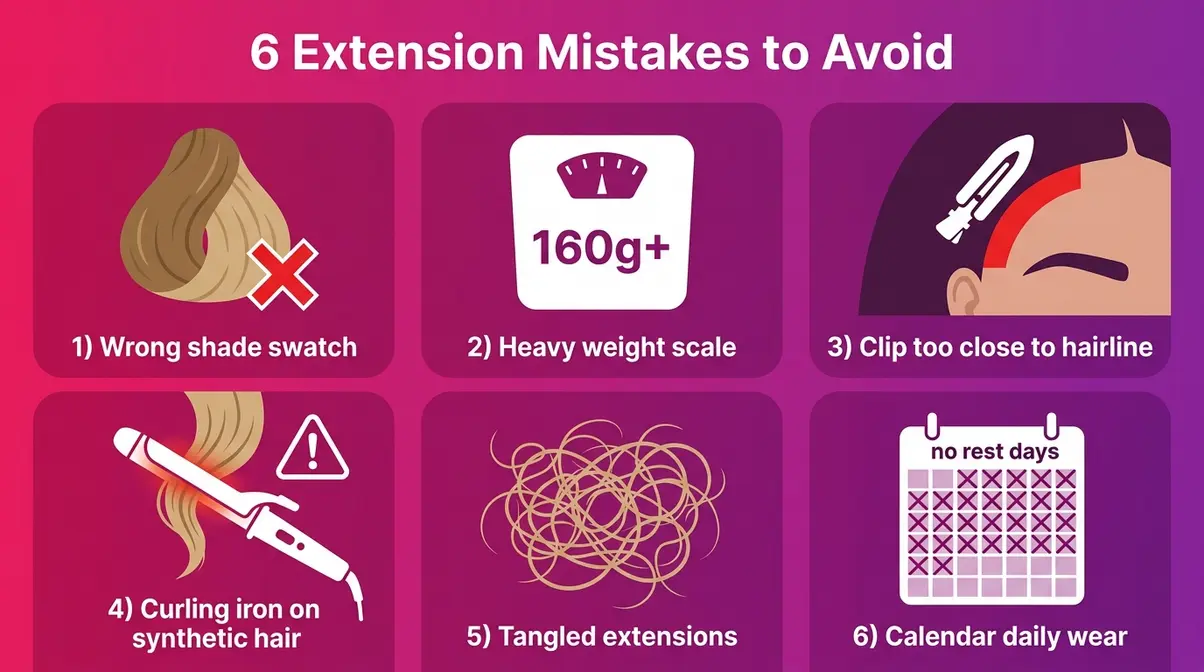
Even the best extensions can look wrong if the application goes sideways. These are the mistakes our team sees most often — and how to avoid them.
Buying the wrong shade. This is the #1 reason extensions look fake. Always order a shade swatch or use the brand’s color-matching tool before committing to a full set. Natural light is your friend — check the match in daylight, not under indoor lighting.
Skipping the weight check. Heavier extensions (160g+) can pull on fine hair and cause visible gaps at the root. If your hair is fine or thinning, stick to 100–120g sets and distribute the clips evenly across your head.
Attaching clips too close to the hairline. Clips placed within an inch of your temples or nape are more likely to show and more likely to cause tension headaches. Always keep clips at least 1.5 inches from your hairline.
Using heat on synthetic extensions. If your set isn’t labeled as heat-safe or made from human hair, a curling iron will melt or permanently frizz the fibers. Always confirm the hair type before applying heat.
Neglecting care between wears. Clip-in and halo extensions should be gently brushed before storage, kept in a cool dry place, and washed every 10–15 wears with a sulfate-free shampoo. Extensions don’t receive the natural oils your scalp produces — they dry out faster than your natural hair and need moisture to stay smooth.
Wearing them too tightly, too often. Research from PMC/NIH confirms that traction alopecia — hair loss caused by repeated pulling — is a real risk with heavy or tight extension methods worn continuously. Give your scalp at least 2 rest days per week.
Frequently Asked Questions
Is 16 inch hair short or long?
16 inches is considered a medium length — longer than a lob (long bob), shorter than what most people call “long hair.” In hairstyling terms, it falls in the collarbone-to-just-below-shoulder range for most frames. It’s long enough to wear in a ponytail, half-up styles, or loose waves, but not so long that it feels heavy or difficult to manage. Most buyers who want “natural-looking added length” without committing to very long hair find 16 inches to be the sweet spot.
What do 16 inch extensions look like?
16 inch extensions look like medium-length, healthy, full hair — typically reaching the collarbone on a person of average height. The exact appearance depends on the texture: straight extensions show the full 16 inches in a sleek finish, while wavy or curly extensions appear 1–2 inches shorter due to the wave pattern. Before-and-after photos consistently show the biggest visible change is volume first, then length — particularly on fine or thin hair where the added density is immediately noticeable.
What to Avoid with Hair Extensions?
There are several things to avoid with hair extensions to protect both the extensions and your natural hair. Don’t sleep in clip-in or halo extensions — the pressure causes breakage and shortens the lifespan of the set. Don’t use heat on synthetic extensions unless they’re specifically labeled heat-safe. Don’t apply heavy conditioners or oil treatments to the root area near clips or bonds, as this causes slippage. Avoid swimming in chlorinated water without protecting extensions first, and never brush wet extensions harshly — always use a wide-tooth comb or a loop brush starting from the ends and working upward.
How long is 16 inches visually?
16 inches (40.64 centimeters) is roughly the length from the tip of your chin to the bottom of your sternum when measured against your body. A helpful real-world reference: hold a standard ruler (12 inches) and imagine adding another 4 inches below it — that’s 16 inches. On most women, this places the hair at the collarbone when worn as an extension, since extensions attach a few inches below the crown. On a 5’2″ frame, it reaches closer to the mid-chest. Straight hair shows the full visual length; curly or wavy styles will appear shorter.
Can you sleep in 16 inch hair extensions?
No, you should never sleep in 16 inch clip-in or halo hair extensions. Leaving temporary extensions in overnight causes severe tension on your natural hair follicles, which can lead to traction alopecia and permanent hair loss. Additionally, the friction from tossing and turning will tangle and mat the extension hair, significantly reducing its lifespan. Always take the extra five minutes to remove your temporary extensions before bed to protect both your scalp and your investment.
The Confident Buyer’s Summary
For first-time buyers with fine, short, or thinning hair, 16 inch hair extensions offer one of the most versatile and manageable starting points available. At 40.64 centimeters, they fall at the collarbone on most frames — long enough to feel transformative, short enough to stay manageable. Across our evaluation of extension types and brands, the consistent finding is that method matters as much as length: halo and clip-in options deliver the best results for fragile hair because they add zero permanent tension to the follicle.
The Height-Adjusted Length Rule is your most practical tool here. Before you order, use the height table in this guide to confirm where 16 inches will actually fall on your body — not on the model in the product photo. That single step eliminates the most common source of buyer disappointment.
Your next step is simple: identify your height, check the table, confirm your budget, and choose one of the trusted brands above. If you’re genuinely unsure between 16 and 18 inches, start with 16 — you can always go longer next time, and a lighter set is kinder to your hair while you learn what works for you. Start with a reputable mid-range brand, wear them for 30 days, and you’ll know exactly what to look for in your next set. Shop our top-rated 16-inch hair extensions here to begin your transformation today.

Dave King
Writes evidence-based hair-care guides for Care About Your Hair — for every hair type, jargon-free and independent.