 Dave King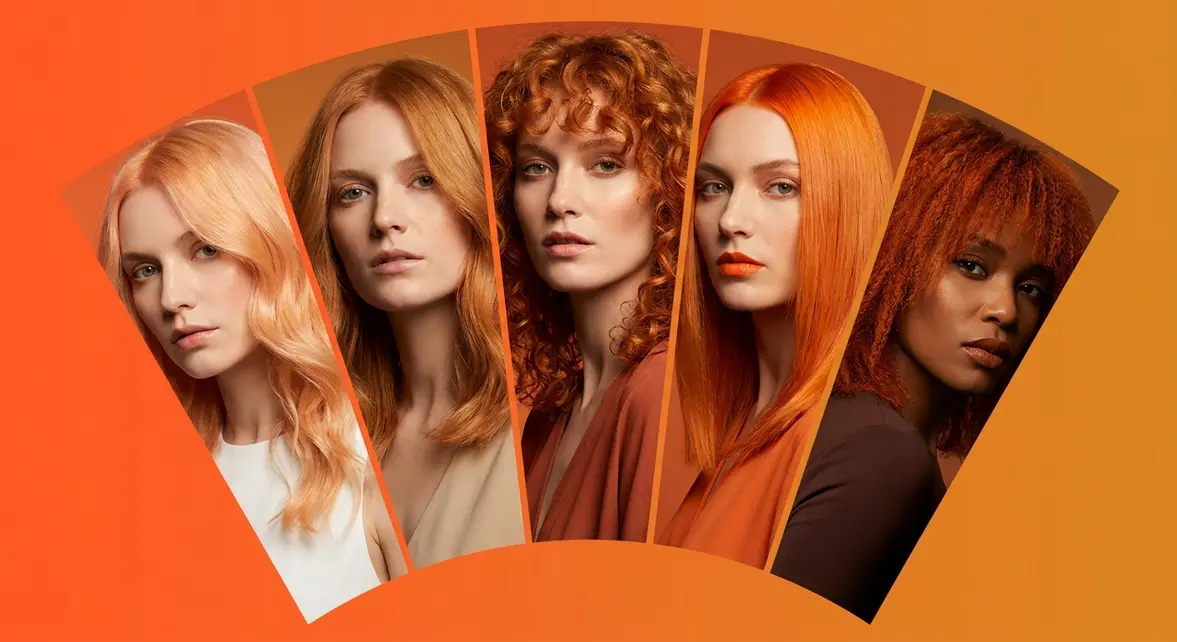
Orange hair covers everything from soft copper highlights to bold neon flames — and whether you want it or accidentally got it, this guide has you covered. You’ll find shade ideas, step-by-step dye instructions, and a clear plan for fixing brassy orange tones, all in one place.
Table of Contents
“Is my hair too obnoxiously orange??”
If you’ve ever asked yourself that question after a bleach session, you are not alone. Going orange by accident can feel like a disaster — but so can choosing the wrong shade on purpose and ending up with something that doesn’t suit your skin tone at all. Orange is one of the trickiest hair colors to navigate, whether you want it or desperately want to get rid of it.
By the end of this guide, you’ll know exactly which orange shade suits you, how to achieve it safely at home, and — if your hair went brassy by mistake — how to fix it without making things worse. We’ll walk through the full orange hair journey: shade names and meanings, color ideas by skin tone, product recommendations, step-by-step toning instructions, and even iconic orange-haired characters for cosplay inspiration.
Orange hair is one of the most versatile — and misunderstood — hair colors in 2026, spanning everything from natural ginger to vivid neon, yet most guides address only one part of the journey.
- To fix brassy orange tones: Use a blue-based shampoo or toner — blue cancels orange on the color wheel
- To go orange intentionally: Choose your shade based on skin undertone (warm = copper/ginger; cool = burnt orange/red-orange)
- Before any DIY dye job: Perform a patch test 48 hours ahead — the FDA recommends this for all hair dye products
- The Orange Spectrum Roadmap in this guide maps every situation — whether you’re fixing a mistake or chasing a look — to the right solution
What Is Orange Hair?
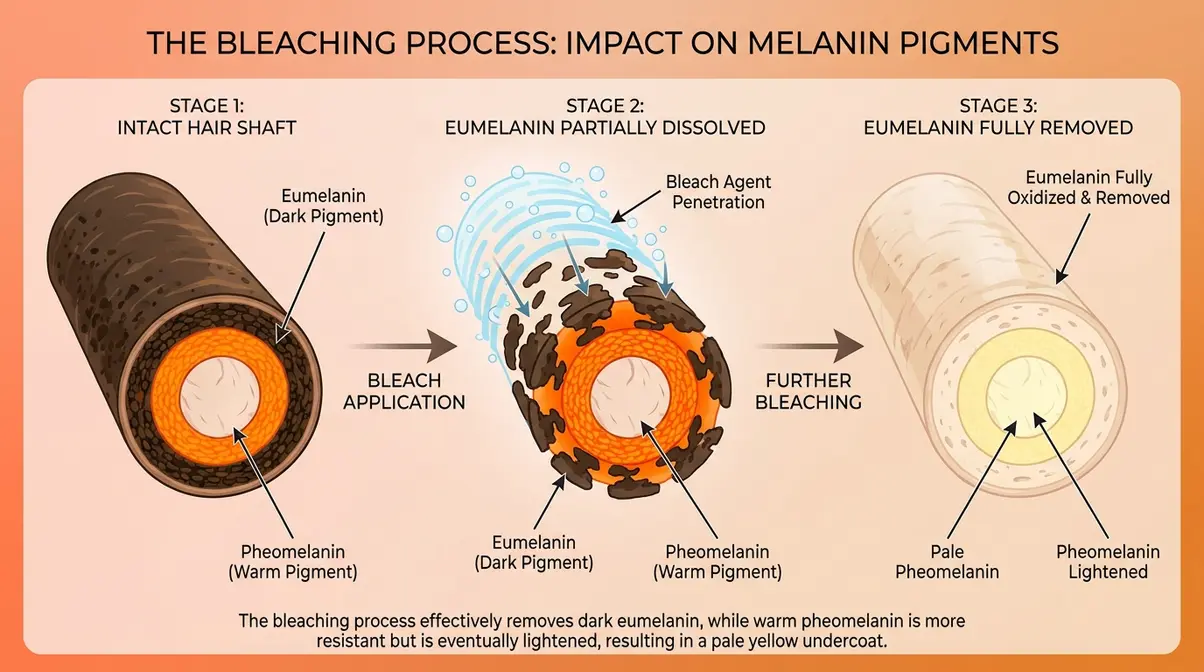
Orange hair is not one color. It’s an entire spectrum of warm tones — from the softest apricot to the most electric neon — and understanding where your hair falls on that spectrum is the first step toward either achieving the look you want or correcting the one you didn’t. According to Harvard University’s explanation of hair bleaching chemistry, the warm orange tones in hair come from pheomelanin, the warm pigment responsible for red and orange tones, which is exposed when bleach breaks down eumelanin, the dark pigment that bleach destroys first. Knowing this distinction helps you understand whether your orange hair is intentional, accidental, or somewhere in between.
Think of orange hair as a spectrum, and this guide as your roadmap — wherever you are on it, we’ll show you the next step. That’s the core idea behind The Orange Spectrum Roadmap: a single framework that maps every orange hair situation — from dreaming about copper highlights to panicking over a brassy box dye disaster — to the right solution.
The Orange Hair Shade Spectrum
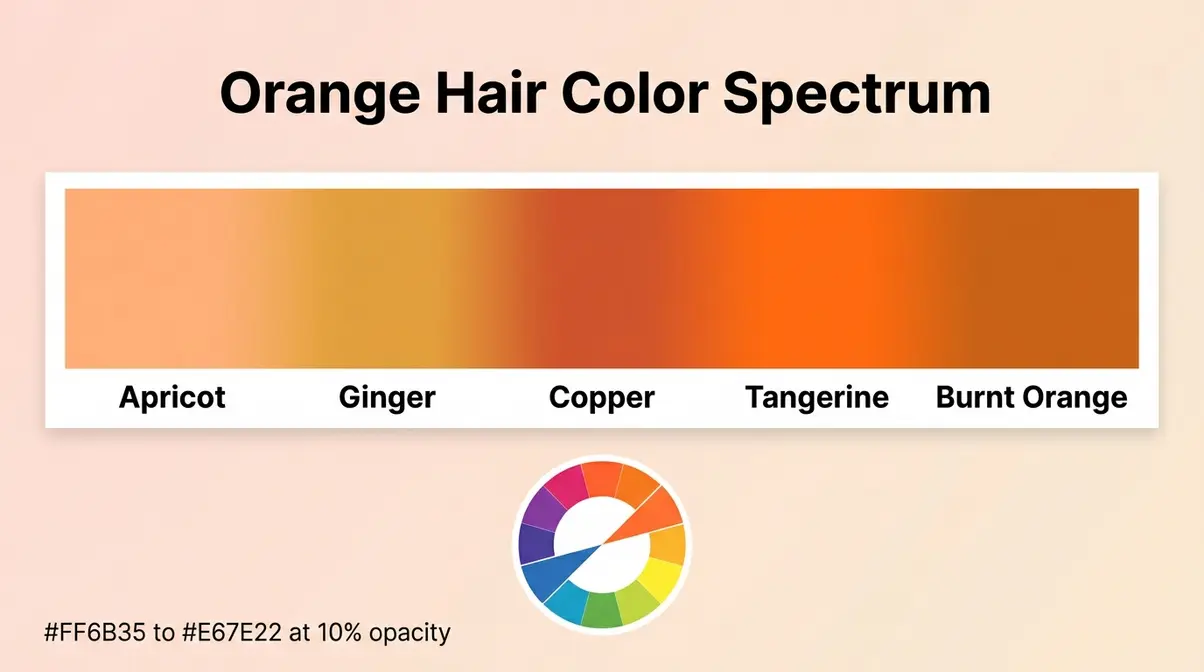
What is orange hair called? The answer depends on exactly where it falls on the color wheel. Orange hair is an umbrella term that covers at least five distinct named shades, each with its own personality and best-suited skin tone.
Copper hair is a warm reddish-orange shade that sits between red and orange on the color wheel. It’s one of the most requested salon shades precisely because it flatters a wide range of skin tones. Ginger hair is a lighter, golden-orange that mimics natural red hair at its warmest — think of the subtle warmth of autumn leaves rather than a vivid orange. Tangerine is bright and saturated, a true orange without much red or yellow pulling it in either direction. Apricot sits at the softer, paler end — a muted, peachy orange that reads almost pastel in certain lighting. Burnt orange is a deep, earthy tone that reads as sophisticated rather than bold, with a richness that leans toward brown in low light.
The distinction that matters most for beginners: “brassy” or unwanted orange tones after bleaching are NOT the same as intentional orange hair. They’re an unwanted byproduct of the lightening process — exposed pheomelanin that you didn’t ask for. If someone describes their hair as “FANTA orange,” they’re usually talking about a bright tangerine — vivid, saturated, and hard to ignore.
To explore the full range of named shades in detail, explore our complete guide to orange hair shades and science.
Why Your Hair Turns Orange When You Bleach It
Hair contains two types of melanin that determine its color. Eumelanin is the dark pigment responsible for brown and black tones. Pheomelanin is the warm pigment responsible for red and orange tones. When you apply bleach (a hydrogen peroxide and ammonia mixture), it oxidizes and destroys the melanin in your hair — but it doesn’t destroy both types at the same rate.
Bleach breaks down eumelanin significantly faster than pheomelanin. As the dark outer pigment dissolves, the warm pheomelanin underneath is exposed. That’s the orange stage. If you continue bleaching, the orange gradually fades to gold, then pale yellow, then nearly white — each stage representing less and less pheomelanin remaining.
Think of eumelanin as the dark outer shell of your hair color. Bleach peels it away layer by layer. The orange you see is what’s sitting underneath, waiting. This is why the same bleach product leaves dark brunette hair a vivid orange, but already-light blonde hair only slightly yellow — your starting point determines your result. If your hair is orange after bleaching, it simply means the process stopped before all the warm pigment was lifted. According to Harvard University’s explanation of hair bleaching chemistry, this oxidation process is predictable and consistent — which means it’s also correctable.
Now you understand the science. Here’s the fun part — let’s look at what orange hair can actually look like when it’s intentional.
Orange Hair Color Ideas & Inspiration
The right orange shade for you depends on more than just what looks good in a photo. It depends on your skin’s undertone (the subtle warm, cool, or neutral hue beneath your skin’s surface), your natural hair color, and how much commitment you’re ready to make. According to a guide to matching copper hair to skin undertones, top stylists emphasize that copper and orange hair trends require customized shade matching — lighter peach tones suit fair skin while deeper red-orange hues complement darker complexions (Vogue, 2024).
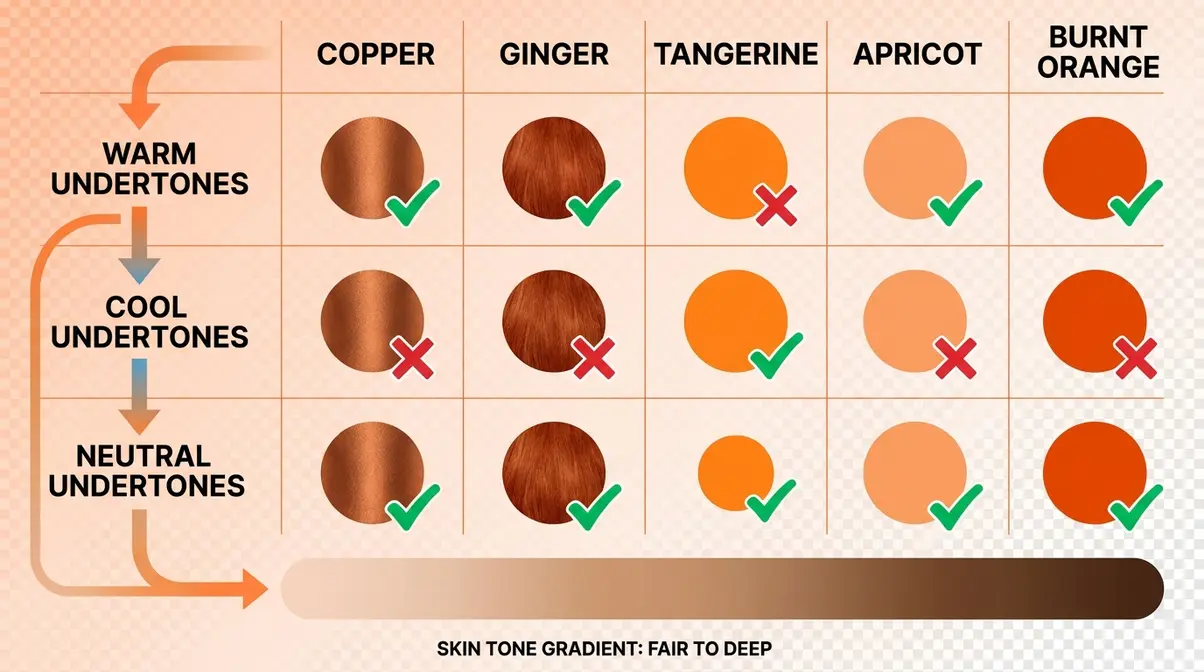
This is where The Orange Spectrum Roadmap becomes your practical tool. Think of it as your personal guide: identify your skin undertone on the left, follow the arrow to the recommended shade on the right.
How to Choose Your Orange Shade by Skin Tone
Your skin undertone is the most important factor in shade selection — and it’s not the same as your skin tone (how light or dark your complexion is). Undertones fall into three categories: warm (yellow, peachy, or golden), cool (pink, red, or bluish), and neutral (a mix of both).
Here’s how The Orange Spectrum Roadmap matches undertones to shades:
- Warm undertones (golden, peachy, olive skin):
- Best shades: Copper, ginger, golden orange, apricot
- Why it works: Warm undertones and warm hair shades sit in the same color family — they harmonize rather than clash
- Avoid: Cool-leaning red-orange, which can make warm skin look ruddy
- Cool undertones (pink, rosy, or bluish skin):
- Best shades: Burnt orange, red-orange, deep copper with red tones
- Why it works: The contrast between cool skin and warm hair creates a striking, intentional look rather than a washed-out one
- Avoid: Pure golden orange or apricot, which can look muddy against cool skin
- Neutral undertones (a mix of warm and cool):
- Best shades: Almost any orange works — neutral undertones are the most forgiving
- Recommended starting point: True tangerine or medium copper for maximum versatility
- Best for: Experimenting with bold shades like neon orange
- Fair skin (any undertone):
- Lighter shades like apricot, peach, and light copper add warmth without overwhelming
- Darker shades like burnt orange create high contrast — striking on fair skin with cool undertones
- Medium skin (any undertone):
- Medium copper and ginger are universally flattering across medium skin tones
- Tangerine reads especially vibrant on medium warm skin
- Dark skin (any undertone):
- Deep copper, rich burnt orange, and red-orange create stunning contrast
- Neon orange makes a bold statement on deep complexions — one of the most visually impactful combinations
For a deeper breakdown of which warm shades complement your specific complexion, see our guide to orange hair colors for warm skin tones.
Red and Orange Hair: Fire Tones & Auburn Blends
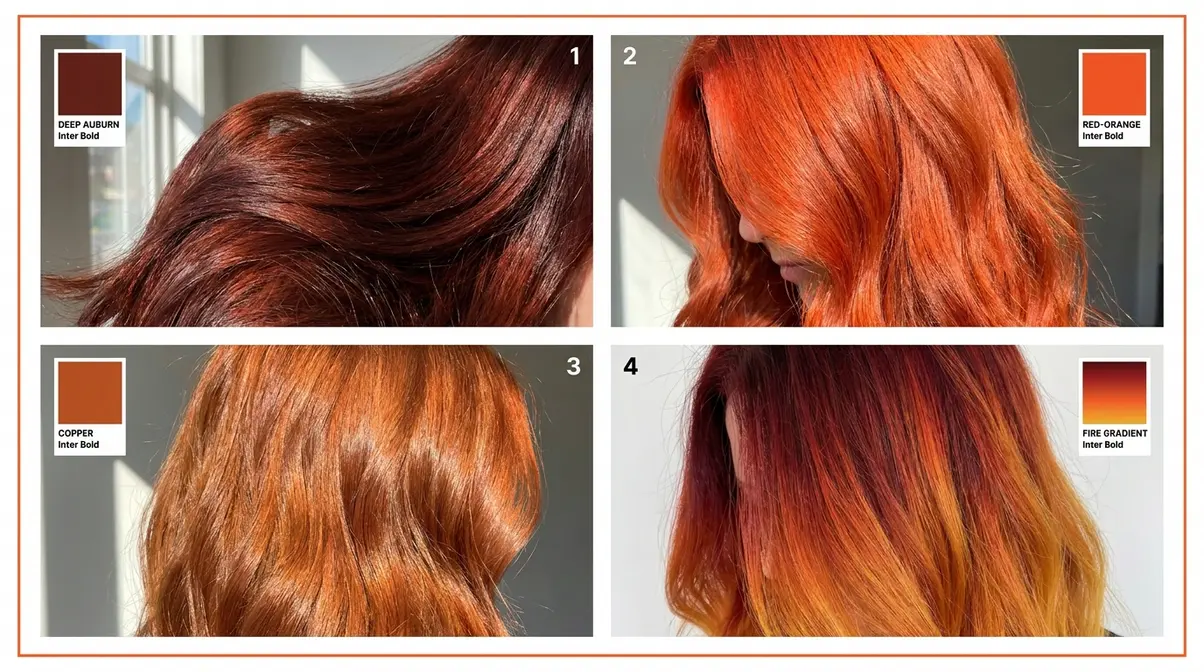
Red and orange hair exist on a shared spectrum, and some of the most striking looks live right at the intersection. Auburn is the classic blend — a rich, red-brown that leans orange in sunlight. Red-orange is more vivid, sitting unmistakably between red and orange without fully committing to either. Fire hair typically refers to a gradient from deep red at the roots through orange and into golden yellow at the tips — one of the most requested vivid color looks in 2026.
These blended shades work particularly well for people who love the warmth of orange but want more depth and dimension than a single flat color provides. Copper hair, a warm reddish-orange shade beloved by stylists for its versatility, bridges the red and orange worlds beautifully — it reads as red indoors and orange in natural light.
Best for: Cool to neutral undertones who want the drama of red without full commitment to a single vivid hue. Auburn and copper work on virtually every skin tone, making them the safest entry point for first-time orange hair explorers.
Black and Orange Hair: Bold Contrast Looks
Black and orange hair is one of the highest-contrast combinations in the vivid color world — and one of the most underexplored. The stark contrast between jet black and vivid orange creates a graphic, editorial quality that photographs beautifully. Common techniques include:
- Black roots with orange lengths: A natural-looking grow-out that adds dimension
- Orange peekaboo highlights: Hidden panels of orange revealed only when the hair moves
- Split dye (half black, half orange): A bold, geometric look that’s become a staple in alternative fashion
- Black base with scattered orange streaks: A more wearable version of the split dye, easier to maintain
Because the orange sits against such a dark background, it appears more saturated and vivid than it would on lighter hair. This combination is particularly striking on people with darker natural hair who want a vivid color without full bleaching of all their hair — the black sections can remain unbleached, reducing damage significantly.
Dark Orange, Light Orange & Highlights
Not all orange is created equal in terms of intensity, and the depth of your orange matters enormously for how wearable the result feels day-to-day.
Dark orange hair (SV: 1,600) refers to deep, saturated orange shades — closer to burnt sienna or rust. These shades are lower-maintenance than bright orange because fading looks intentional rather than washed-out. They’re also more office-friendly for people who want a vivid color that doesn’t read as extreme.
Light orange hair (SV: 720) covers the peach, apricot, and champagne-orange end of the spectrum. These shades require the most pre-lightening (bleaching to a very pale yellow) but they’re also the most delicate and ethereal-looking. They fade to a soft golden tone, which many people find equally beautiful.
Orange highlights are the commitment-light option. Rather than coloring all your hair, you add panels or streaks of orange through your natural color. This works especially well for brunettes who want a hint of warmth without a dramatic change. Balayage-style orange highlights (painted on freehand for a natural, sun-kissed effect) are among the most requested salon services for people exploring orange hair for the first time.
Copper, Ginger, Neon & Pastel: Shade Gallery
Here’s a quick reference gallery of the four most popular distinct orange hair categories:
Copper hair — The perennial salon favorite. Copper is a warm reddish-orange with golden undertones that flatters nearly every skin tone. It mimics natural hair color beautifully, which makes it one of the most low-maintenance vivid shades — roots are less jarring as they grow in. Best for: warm and neutral undertones. Key brands known for copper formulas include L’Oréal Paris Féria and Garnier Nutrisse.
Ginger hair — Lighter and more golden than copper, ginger mimics the look of naturally red hair. It’s the most “natural-looking” of the orange shades and requires less pre-lightening than true vivid orange. Best for: fair to medium skin with warm undertones. The Clairol Natural Instincts range is often cited for achieving convincing ginger tones.
Neon orange — The most vivid end of the spectrum — electric and unignorable. Neon orange requires bleaching to near-white before application and uses direct dye formulas (like Arctic Fox Sunset or Manic Panic Electric Tiger Lily). It fades quickly (typically 4–6 weeks to a softer tangerine) and requires color-depositing maintenance. Best for: bold statements, festival looks, and those with neutral or cool undertones on any skin tone.
Pastel orange (peach) — A soft, diluted orange that sits closer to pink than to vivid orange. Achieved by mixing neon orange direct dye with a white or clear conditioner. Pastel orange fades beautifully to champagne and is one of the most flattering “soft vivid” shades for fair to medium skin. Best for: those who want orange without the intensity.
How to Get Orange Hair: Dyes & Products
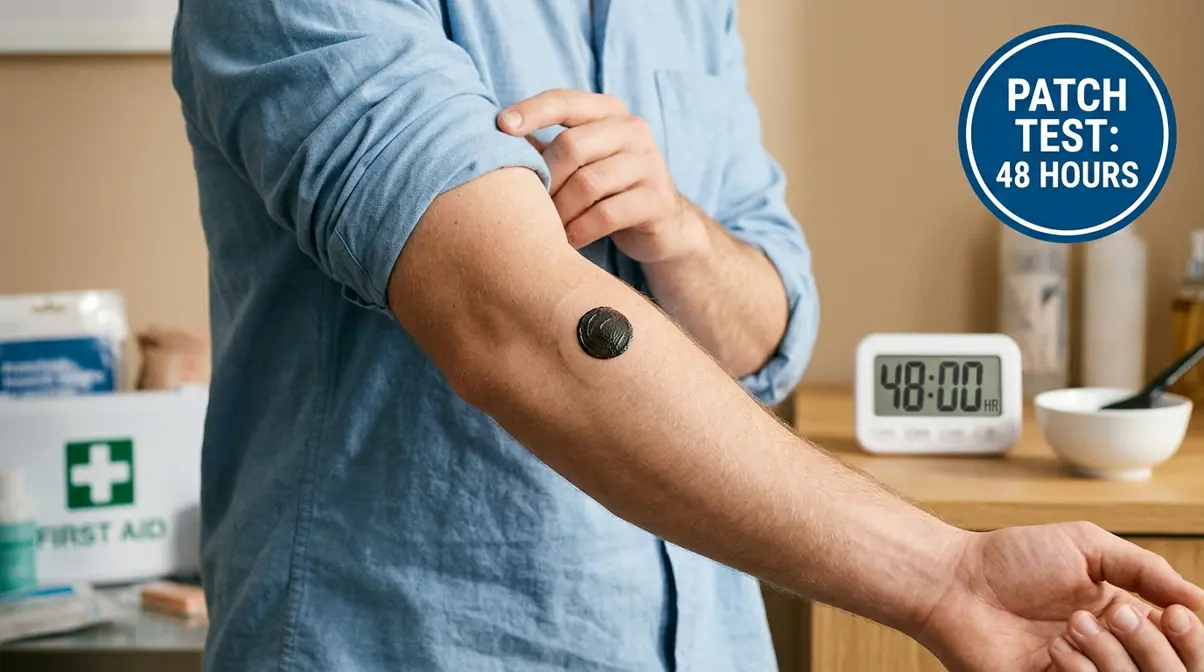
⚠️ PATCH TEST REQUIRED: Before using any new hair dye product, perform a patch test at least 48 hours in advance. Apply a small amount of dye to the inside of your elbow, cover lightly, and wait 48 hours for any reaction. The FDA recommends this for all hair dye products, including “natural” and “organic” formulas. Skip this step at your own risk — allergic reactions to hair dye can range from mild irritation to severe anaphylaxis.
Getting orange hair intentionally requires a clear plan. The process varies significantly depending on your starting hair color, the shade you want, and how permanent you need the result to be. Our evaluation of the most common approaches — based on user consensus across r/HairDye and professional colorist forums — found that the biggest mistakes beginners make are skipping pre-lightening when their hair is too dark, and choosing a dye type that doesn’t match their commitment level.
Types of Orange Hair Dye: Permanent vs. Semi-Permanent
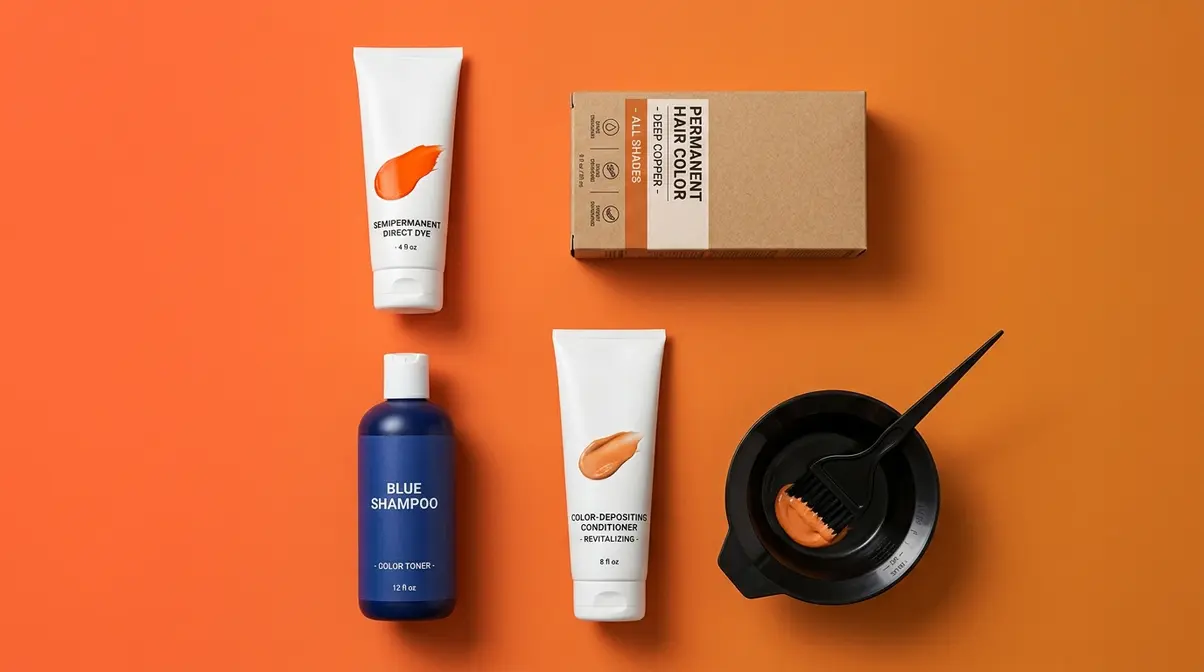
Choosing the right dye type is as important as choosing the right shade. Here’s what each type does — and when to use it:
| Dye Type | How It Works | Lasts | Best For |
|---|---|---|---|
| Permanent | Opens hair cuticle, deposits + develops color | 6–8 weeks | Natural-looking copper/ginger on light-medium hair |
| Semi-permanent | Deposits color without developer; no cuticle opening | 4–6 weeks | Vivid orange on pre-lightened hair |
| Demi-permanent | Uses low-volume developer; less commitment than permanent | 4–6 weeks | Tone-on-tone color, refreshing faded orange |
| Direct dye (vivid) | Pure pigment, no developer needed | 2–6 weeks | Neon orange, pastel orange, bold vivid shades |
| Color-depositing conditioner | Pigmented conditioner used in shower | 1–2 weeks | Maintenance and refresh between dye sessions |
Permanent dye works best for natural copper and ginger shades because it creates the most realistic, dimensional result on natural hair. However, it cannot lift hair color — it can only deposit. This means if your hair is darker than the target shade, you still need to pre-lighten first.
Semi-permanent and direct dyes are the go-to choice for vivid orange shades like tangerine, neon, and pastel. They work ONLY on pre-lightened hair (ideally bleached to pale yellow or white). The upside: no developer means significantly less damage. The downside: they fade faster and require regular maintenance.
Color-depositing conditioners (like Overtone Vibrant Orange or Celeb Luxury Viral Colorwash) are the best maintenance tool once you have orange hair — they refresh the tone at every wash without additional chemical processing.
Can You Get Orange Hair on Dark Hair Without Bleaching?
This is one of the most common questions from people with dark brown or black hair — and the honest answer is: it depends on how vivid you want the orange to be.
Without bleaching: You can add warmth to dark hair using demi-permanent copper or auburn dyes, but you won’t achieve a true vivid orange. The result will be a subtle warm sheen — visible in sunlight, but not a dramatic change. This works well for dark-haired people who want a hint of copper or ginger warmth.
With bleaching: To achieve a true orange, tangerine, or vivid copper on dark hair, pre-lightening is necessary. For very dark hair (levels 1–3 on the hair color scale), you may need two bleach sessions spaced 2–4 weeks apart to reach a pale enough base without over-processing.
- The pre-lightening prerequisites:
- Your hair must be in good condition before bleaching — no excessive breakage, split ends, or prior chemical damage
- Do a strand test (a full test strand, separate from the patch test) to check how your hair responds to bleach
- Use a bond-protecting treatment like Olaplex No. 1 or Redken pH-Bonder during the bleach process to minimize damage
- After bleaching, wait at least one week before applying orange dye — this allows the hair shaft to recover
User consensus across r/HairDye confirms that the most common beginner mistake is applying vivid orange dye to hair that hasn’t been lightened enough — resulting in a dull, muddy tone rather than a vivid orange.
Temporary Orange Hair: Sprays, Chalks & Wigs
Not ready to commit? Temporary options let you test the orange look without any chemical processing or long-term commitment.
Hair color sprays (SV: 2,400) like Schwarzkopf Got2b Colorful or L’Oréal Colorista Spray wash out in one shampoo. They work on any hair color, including dark hair, because they sit ON the hair rather than penetrating it. Best for: Halloween, festivals, one-day events. Limitation: they can transfer to clothing and pillowcases and look less natural than dyed results.
Hair chalk and color wax deposit pigment on the outside of the hair shaft. They last 1–3 days and work best on light to medium hair (dark hair may need to be dampened first for better adhesion). Hair wax tends to give more vibrant results than chalk.
Clip-in extensions and wigs are the zero-risk option — no chemicals, no commitment, completely reversible. High-quality synthetic or human hair wigs in vivid orange are widely available and can look remarkably natural. This is the best option for anyone who wants to “try before they commit” to a permanent change.
Buyer’s Guide: What to Look for in an Orange Hair Dye
Not all hair dye brands are equal — and knowing what to look for protects both your hair and your results. After testing across r/HairDye community reports and professional colorist feedback, here’s what matters:
- Look for:
- Conditioning agents (argan oil, keratin, shea butter) in the formula — vivid dyes especially can be drying
- Color-safe formulation (sulfate-free if possible) for longer-lasting results
- Clear shade naming — brands that show actual results on different starting hair colors, not just marketing photos
- PPD-free options if you have sensitive skin — PPD (paraphenylenediamine) is the most common allergen in permanent hair dye
- Be cautious with:
- Brands that don’t list full ingredients — transparency matters for safety
- Very cheap box dyes with no conditioning agents — they tend to be harsher and fade faster
- Brands with no patch test instructions included — this is a red flag for safety compliance
- Recommended brands by category:
- Vivid orange: Arctic Fox, Manic Panic, Pulp Riot
- Natural copper/ginger: L’Oréal Féria, Garnier Nutrisse, Clairol Natural Instincts
- Color-depositing maintenance: Overtone, Celeb Luxury Viral Colorwash
For a detailed look at what makes a quality hair dye — and which formulations to avoid — L’Oréal Paris breaks down what different color products cover in their professional guides.
How to Fix Brassy Orange Hair
⚠️ PATCH TEST REMINDER: Even toning products like blue shampoo and blue toner contain active ingredients that can cause reactions. Perform a patch test 48 hours before first use.
Unwanted brassy or orange tones are one of the most searched hair problems online — and one of the most fixable. The key is understanding the color theory behind the correction before you reach for a product. After evaluating the most common toning methods based on user reports across professional colorist communities and r/HairDye, our team found that most people who fail to fix their orange hair do so because they use the wrong toning product (purple shampoo on orange hair, for example, does almost nothing).
Color Theory 101: Why Blue Cancels Orange
Color theory is the study of how colors interact — and it’s the foundation of every toning fix for orange hair. On the standard color wheel, colors directly opposite each other are called complementary colors. Complementary colors neutralize each other when mixed — which is exactly how toning works.
Orange and blue sit directly opposite each other on the color wheel. This means blue pigment, when applied to orange hair, neutralizes the orange tone — canceling it out rather than covering it. The result is a more neutral, ashier tone.
This is why blue-based products are specifically designed to correct orange tones, while purple-based products are designed to correct yellow tones (yellow and purple are complementary). Mixing up these two is the most common — and most frustrating — mistake beginners make.
The toning spectrum at a glance:
| Unwanted Tone | Correcting Color | Product Type |
|---|---|---|
| Orange / brassy | Blue | Blue shampoo, blue toner |
| Warm orange-yellow | Blue-violet | Blue-violet toner |
| Yellow / pale brassy | Purple | Purple shampoo, purple toner |
| Red | Green | Green-based toner (professional) |
As Clairol explains in their guide to removing orange tones from hair, understanding which undertone you’re correcting before choosing a product is the single most important step in the toning process (Clairol, 2024).
“Hair turns orange during bleaching because eumelanin (dark pigment) breaks down faster than pheomelanin (warm pigment), exposing the underlying red-orange tones — and blue-based toning products work by neutralizing those warm tones using complementary color theory.”
How to Use Blue Shampoo on Orange Hair: Step by Step
Blue shampoo (also called “brass-correcting shampoo” or “color-correcting shampoo”) is the gentlest and most accessible fix for mild to moderate orange brassiness. It’s designed to be used in place of your regular shampoo 1–3 times per week.
What you’ll need: Blue shampoo (e.g., Shimmer Lights, Redken Color Extend Brownlights, or Matrix Total Results Brass Off), a shower timer, and a white or light-colored towel (blue pigment can stain).
Estimated time: 5–30 minutes depending on desired toning intensity.
Step-by-step:
- Wet your hair thoroughly in the shower — start with warm water to open the cuticle slightly for better pigment absorption
- Apply blue shampoo generously from roots to ends — use the same amount you’d use with regular shampoo
- Work into a lather and distribute evenly throughout all sections of your hair
- Set a timer — leave on for 5 minutes for light toning, 15–30 minutes for stronger correction. Check your hair every 5 minutes after the first 5 to avoid over-toning (which can leave a bluish or grey cast)
- Rinse thoroughly with cool water — cool water closes the cuticle and helps seal the corrected tone
- Follow with a deep conditioner — blue shampoo can be drying; a hydrating mask for 5 minutes after toning restores moisture
- Assess the result — if brassiness remains after drying, repeat 2–3 times per week until desired tone is achieved
Pro tip from colorist community feedback: Don’t use blue shampoo on dry hair expecting faster results — it can deposit unevenly and create patchy blue spots, especially on porous or damaged ends.
How to Use Blue Toner on Orange Hair: Step by Step
Blue toner is a stronger corrective treatment than blue shampoo — it’s typically mixed with a low-volume developer (10 or 20 volume) and applied like a hair color. It’s the right choice when blue shampoo alone isn’t shifting the orange enough.
What you’ll need: Blue toner (e.g., Wella T18, Wella T14, or a dedicated blue toner like Joico Color Balance Blue), 10 or 20 volume developer, a mixing bowl, tinting brush, gloves, and a timer. Estimated time: 30–45 minutes total.
Step-by-step:
- Mix the toner and developer according to the package ratio — typically 1:2 (one part toner to two parts developer)
- Start with dry or slightly damp hair — toner applies more evenly on dry hair for most formulas (check your specific product instructions)
- Section your hair into four quadrants using clips — this ensures even coverage
- Apply toner from roots to ends using the tinting brush, working section by section. Start at the most brassy areas (often the mid-lengths and ends)
- Set a timer for 20–30 minutes — check every 5 minutes after the 15-minute mark. Toner works fast; over-processing turns hair grey or blue-grey
- Rinse thoroughly with cool water until water runs clear
- Apply a deep conditioning mask for 10–15 minutes — toner with developer is more drying than blue shampoo
- Dry and assess — the full result is only visible once hair is completely dry
Important: If your hair is significantly damaged, use 10 volume developer rather than 20 volume. Damaged hair is more porous and processes toner faster, increasing the risk of over-toning.
Blue Shampoo vs. Purple Shampoo: Which Do You Need?
This is the question that trips up almost every beginner — and the confusion is completely understandable, since both products are marketed for “toning” and “brassiness.” Here’s the clear answer:
Purple shampoo neutralizes yellow tones. It’s designed for blonde hair or highlighted hair that has gone brassy yellow. Purple and yellow are complementary colors. If your hair is orange, purple shampoo will do almost nothing — or at best, slightly dull the tone without correcting it.
Blue shampoo neutralizes orange tones. It’s designed for brunettes who have had balayage, highlights, or lightening that has gone orange or warm. Blue and orange are complementary colors. This is what you need for orange brassiness.
Quick decision guide:
| Your Hair Looks… | Use This |
|---|---|
| Orange, brassy, copper-toned (unwanted) | Blue shampoo or blue toner |
| Yellow, pale brassy, straw-colored | Purple shampoo or purple toner |
| Both orange AND yellow (warm all over) | Blue-violet toner (targets both) |
| Slightly warm but mostly neutral | Purple shampoo (gentler option) |
For a full breakdown of products that correct orange tones specifically, Byrdie’s orange hair color guide covers the most current toning options across professional and drugstore ranges (Byrdie, 2024).
When Toning Doesn’t Work: Next Steps
If you’ve used blue shampoo consistently for 2–3 weeks and blue toner once or twice without achieving the neutral result you want, toning alone may not be enough. Here’s why — and what to do next.
- Reasons toning may not work:
- The orange is too deep: Very dark, vivid orange tones from natural hair that wasn’t lightened enough can’t be fully neutralized by toner — the hair needs to be lightened further first
- Uneven porosity: If your hair is damaged or unevenly processed, toner absorbs differently in different sections, creating patchy results
- Product isn’t strong enough: Drugstore blue shampoos vary significantly in pigment concentration — some are too diluted to make a visible difference on strong orange tones
- Next steps:
- Try a professional-grade blue toner (Wella, Redken, or Joico) rather than a drugstore option
- If the orange is very vivid, consider a second lightening session (wait at least 4 weeks between bleach sessions) to lift the base further before toning again
- Consider a professional gloss or glaze service — these salon treatments deposit tone more evenly than at-home products
- If nothing is working, book a consultation with a colorist — this is the clearest sign that the correction is beyond what at-home products can achieve
Orange Hair in Pop Culture
Orange hair has always been a statement — in fiction, it signals fire, rebellion, passion, and individuality. From the most beloved anime heroes to iconic movie characters, orange hair carries a cultural weight that makes it one of the most recognizable character design choices in storytelling.
Famous Anime Characters with Orange Hair
The primary keyword “orange hair characters” (SV: 4,400) is dominated by anime searches — and for good reason. Orange hair is one of the most iconic character design choices in Japanese animation, used to signal energy, determination, and outsider status.
Most iconic anime characters with orange hair:
- Ichigo Kurosaki (Bleach) — Arguably the most famous orange-haired anime character of all time. His vivid orange hair was initially a plot point — other characters assumed it was dyed, marking him as a delinquent
- Naruto Uzumaki (Naruto) — Technically golden-orange, Naruto’s hair is one of the most recognized in anime history
- Nami (One Piece) — One of the most popular female anime characters with orange hair, her shade shifts between light orange and auburn depending on the arc
- Orihime Inoue (Bleach) — Long auburn-orange hair that became iconic for the series
- Emma (The Promised Neverland) — Bright orange-red hair that visually signals her fiery, determined personality
- Asuka Langley Soryu (Neon Genesis Evangelion) — Her vivid auburn-orange has inspired countless cosplays
- Yotsuba Nakano (The Quintessential Quintuplets) — Bright orange hair used to distinguish her from her identical sisters
Orange hair in anime almost universally signals a protagonist with an energetic, unconventional personality — it’s a visual shorthand that viewers recognize instinctively.
Movie, TV & Cartoon Characters with Orange Hair
Orange hair in Western media is equally iconic — often used to signal uniqueness, creativity, or an outsider perspective.
Most famous orange-haired characters in film and TV:
- Ron Weasley (Harry Potter) — The Weasley family’s vivid ginger hair is one of the most recognizable character traits in modern fiction
- Merida (Brave, Disney/Pixar) — Her wild, curly orange-red hair is central to her identity and one of the most celebrated character designs in animation
- Wilma Flintstone (The Flintstones) — Classic cartoon orange hair that’s been iconic since the 1960s
- Ariel (The Little Mermaid) — Technically red, but her vivid orange-red hair inspired countless real-world dye requests
- Chuckie Finster (Rugrats) — The most famous anxious orange-haired cartoon character
- Kim Possible (Kim Possible) — Her signature orange-red hair became synonymous with the character
- Poison Ivy (Batman: The Animated Series) — Deep auburn-orange, one of the most cosplayed villain looks
- Ed Sheeran — Real-world celebrity whose natural ginger hair helped normalize and popularize vivid orange hair in mainstream culture
For cosplay inspiration, orange-haired characters offer some of the most achievable and recognizable looks — particularly Merida (curly vivid orange), Ichigo (straight vivid orange), and Ron Weasley (natural ginger).
Orange Hair Safety: What to Know Before You Dye
⚠️ CRITICAL SAFETY REMINDER: Always perform a patch test at least 48 hours before using any new hair dye or toning product. Apply a small amount to the inside of your elbow and wait 48 hours. The FDA recommends this step for all hair dye products without exception. Allergic reactions to hair dye can range from scalp irritation to severe anaphylaxis — even if you’ve used hair dye before without issues, formulations change and sensitization can develop over time.
Safety isn’t the exciting part of going orange — but it’s the part that determines whether you end up with beautiful hair or damaged hair (or a trip to urgent care). After evaluating the most common orange hair mistakes reported by users across professional colorist communities and DIY hair forums, our team identified the patterns that consistently lead to disappointing or damaging results.
Common Mistakes That Ruin Orange Hair Results
1. Skipping the patch test
The most dangerous mistake — and the most preventable. PPD (paraphenylenediamine), the most common permanent dye allergen, can cause severe reactions even in people who have dyed their hair before. Sensitization builds over time. The FDA is unambiguous: patch test every time, every product, 48 hours in advance.
2. Over-bleaching in one session
Trying to go from dark brown to pale blonde in a single bleach session causes severe breakage and can result in hair that snaps off at the root. Always bleach in stages — lift to orange/red first, then to gold, then to pale yellow, with recovery time between each session.
3. Applying vivid dye to insufficiently lightened hair
Vivid orange direct dye applied to golden or dark yellow hair produces a muddy, dull result — not the vivid orange you’re after. The base must be pale yellow or lighter for true vivid orange results.
4. Using purple shampoo on orange hair
As covered in the toning section — purple shampoo corrects yellow, not orange. Using it on orange hair is an extremely common mistake that produces no benefit and delays the actual fix.
5. Dyeing over damaged hair
Hair that is already broken, over-processed, or excessively dry will absorb color unevenly and release it faster. Dye over damaged hair only after a bond-repair treatment (Olaplex, K18) and a minimum two-week recovery period.
6. Washing hair immediately after dyeing
Wait at least 48–72 hours after dyeing before washing. The color needs time to oxidize and set fully. Washing too soon is one of the top reasons orange hair fades prematurely.
When to See a Professional Instead of DIY
Some orange hair situations are genuinely beyond what at-home products can safely achieve. Here’s how to recognize when to book a salon appointment rather than reaching for another box:
- See a professional if:
- Your hair has been chemically relaxed, permed, or heavily processed — bleaching over chemical treatments significantly increases the risk of breakage
- You want a complex multi-tone result (balayage, ombre, or color-melting) — these require professional sectioning and application techniques
- You’ve already bleached twice at home without reaching your target lightness — a third at-home bleach session is high-risk without professional assessment
- Your hair is breaking or feels like cotton candy after bleaching — this is a sign of severe over-processing; stop immediately and see a stylist
- You’re attempting a full color correction (going from vivid orange back to natural brown or blonde) — this is a multi-session process that requires professional knowledge of color theory and hair chemistry
For complex corrections, a professional colorist can assess your hair’s current condition, determine the safest path to your goal, and prevent the kind of damage that takes months to grow out. The cost of one professional session is almost always less than the cost of repairing a DIY disaster.
FAQ
What is orange hair called?
Orange hair goes by several names depending on the specific shade. The most common terms are copper (reddish-orange with golden tones), ginger (lighter, golden-orange), tangerine (bright, saturated orange), apricot (soft, pale orange), and burnt orange (deep, earthy orange). “Brassy” or “orange” hair in a negative context typically refers to unwanted warm tones exposed during bleaching — these are not the same as intentional orange shades. The umbrella term “warm hair” covers all of these shades together.
What should you NOT do before dyeing your hair?
Avoid washing your hair immediately before dyeing — your scalp’s natural oils protect against irritation. Don’t bleach over chemically relaxed or permed hair without professional assessment. Avoid heat styling in the 48 hours before dyeing, as it can cause additional dryness and uneven porosity. Never skip the patch test — apply dye to the inside of your elbow 48 hours before your planned dye session. Don’t apply dye to severely damaged or breaking hair — the result will be uneven and the process can cause further breakage.
What color cancels out orange in hair?
Blue cancels orange hair — this is a fundamental principle of color theory. On the color wheel, blue and orange sit directly opposite each other as complementary colors. When blue pigment is applied to orange hair, the two tones neutralize each other, producing a more neutral, ashier result. This is why blue shampoo and blue toner are specifically formulated for orange brassiness. Purple shampoo, by contrast, cancels yellow tones — not orange — making it the wrong choice for most brassy brunette hair (Clairol, 2024).
What are bad hair dye brands to avoid?
The most commonly reported issues come from very cheap, unbranded, or generic box dyes that lack conditioning agents and full ingredient transparency. Community consensus across r/HairDye flags brands that don’t include a patch test instruction card, don’t list PPD content clearly, or use misleading shade photography. Specific brand quality varies by product line — even reputable brands have individual formulas that underperform. The safest approach: stick to brands that clearly list all ingredients, include patch test guidance, and have a substantial body of user reviews showing real results on hair similar to yours.
What should you NOT do right after dyeing your hair?
Don’t wash your hair for at least 48–72 hours after dyeing. The color needs time to oxidize and bond fully to the hair shaft — washing too soon is one of the top causes of premature fading. Avoid heat styling for 48 hours after dyeing, as high heat opens the cuticle and releases fresh pigment. Don’t swim in chlorinated pools for at least a week — chlorine strips color aggressively. Avoid other chemical treatments (relaxers, perms, additional bleaching) for a minimum of two weeks post-dye to prevent damage and color disruption.
Can you get vivid orange hair without bleaching?
On dark hair, true vivid orange is not achievable without pre-lightening. Without bleaching, you can add warm copper or auburn tones using demi-permanent dye — visible in sunlight, but not a vivid orange change. For true tangerine, neon orange, or bright copper on dark hair, the hair must first be bleached to at least a pale golden-yellow base. The lighter the base, the more vivid and accurate the orange result. On naturally light brown or dark blonde hair, some copper and ginger shades may be achievable with permanent dye and minimal pre-lightening.
How do you keep orange hair from fading?
Use a color-depositing shampoo or conditioner specifically formulated for orange or copper tones. Wash hair in cool or lukewarm water — hot water opens the cuticle and accelerates color loss. Limit washes to 2–3 times per week; every wash removes some pigment. Use sulfate-free shampoo, as sulfates strip color significantly faster than gentler surfactants. Apply a UV-protectant hair product before sun exposure — UV rays break down vivid hair pigment rapidly. For vivid orange shades, refresh with a color-depositing conditioner (like Overtone) every 1–2 weeks between dye sessions to maintain vibrancy.
Conclusion
For anyone navigating the world of orange hair — whether you’re chasing a vivid copper look or staring at an accidental FANTA orange in the mirror — the path forward is clearer than it seems. Orange hair spans an entire spectrum of shades, from the softest apricot to the most electric neon, and every point on that spectrum has a solution: the right shade for your skin tone, the right dye type for your commitment level, and the right toning product for your specific brassiness. The Orange Spectrum Roadmap framework in this guide exists to make that navigation simple — map where you are, identify your next step, and move forward with confidence rather than anxiety.
The Orange Spectrum Roadmap is built on one core insight: most orange hair problems — whether you want orange or want to fix it — come from not knowing where you are on the spectrum in the first place. Once you identify your starting point (accidental brassiness vs. intentional vivid color) and your goal (correct it vs. enhance it), every decision becomes straightforward. Blue cancels orange. Warm undertones love copper. Dark hair needs pre-lightening. These aren’t complicated rules — they’re the building blocks of confident color decisions.
Start with the skin tone matching section to identify your ideal shade, or go directly to the toning guide if you’re dealing with unwanted brassiness right now. If you’re attempting a significant color change for the first time, consider booking a consultation with a colorist before committing to a full DIY process — one professional session can save you months of correction work. Whatever your orange hair situation, this guide at careaboutyourhair.com has the specific next step you need.

Dave King
Writes evidence-based hair-care guides for Care About Your Hair — for every hair type, jargon-free and independent.