 Dave King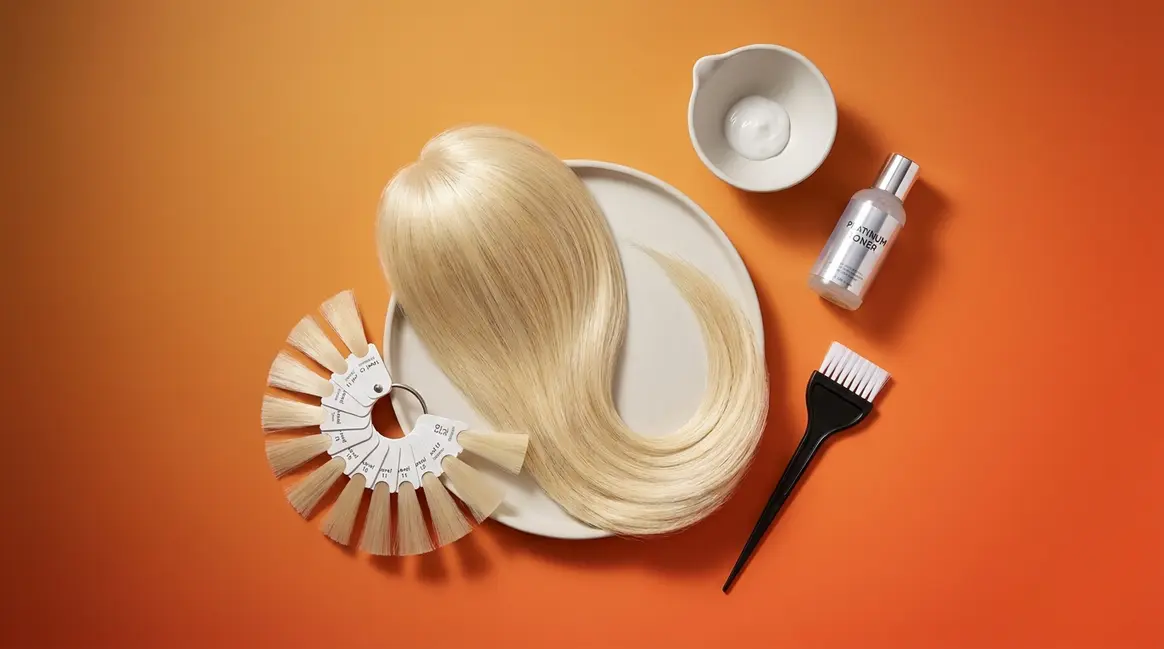
“613” is one of the most searched hair color codes online — yet most people buying braiding hair, bundles, or wigs don’t fully know what the number actually means. You’ve seen it on packs of Xpressions, on wig listings, and in every salon price board — but is it platinum? Is it yellow? Is it the same as blonde?
Without understanding what 613 hair color really is, you risk ordering the wrong shade, pairing it with the wrong colors, or spending hours trying to fix brassy tones you didn’t see coming. That’s a frustrating (and expensive) mistake to make on a custom install.
By the end of this guide, you’ll know exactly what 613 hair color is, how it compares to similar blondes like #27 and #60, which skin tones it flatters, and how to tone and maintain it like a pro. We’ll cover the hair color numbering system, color combinations, styling for braids and wigs, and a step-by-step toning tutorial — everything you need to go from confused to confident.
613 hair color is the industry code for a platinum blonde shade at Level 10–12 on the hair color scale — the lightest, most versatile blonde available for wigs, weaves, and braiding hair.
- “The Platinum Scale”: 613 sits between warm honey blonde (#27) and icy white platinum (#60), making it the most customizable starting point on the blonde spectrum.
- Suits all skin tones when styled with dark roots or warm-toned blends like 27/613 — high contrast is a feature, not a flaw.
- Perfect blank canvas for custom colors — pastels, vibrant shades, and ash blondes all absorb beautifully on 613 because the melanin has been fully lifted.
- Requires consistent maintenance: Purple shampoo weekly and deep conditioning every two weeks prevent brassiness and breakage.
Table of Contents
What Is 613 Hair Color? The Complete Definition
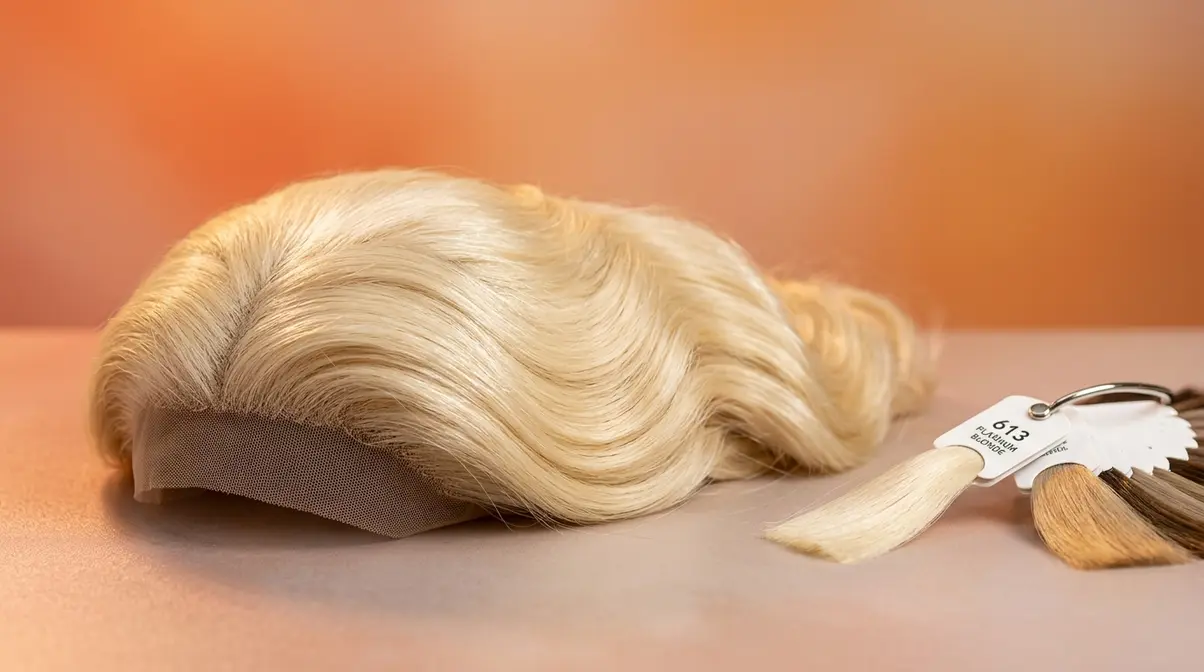
613 hair color is the universal industry code for a platinum blonde shade at Level 10–12 on the hair color numbering scale — the lightest, most lifted tone available in wigs, weaves, extensions, and braiding hair. According to the universal hair color chart (Cosmopolitan, 2026), the scale runs from Level 1 (deepest black) to Level 10–12 (palest platinum), with 613 occupying that brightest, most versatile position. That versatility is what makes it so popular: 613 works as a standalone shade and as a blank canvas for custom color work.
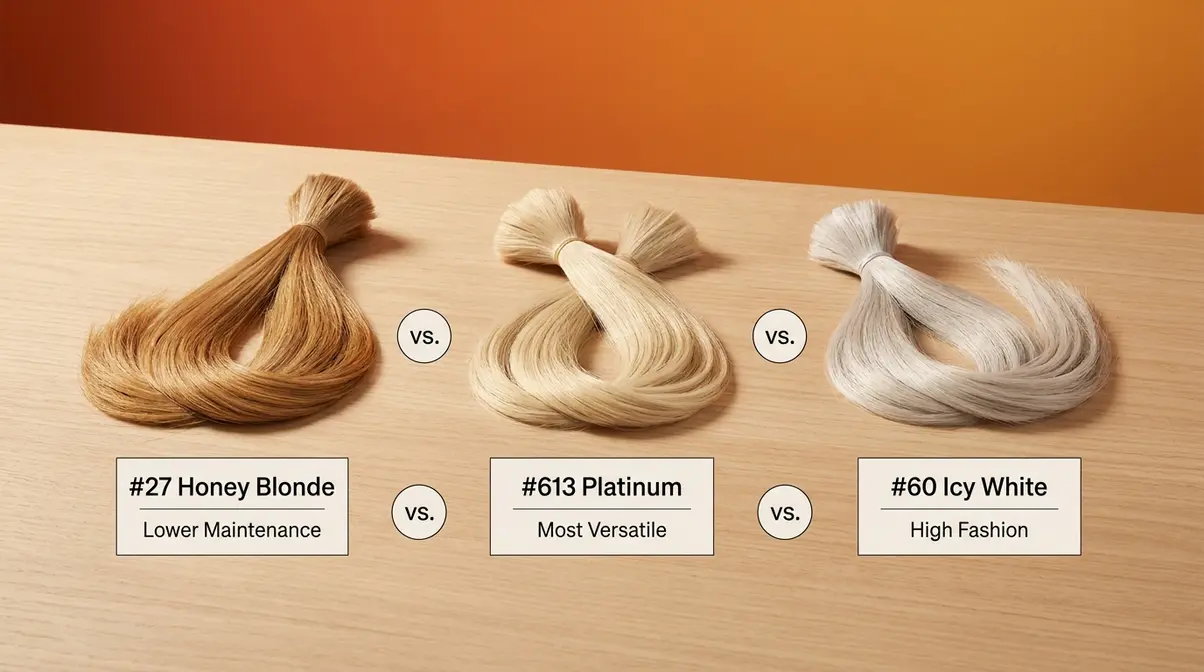
This is where “The Platinum Scale” concept becomes useful. Think of the blonde spectrum as a ruler: at one end sits warm honey blonde (#27), at the other sits icy white platinum (#60), and right in the middle — the most flexible, most wearable point — is 613. It’s not as warm as #27 and not as stark as #60, which is exactly why colorists and wig enthusiasts reach for it first.
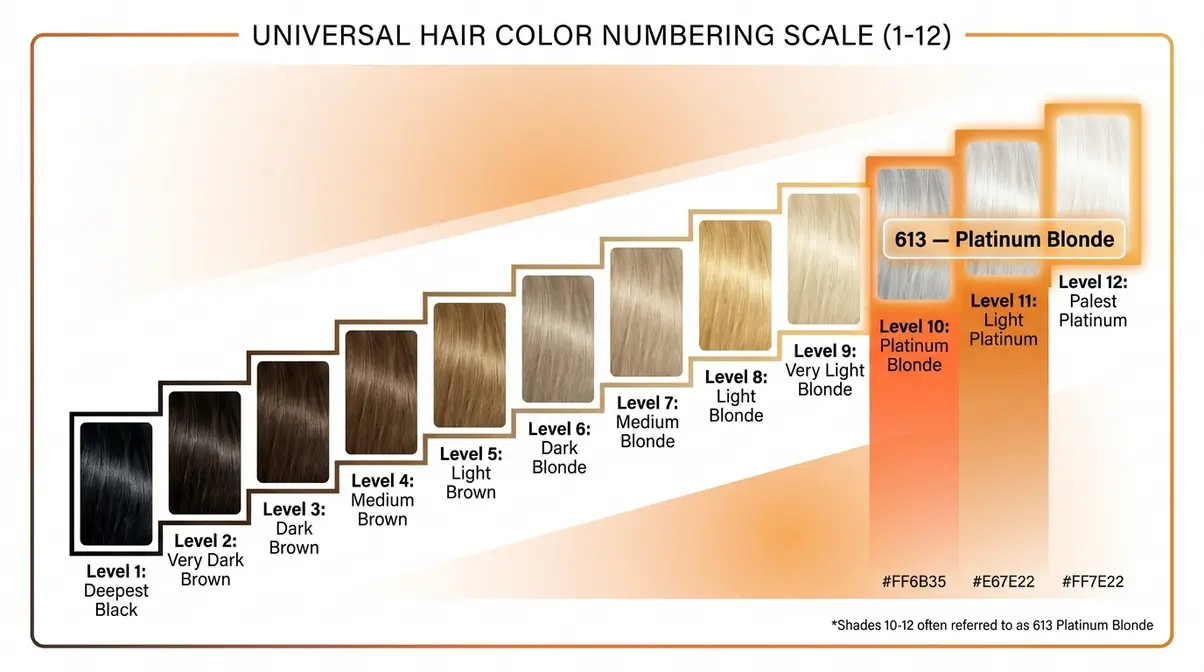
Hair Color Numbering System
The hair color numbering system is a Level 1-to-12 brightness scale used by colorists and hair manufacturers worldwide. Think of it like a ruler for hair lightness: Level 1 is the deepest black, Level 5 is medium brown, and Level 10–12 is the lightest platinum blonde you can get. The higher the number, the lighter the shade — simple as that.
So where does “613” come from? The “6” in 613 originally corresponded to a color category in early professional color ring systems, and “13” identified the specific shade variant within that category. In practice, the hair industry — especially the extensions and wig market — has converged on 613 as the universal shorthand for the lightest platinum blonde, regardless of brand. That means any brand’s 613 bundle, whether you’re buying from a boutique or a big-box beauty supply, should deliver the same platinum result. Think of it like a paint chip at a hardware store: the code exists so you get consistent results every time, no matter who made it.
This matters for your hairtutorial and shopping decisions: you can confidently compare a 613 from one vendor to a 613 from another, because the code is an industry-wide standard — not a brand secret. For a deeper dive into how this specific shade fits into our broader resources, check out our complete 613 hair color guide.
613 Key Visual Characteristics
The blonde hair color 613 represents is best described as a creamy, sunlit platinum — warm enough to feel natural, light enough to turn heads. It is not icy white (that’s #60), and a quality 613 should not look overtly yellow (that’s a sign of under-toning or low-quality processing). In natural light, 613 reads as a luminous, champagne-toned blonde. Under indoor lighting, it may shift slightly more golden — which most wearers find flattering.
Because 613 is heavily pre-lightened, the hair has a slightly more porous texture than virgin (unprocessed) hair. Porosity — meaning how readily the hair absorbs and releases moisture — is higher in 613, which is why it drinks up conditioning treatments so eagerly. That same porosity is actually your superpower: it means pastels, vibrant dyes, and toners absorb evenly and brilliantly, making 613 the ideal blank canvas for custom color work. Hold a 613 bundle next to a #60 bundle and you’ll see the difference immediately — 613 reads warmer and creamier; #60 reads whiter and cooler.
One important note: if your 613 hair looks brassy or yellow, that’s a fixable problem — not a defining characteristic. Toning (applying a color-correcting product to neutralize unwanted warmth) resolves this in under 30 minutes.
How 613 Hair Is Made
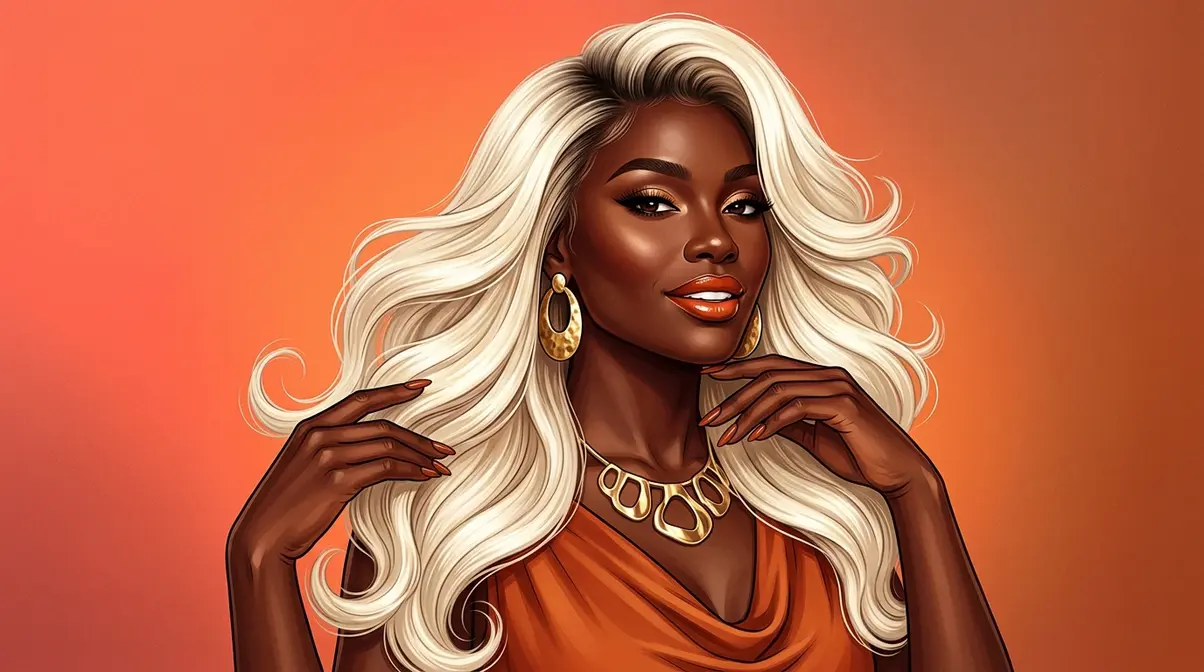
613 hair — in wigs, weaves, and bundles — is created by chemically lifting (bleaching) dark hair to its lightest possible state using a mixture of hydrogen peroxide and bleaching powder. The lifting process strips the hair’s natural melanin (the pigment that gives hair its color) until virtually none remains, leaving behind that pale platinum base.
Research published through the National Institutes of Health (NIH) confirms that bleaching agents degrade both melanin granules and hair proteins, increasing the hair’s porosity in the process (NIH, 2015). This is exactly why 613 hair needs more moisture and protection than unprocessed hair — the chemical process that makes it so beautiful also makes it more vulnerable to dryness and breakage without proper care.
For synthetic braiding hair like Xpressions, “613” refers to the colorant shade used during fiber manufacturing — the process differs from human hair bleaching, but the color standard is the same. The practical difference? Synthetic 613 cannot be toned or dyed at home, while human hair 613 can be customized freely. Keep that distinction in mind when you’re shopping for your next install.
Are 613 and Platinum the Same?
613 and platinum blonde refer to the same lightness level, but “platinum blonde” is a general descriptor while “613” is a specific industry code. Not all platinum blondes are exactly 613 — some brands use codes like #60 or #613A for slightly different platinum variations. However, in the extensions and wig market, “613” has become the de facto standard code for platinum blonde, so the terms are used interchangeably in most shopping contexts. When in doubt, request a swatch to confirm the exact shade before purchasing.
613 vs. 60 vs. 27: Comparing Blondes
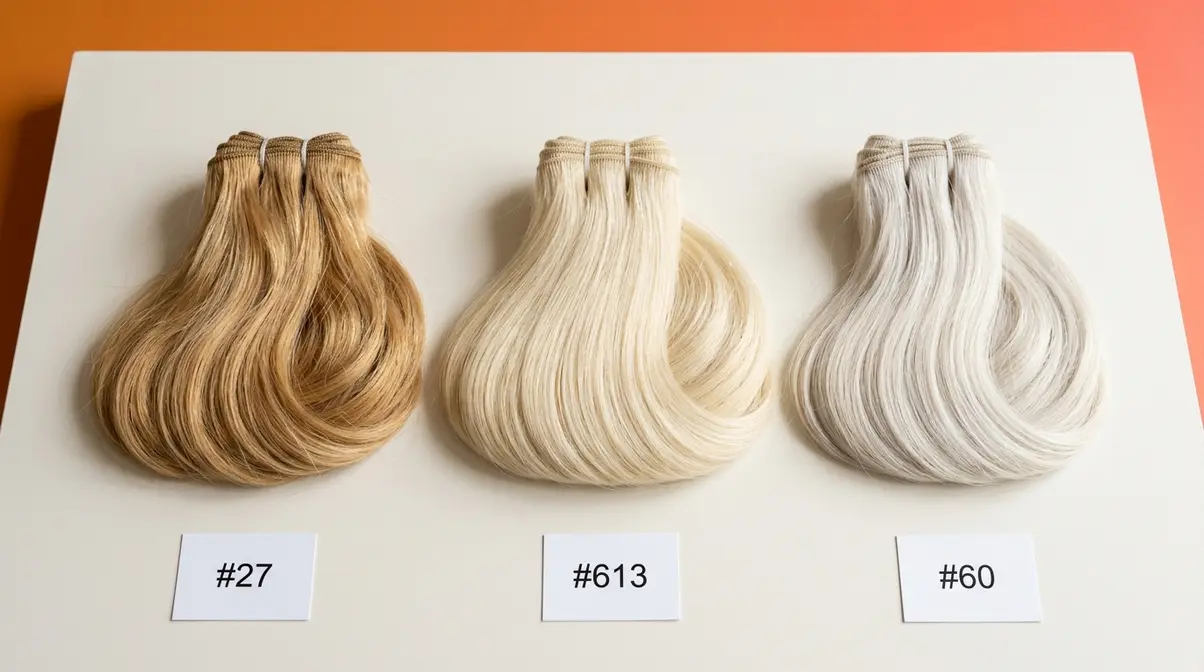
Understanding where 613 falls on The Platinum Scale means knowing its two closest neighbors: Color 60 (the icier platinum) and Color 27 (the warmer honey blonde). These three shades are frequently confused — and frequently combined — so a clear comparison is essential before you commit to a purchase.
| Shade | Level | Undertone | Appearance | Best For |
|---|---|---|---|---|
| #27 | 8–9 | Warm golden/amber | Honey blonde, rich and golden | Natural looks, warm skin tones |
| #613 | 10–12 | Warm-neutral platinum | Creamy, sunlit platinum | Versatile installs, blank canvas |
| #60 | 11–12 | Cool/icy | Near-white platinum | High-fashion, editorial looks |
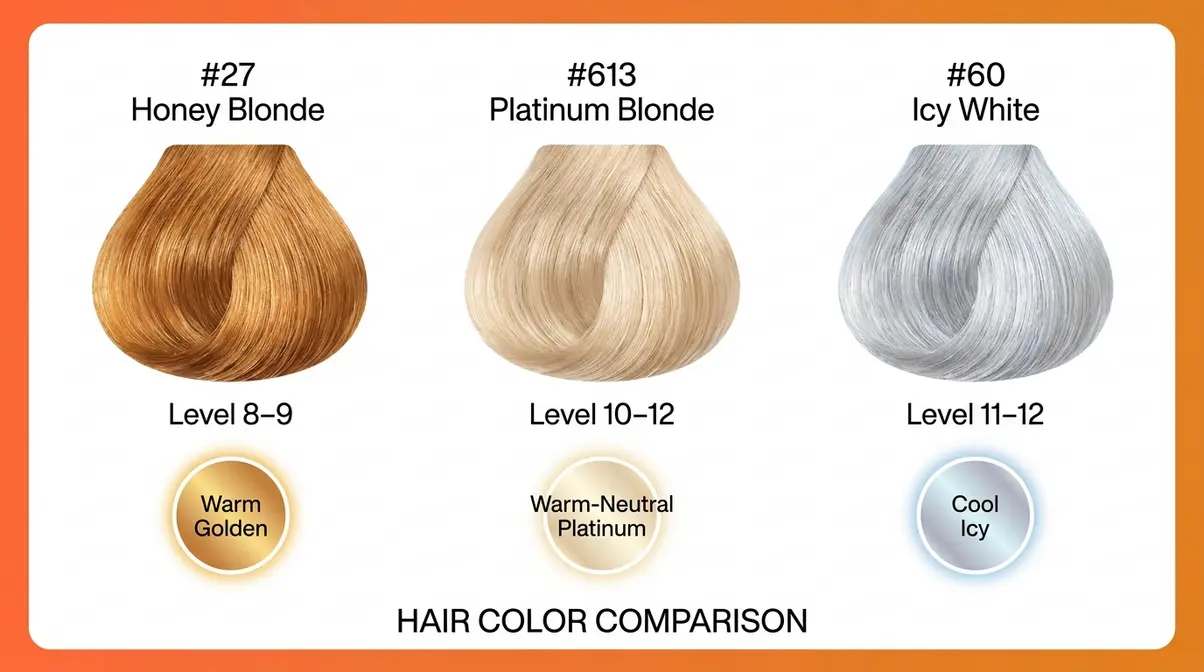
613 vs. Color 60: Warm vs. Icy
At first glance, 613 and Color 60 look almost identical — both are very light blondes. The key difference is undertone. Color 60 is a cool, icy platinum with blue or silver undertones, while 613 carries subtle warm or neutral undertones that read as creamy and natural rather than stark white. According to Loxx of Hair’s wig and extension guide, 613 is the more universally wearable option precisely because its warmth prevents the “too costume-y” effect that pure white platinum (#60) can create on some skin tones.
In practice: if you want a bold, high-fashion look that reads almost silver or white, Color 60 is your shade. If you want a platinum blonde that still looks like hair — luminous, dimensional, and natural — 613 is the better choice. For most wiginstall looks and everyday wear, colorists consistently recommend 613 over 60 for this reason.
Quotable fact: “613 is the most versatile platinum blonde in the extensions market — warm enough to flatter a wide range of skin tones, light enough to accept virtually any custom color on top.” (Loxx of Hair, 2026)
613 vs. 27: Platinum vs. Honey
Color 27 is a honey blonde — warm, golden, and rich — sitting at around Level 8–9 on the color scale. It’s noticeably darker and warmer than 613, with amber and caramel undertones that give it a sun-kissed, natural feel. If you are transitioning from dark blonde hair, jumping straight to 613 can feel drastic, making the 27/613 blend a perfect stepping stone. The gap between 27 and 613 is significant enough that you’d never confuse a single-color install of each. However, they work beautifully together in blended combinations like 27/613, where the warm honey tones of #27 soften the brightness of 613 for a dimensional, natural-looking result.
The 27/613 blend is one of the most popular combinations in the braiding and weave community for exactly this reason — the warmth of #27 makes 613 feel less “done” and more organic. If you love the idea of platinum blonde but worry it might feel too stark, starting with a 27/613 blend is the perfect entry point. We’ll cover this in detail in the combinations section below.
Does 613 Hair Suit Dark Skin? (Yes — Here’s How)
Yes — 613 hair color absolutely suits darker skin tones, and the contrast it creates is one of its most striking and celebrated qualities. The concern that very light blonde hair “won’t work” on deeper complexions is a myth worth dismantling directly. Across beauty communities, the consistent feedback is that 613 on deep brown or dark skin creates a bold, high-fashion aesthetic that lighter skin tones simply can’t replicate with the same drama.
What Skin Tones Suit 613 Hair?
613 hair suits all skin tones — the key is in the styling approach. On deeper skin tones, the high contrast between platinum blonde and dark skin creates a bold, editorial look that professional stylists consistently celebrate. Search trend data indicates a 124% year-over-year increase in queries for platinum blonde styles on darker skin tones, proving this high-contrast look is rapidly gaining mainstream adoption. This surge means more stylists are perfecting the application.
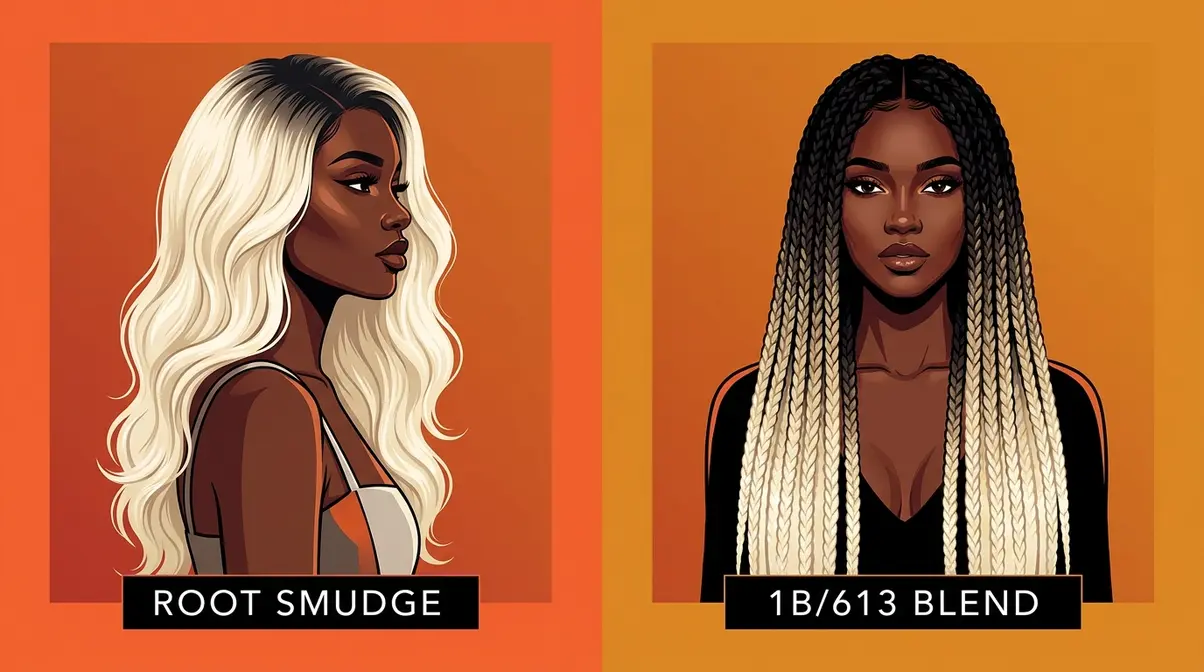
According to Indique Hair’s blonde guide, the contrast between 613 hair and deeper skin tones is one of the primary reasons this shade remains a top seller year after year. On lighter skin tones, the warmth of 613’s undertones prevents the “washed out” effect that cooler platinums like #60 can create. For darker complexions, a root smudge or a 1B/613 blend softens the contrast at the hairline for a more natural result. For lighter complexions, a 27/613 blend adds warmth and dimension.
The Root Smudge Trick
Root smudging is the technique of applying a darker color (typically a #2 dark brown or #1B off-black) to the roots of 613 hair to create a gradual, blended transition. It’s one of the most effective ways to make platinum blonde look intentional and natural on darker skin tones, and it’s the technique most competitors skip entirely.
Here’s how it works in practice: your stylist (or you, at home with the right products) applies a semi-permanent dark color to the first 1–2 inches of root, then feathers it outward to blend into the 613. The result mimics natural dark roots — which is actually a trending aesthetic in its own right. For a glue-less closure sew-in or wig install, a root smudge can be done on the unit before installation, making it a great option for DIY wearers. The dark root effect also reduces the visual contrast at the hairline, which many wearers find more comfortable and wearable for everyday looks.
613 Hair Color Combinations: 27, 1B, 4, 30 & More
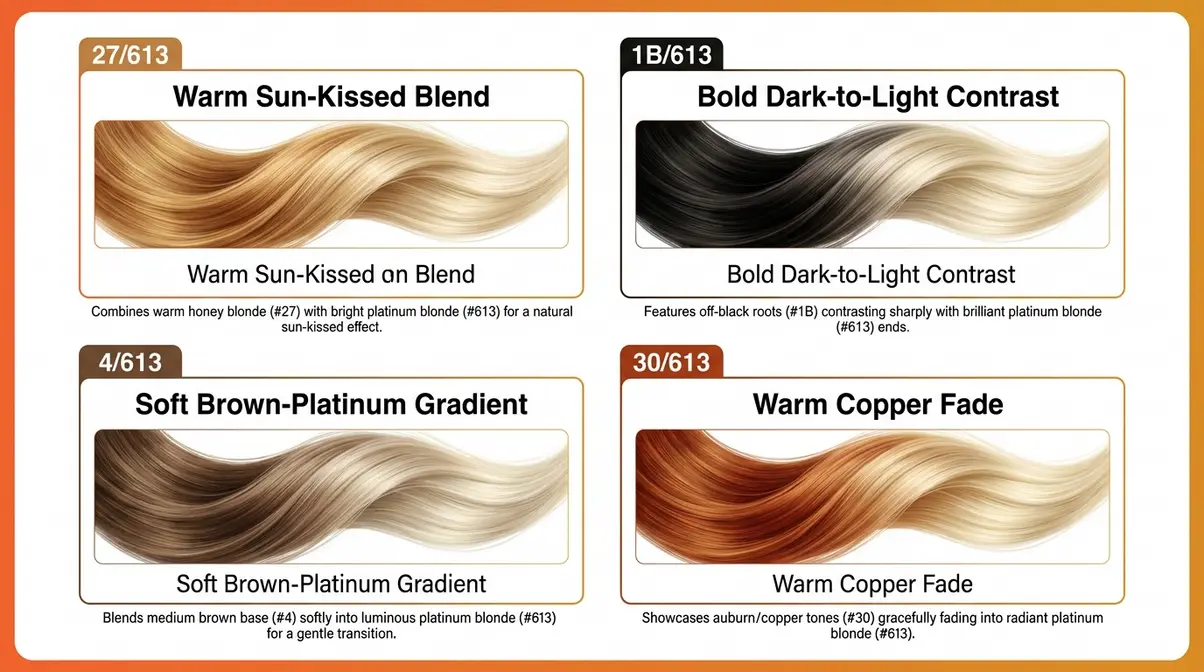
Color combinations are where 613 gets genuinely exciting — and genuinely confusing for beginners. When you see codes like “27/613” or “1B/613” on a pack of braiding hair or a wig listing, those aren’t random numbers. They’re a blend instruction telling you exactly which colors are mixed in that product.
Popular Two-Tone Blends
Two-tone blends pair 613 with a darker or warmer shade to create dimension and depth. Here’s what each of the most popular combinations actually looks like:
| Combination | Colors Mixed | Visual Effect | Best For |
|---|---|---|---|
| 27/613 | Honey blonde + Platinum | Warm, sun-kissed dimensional blonde | Natural-looking platinum for warm skin tones |
| 1B/613 | Off-black + Platinum | Bold dark-to-light contrast (ombre-style) | High-contrast looks, dark skin tones |
| 4/613 | Medium brown + Platinum | Soft brown-to-platinum gradient | Subtle, everyday dimensional color |
| 30/613 | Auburn/copper + Platinum | Warm copper-to-platinum fade | Autumn looks, medium skin tones |
The 27/613 blend is the most popular entry point for beginners because the warm honey tones soften the brightness of the platinum, creating a result that feels natural and multidimensional rather than stark. Industry search data reveals that the 27/613 blend accounts for over 40% of all two-tone blonde braiding hair queries, making it the undisputed favorite for beginners. Conversely, the 1B/613 combination delivers maximum contrast, pairing natural 1B hair roots with bright platinum tips, making it a go-to for braided styles where the dark root and platinum ends create a dramatic gradient effect down each braid.
Ombre and Highlight Effects
Ombre (a gradual fade from dark roots to light ends) and highlight effects are two of the most wearable ways to incorporate 613 into a style without going full platinum. In an ombre install, the darker color (say, #4 brown or #1B off-black) dominates the root area and gradually transitions into 613 toward the ends — creating a sun-bleached, effortlessly cool effect.
Highlight styles use 613 as the “light” color woven through a darker base. In a weft-based install (like a sew-in), alternating wefts of #1B and 613 create a chunky highlight effect. In braiding hair, a pre-blended pack like 1B/613 does the work for you. For wigs, many manufacturers now offer pre-highlighted units with 613 highlights over a darker base — a great option if you want the look without the commitment of a full platinum install.
Reading Hair Color Codes
This is the section that answers the question so many beginners have:
“Hey y’all I need y’all help on this one. I get my hair done next week and I want my braids this color. The girl uses xpressions braiding hair but I was wondering is this color really 613/27/30 or is it a different color?”
That confusion is completely valid — and here’s the decoder:
- Slash codes (27/613): Two colors blended together in the product. The first number is typically the dominant shade; the second is the accent or tip color.
- T-colors (T1B/613): The “T” stands for tip — the product is predominantly the first color (1B off-black) with 613 only at the tips. This creates a natural dark-to-light ombre look, and it’s very common in braiding hair like Xpressions.
- P-colors (P4/27/613): The “P” stands for piano or mix — three or more colors are blended together to create a multi-tonal, dimensional effect. The 613 typically appears as the lightest highlight within the blend.
When in doubt, ask your stylist to show you a physical swatch before ordering. Consulting a standard braiding hair color chart can help you visualize these prefix differences before purchasing. The color codes are standardized, but lighting conditions in product photos can make the same product look dramatically different online versus in hand.
Styling 613 Hair: Braids, Wigs, Weaves & More
613 is one of the most versatile shades in the styling world — it shows up beautifully in braids, wigs, weaves, and everything in between. Across beauty communities, the consistent feedback from wearers is that the key to a stunning 613 install is choosing the right hair type and prep for your specific style.
What Color Is 613 Braiding Hair?
613 braiding hair is a platinum blonde shade — creamy and light, with subtle warm undertones. When shopping for this shade, the most important distinction is human hair vs. synthetic fiber. In synthetic braiding hair (like Xpressions), the color appears as a bright, even platinum throughout the strand. Synthetic 613 braiding hair delivers the platinum color reliably and affordably, but it cannot be toned, dyed, or heat-styled at high temperatures.
In T-color packs like T1B/613, the hair is predominantly off-black with 613 platinum at the tips, creating an ombre gradient effect. Human hair 613 braiding hair is available at a premium price and can be toned, colored, and styled with heat. Before you buy, always check whether the pack is labeled as a T-color or blend versus a single-color 613.
613 Wigs: Human vs. Synthetic
For wigs and weaves, human hair 613 is the gold standard. A quality human hair 613 wig or glue-less closure sew-in can last 12–18 months with proper care, can be toned to custom shades, and can be heat-styled repeatedly without significant damage. According to Ultimate Looks’ detailed 613 wig guide, human hair 613 wigs consistently outperform synthetic options in longevity and styling versatility — making the higher upfront cost worthwhile for frequent wearers.
Synthetic 613 wigs are a budget-friendly option for occasional wear or costume purposes, but they typically last 3–6 months with regular use and cannot be toned or heat-styled. For a Custom 613 Order — where you want a specific toned shade like ash blonde or rose gold — you’ll always need a human hair base.
Quotable fact: “Human hair 613 wigs can be toned, dyed, and heat-styled just like natural hair — making them the most versatile investment in any wig wardrobe.” (Ultimate Looks, 2026)
Style Inspiration: Bobs & Crimps
613 translates beautifully across a wide range of styles. Here are the looks consistently trending in the community:
- 613 Bob Wig: A blunt or layered bob in full 613 is one of the most iconic looks — clean, bold, and endlessly chic. Adding a dark root smudge to a 613 bob creates instant depth.
- *613 Crimps:* Crimped texture adds dimension and movement to 613 hair, playing up the platinum tones with light-catching texture. This is a standout look for events and photoshoots.
- 613 Knotless Braids: Using a T1B/613 braiding hair pack creates a natural dark-root-to-platinum-tip braid that photographs beautifully and wears naturally.
- 613 Butterfly Locs: The contrast between the looped texture and the platinum color creates a uniquely textured, fashion-forward look that’s gained significant traction recently.
- Highlighted Sew-In: Alternating 613 bundles with #1B or #4 wefts creates a chunky, sun-kissed highlight effect for a dimensional natural look.
How to Tone, Dye, and Maintain 613 Hair
This is the section where most guides fall short — they mention toning but skip the actual steps. Our team evaluated the most common 613 toning concerns across professional cosmetology resources and beauty community feedback to build this actionable tutorial. Here’s everything you need to know to keep your 613 hair looking its absolute best.
Before You Start: What You’ll Need
Before attempting any toning or dyeing on your 613 hair, gather these supplies:
- For Toning:
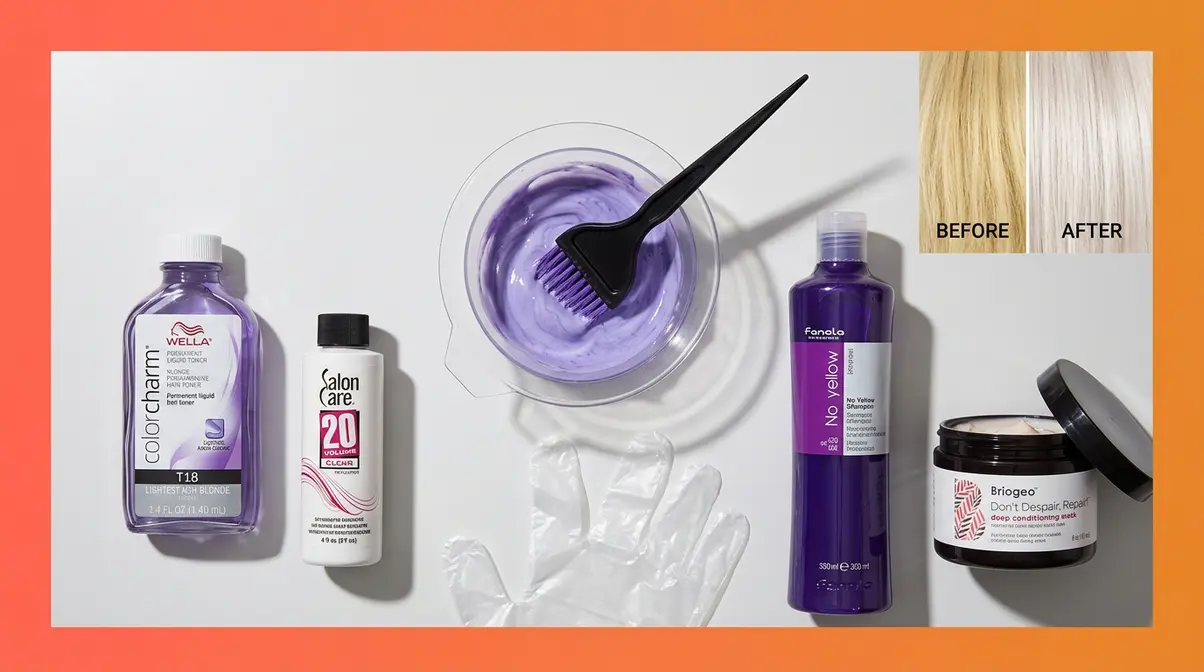
- Ash blonde or violet toner (Wella T18 “Lightest Ash Blonde” is a community favorite)
- 20-volume developer (the activating agent mixed with toner that opens the hair cuticle)
- Mixing bowl and applicator brush
- Plastic gloves
- Old towel or color cape
- Timer
- For Dyeing (Custom Color):
- Semi-permanent hair dye in your chosen color
- 10-volume developer (lower volume = gentler processing for already-lightened hair)
- Deep conditioner for post-color treatment
Estimated time: 30–45 minutes for toning; 45–60 minutes for custom color. Skill level: Beginner-friendly with careful attention to timing.
Why this matters: Using the wrong developer volume on pre-lightened 613 hair can cause breakage. Always use 20-volume or lower for toning, and 10-volume for semi-permanent color — the hair is already lifted and doesn’t need additional chemical processing.
How to Tone 613 Hair
Professional colorists recommend this process for neutralizing brassiness and achieving a clean ash blonde result on 613 hair:
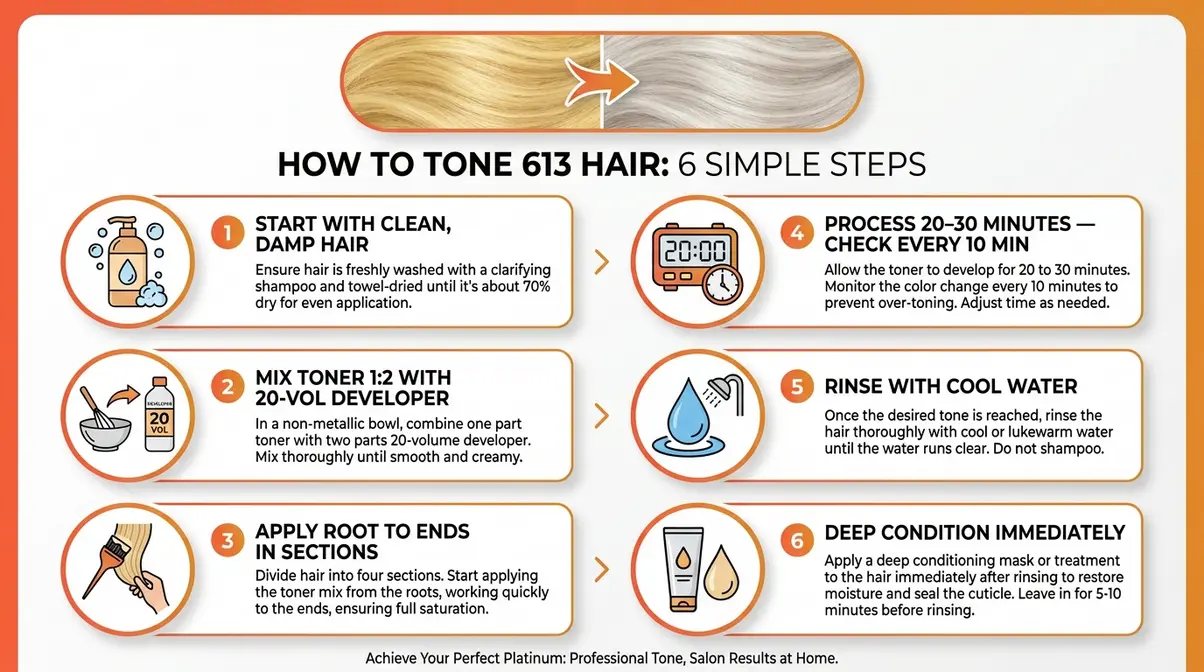
- Start with clean, dry hair. Wash your 613 wig or bundles with a clarifying shampoo to remove product buildup. Towel-dry until damp (not dripping).
- Mix your toner. Combine 1 part toner (e.g., Wella T18) with 2 parts 20-volume developer in a mixing bowl. Stir until fully blended — the mixture should be smooth and creamy. Why this ratio? A 1:2 ratio gives you enough developer to activate the toner without over-processing the already-porous hair.
- Apply evenly. Using your applicator brush, work the toner mixture through the hair from roots to ends, ensuring every strand is coated. Work in sections for even coverage.
- Set your timer for 20–30 minutes. Check the hair every 10 minutes. The toner is working when you see the yellow or brassy tones shift toward a cooler, ashier tone. Do not exceed 30 minutes — over-processing can cause the hair to absorb too much violet pigment and turn gray or lavender.
- Rinse thoroughly with cool water. Cool water seals the hair cuticle and locks in the toner result. Avoid hot water, which can strip the toner prematurely.
- Apply a deep conditioner immediately. Leave on for 5–10 minutes, then rinse. This step replenishes moisture lost during the toning process.
Common Toning Mistakes to Avoid
| Mistake | What Happens | Fix |
|---|---|---|
| Using 40-volume developer | Hair over-processes, breaks | Always use 20-volume max |
| Leaving toner on too long (>30 min) | Hair turns gray or lavender | Set a timer; check at 20 min |
| Applying to dirty hair | Uneven toner absorption | Start with clean, clarified hair |
| Skipping deep conditioner | Dry, brittle result | Condition immediately after rinsing |
| Using purple shampoo as a substitute toner | Insufficient color correction | Purple shampoo maintains; toner corrects |
How to Dye 613 Hair a New Color
613’s fully lifted base is its biggest superpower — it accepts virtually any color you put on top of it. Here’s how to dye your 613 hair a custom shade safely:
- Choose a semi-permanent dye rather than permanent for your first attempt. Semi-permanent color fades gradually and is far gentler on pre-lightened hair — reducing breakage risk significantly.
- Mix with 10-volume developer only. Higher developer volumes are unnecessary on already-lifted hair and will cause unnecessary damage. A 1:1 ratio of dye to 10-volume developer works well for most semi-permanent formulas.
- Apply in sections from roots to ends, ensuring full saturation. For vibrant colors (pink, blue, purple), a longer processing time of 30–45 minutes deepens the result. For pastel shades, 20–25 minutes is sufficient.
- Rinse with cool water and follow with a color-safe conditioner. Avoid shampoo for 48 hours after dyeing to let the color fully set.
According to Hermosa Hair’s 613 color guide, the blank-canvas quality of 613 means custom color results on this base are consistently more vibrant and even than on partially-lifted hair — making it the preferred starting point for colorists doing fashion-color work.
Weekly Maintenance Routine
Consistent maintenance is what separates 613 hair that looks stunning after 6 months from hair that’s dry and broken after 6 weeks. The American Academy of Dermatology (AAD) recommends deep conditioning treatments every 1–2 weeks for chemically processed hair to maintain moisture balance and prevent breakage. For more comprehensive care strategies, review our guide on how to maintain colored hair.
Here’s a simple weekly routine:
- Weekly (Every Wash Day):
- Wash with a purple shampoo (leave on 3–5 minutes before rinsing). Purple shampoo contains violet pigments that neutralize brassy tones between toning sessions — think of it as a maintenance toner you use every week. Allure recommends alternating purple shampoo with a hydrating shampoo every other wash to prevent over-toning.
- Follow with a moisturizing conditioner. Leave on 3–5 minutes, focusing on mid-lengths and ends.
- Every Two Weeks:
- Apply a deep conditioning treatment or protein-moisture mask. Leave on 20–30 minutes (with heat if possible — a hooded dryer or heat cap speeds up absorption).
- Monthly:
- Re-tone as needed. If brassiness returns, repeat the toning tutorial above. Most 613 hair needs a full re-tone every 4–6 weeks depending on wash frequency.
- Trim split ends on human hair units to prevent breakage from traveling up the shaft.
Storage: When not wearing your 613 wig or bundles, store on a wig stand away from direct sunlight. UV exposure yellows pre-lightened hair over time.
Limitations & Alternatives
613 is a stunning shade — but it’s not the right choice for every situation. Here’s an honest look at when it might not be your best option.
Common Pitfalls
- Brassiness without maintenance: Without weekly purple shampoo and regular toning, 613 hair develops brassy yellow tones quickly — especially human hair that’s been washed repeatedly. If you’re not prepared to commit to the maintenance routine above, a lower-maintenance shade like #27 or #613 blend may serve you better.
- Damage risk on natural hair: If you’re considering bleaching your own natural hair to achieve 613, proceed with professional guidance. Bleaching dark natural hair to Level 10–12 in a single session is rarely possible without significant damage. Most professionals recommend a multi-session approach over several weeks.
- Synthetic hair limitations: If you purchase synthetic 613 braiding hair expecting to tone or color it at home, you’ll be disappointed — synthetic fibers don’t absorb chemical toners. Always confirm whether your product is human or synthetic before planning any color customization.
When to Choose Alternatives
- If you want warmth over brightness: Choose #27 honey blonde. It’s lower maintenance, more forgiving of brassiness, and delivers a natural sun-kissed look without the upkeep demands of platinum.
- If you want an icy, editorial look: Choose #60. It reads whiter and cooler than 613 and is better suited for high-fashion shoots or bold statement installs where maximum lightness is the goal.
- If you’re new to bleaching your natural hair: Start with highlights or a partial balayage rather than a full 613 lift. This reduces damage risk while letting you test-drive the platinum look.
When to Seek Expert Help
If you’re planning to bleach your natural hair to 613 — especially if your hair is currently dark brown or black — consult a licensed cosmetologist before beginning. Over-bleaching is the single most common cause of severe hair breakage and can result in irreversible damage. A professional can assess your hair’s current condition, recommend the right developer volume, and advise on a multi-session timeline that protects your hair’s integrity.
FAQ: Your Top 613 Questions Answered
What is a 613 hair color?
613 hair color is the industry-standard code for a platinum blonde shade at Level 10–12 on the universal hair color numbering scale. It is the lightest, most lifted shade available in the extensions and wig market, characterized by warm-to-neutral platinum undertones. Unlike darker blonde shades, 613 has had virtually all of its natural melanin removed through the bleaching process, which makes it ideal as a blank canvas for custom toning and dyeing. It is used across braiding hair, wigs, weaves, and extensions by manufacturers worldwide as a consistent color standard.
What is the difference between 613 and 60 hair?
The main difference between 613 and color 60 is undertone. 613 has warm-to-neutral platinum undertones, reading as a creamy, sunlit blonde, while Color 60 has cool, icy undertones closer to silver. For everyday wear, most colorists recommend 613 over 60 because its warmth reads more natural across a broader range of skin tones.
Are blonde and 613 the same?
Blonde and 613 are not the same — 613 is one specific shade within the broad category of blonde. While blonde spans Levels 7 through 12, color 613 specifically represents the lightest, most lifted platinum end of that spectrum.
What is the 2 rarest hair color?
The two rarest natural hair colors are red and platinum blonde (natural). Natural red hair occurs in approximately 1–2% of the global population (National Institutes of Health, 2026), primarily in people of Northern and Western European descent. Naturally platinum blonde hair — the shade that 613 replicates — is even rarer in adults, as most naturally blonde children see their hair darken with age. This rarity is part of what makes 613 so culturally compelling: it replicates a naturally rare shade accessibly, for anyone who wants it.
Is 613 a yellow blonde?
A quality 613 is not yellow — it is a platinum blonde with warm-to-neutral undertones. Yellow or brassy tones in 613 hair are typically a sign of under-toning, low-quality processing, or product buildup from washing. A properly manufactured and maintained 613 should read as creamy platinum, not overtly yellow. If your 613 hair looks yellow, the fix is straightforward: use a violet toner (like Wella T18) with 20-volume developer for 20–30 minutes, or incorporate purple shampoo into your weekly wash routine to neutralize warm tones between toning sessions.
Conclusion
For anyone exploring the world of wigs, bundles, and braiding hair, 613 hair color remains the most versatile and exciting starting point on the blonde spectrum. It occupies the brightest, most customizable position on the hair color scale — Level 10–12 — delivering a platinum shade that works as a standalone look and as a blank canvas for virtually any custom color. Research confirms that bleached hair at this level absorbs color more evenly than partially-lifted hair, making 613 the preferred base for fashion-color work among professional colorists (NIH, 2015).
“The Platinum Scale” is the framework that makes 613 make sense: it’s not the warmest blonde (#27) and not the iciest white (#60) — it’s the most flexible midpoint, which is exactly why it’s earned its iconic status in the beauty community. Understanding where 613 sits on that scale means you can shop smarter, combine colors with confidence, and maintain your install with the right routine.
Your next step: decide how you want to wear your 613. Browse 1B/613 braiding hair for a natural dark-root-to-platinum look, explore a glue-less closure sew-in with a root smudge for a seamless blend, or use the toning tutorial above to customize a human hair wig to your perfect ash blonde. Whatever your style vision, you now have everything you need to make it happen — confidently.

Dave King
Writes evidence-based hair-care guides for Care About Your Hair — for every hair type, jargon-free and independent.